Med spa no-shows
How to reduce no-shows at a med spa
To reduce no-shows, book leads fast, send reminders that ask for a reply, hold a card on file under a clear policy, and run a recovery flow for the patients who still miss. No-shows are a system problem, not a patient problem. We build that system in GoHighLevel, and across the clinics our team measured, the median show rate went from 61% to 82%.
Show rates, across the clinics our team measured
Median clinic show rate, before and after the full system
Show rate after 72-hour, 24-hour and 2-hour reminders with confirm by reply (77 clinics)
No-shows rebooked within 14 days after a recovery flow (54 clinics)
The problem
Why med spa patients don't show up
Most advice on no-shows blames the patient and stops at "send a reminder." In our team's data, the misses trace back to how the clinic books, reminds and follows up.
The booking was slow
A lead who waits a day to hear back is less committed when the date comes. Across 186,400 leads, patients booked within 5 minutes showed up 84% of the time. Patients booked after 24 hours showed up 71% of the time.
The reminder asked for nothing
A one-way "see you tomorrow" text is easy to ignore. You learn about the miss when the chair is already empty, too late to fill it.
Nobody followed up
Before a recovery flow, only 9% of no-show patients rebooked within 14 days in our team's data.
Our show-rate data
What each layer did to show rate
Each row is a separate measurement across a different group of clinics, so the gains don't simply add up. The card-on-file clinics, for example, started at 74%, not 61%.
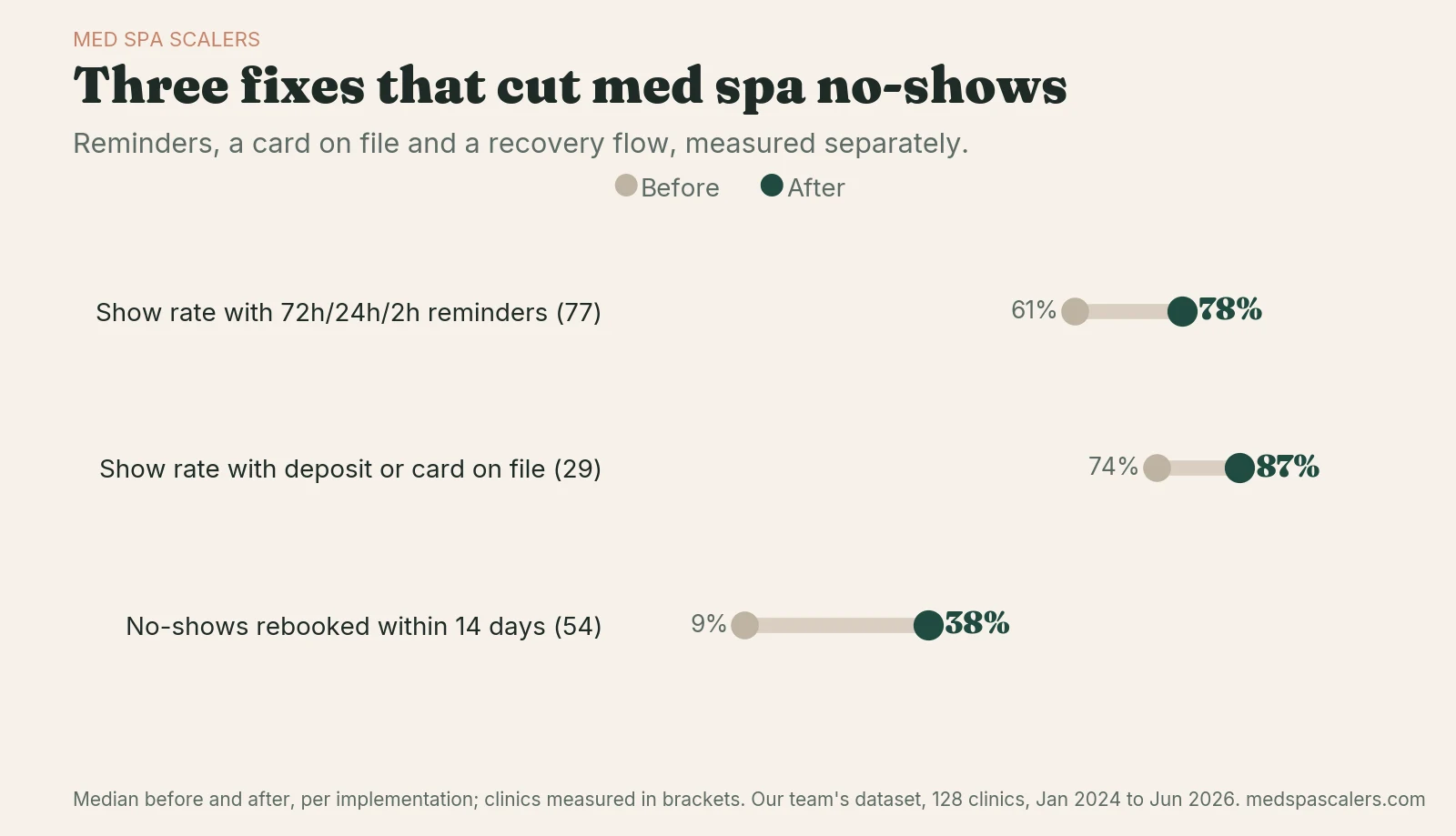
The fixes are small builds. A card on file took about an hour to set up and added a median $7,300. No-show recovery took about two hours, added a median $14,200 in revenue and paid back in about a week.
Methodology: before = a clinic's first 90 days, after = months 4 to 6. Figures are medians across clinics, January 2024 to June 2026. Full method and limitations are in our med spa speed-to-lead study.
The playbook
Four layers that reduce no-shows
1. Book fast
Reply to every new lead within seconds and let them pick a time themselves. Self-booking lifted booked rates from 21% to 27% across 47 clinics. After hours, an AI receptionist for your med spa answers and books, so the patient commits while they're still interested.
2. Remind and ask for a reply
Send reminders at 72 hours, 24 hours and 2 hours, and ask the patient to confirm by reply. Silence at 24 hours is the cue to call. This took show rate from 61% to 78% across 77 clinics.
3. Hold a card on file
Take a card or a deposit at booking, under a policy the patient sees and agrees to. In 29 clinics, show rate went from 74% to 87%. You set the fee.
4. Recover the misses
When someone still doesn't show, a recovery flow texts them the same day with a rebooking link, then follows up by call and text. Rebooking within 14 days went from 9% to 38% across 54 clinics.
Reminder messages
A med spa appointment reminder sequence you can copy
This is the shape of the confirm-by-reply sequence we build. Keep treatment details and health information out of texts, and only text patients who agreed to receive them.
At booking
"Hi {first name}, you're booked at {clinic} on {day} at {time}. Our cancellation policy: {link}. Need to change it? Reply R."
72 hours before
"Hi {first name}, see you {day} at {time}. Reply YES to confirm or R to reschedule."
24 hours before
"Reminder: your appointment is tomorrow at {time}. Reply YES to confirm. Changes inside 24 hours fall under our policy: {link}."
2 hours before
"See you at {time} today. We're at {address}. {Parking note}."
No reply by the 24-hour text? The workflow alerts your front desk to call. If the patient cancels, the slot goes to your waitlist. If they no-show, the recovery flow starts: "Hi {first name}, we missed you today. Here's a link to pick a new time: {link}."
Policy
How to structure a med spa no-show and cancellation policy
A policy works when the patient sees it before they book, agrees to it, and hears it again in every reminder. Here is the structure we set up. You choose the amounts and windows.
- Definitions. What counts as a late cancellation, a no-show and a late arrival.
- Notice window. How much notice you need to cancel or reschedule without a fee.
- How to cancel. Reply to any reminder, use the booking link or call.
- Card on file or deposit. Collected at booking. Say whether a deposit is applied to the treatment, refunded or kept.
- The fee. A flat amount or a share of the booked service, set by you. Say how it is calculated and when it is charged.
- Exceptions. Emergencies and illness, and who on your team can waive the fee.
- Repeat no-shows. What happens after more than one miss, such as prepaying future visits.
- Acknowledgment. A checkbox at online booking and a signature on intake forms, so you have a record if a charge is disputed.
Store cards through your payment processor, never in notes or spreadsheets. PCI rules don't allow card verification codes to be kept for card-on-file charges (see the PCI Security Standards Council FAQ). Rules on fees and texting patients vary by state, so have your attorney review your final policy. This is a summary, not legal advice.
How we build it
How we set up no-show prevention in GoHighLevel
Audit your show rate
We pull your show rate, response time and how many no-shows rebook, to find the missing layer.
Build the layers
Instant lead replies, self-booking, confirm-by-reply reminders, card capture and the recovery flow, all in your CRM. Your policy goes into booking and every reminder.
Report on shows
Each month you see booked consults, show rate, no-shows recovered and slots refilled, not just leads.
Case study
Lumiere Aesthetics: show rate from 63% to 85%
Lumiere Aesthetics is a toxin and filler clinic in Scottsdale, Arizona. Our team ran the full stack: ads, CRM, speed-to-lead, reminders and reviews. This was work led by our team, shared with the clinic's consent.
Before = the clinic's first 90 days, after = months 4 to 6. Show rate improved alongside faster booking and reminders, so the gain can't be credited to one change.
Where it fits
No-show prevention is part of the whole patient system
Reminders, card capture and recovery all run inside your med spa CRM, next to lead follow-up and reactivation of older patients. If you're choosing a platform, our med spa software comparison compares booking, reminders and payments across the main tools.
Email carries the policy, prep instructions and longer nurture, covered in med spa email marketing. Show rates vary by treatment; see Hydrafacial marketing for one of the highest.
Series treatments depend on every session being kept; see how we book the full schedule in microneedling marketing.
As a med spa marketing agency, we report on patients who show up, not leads.
FAQ
Med spa no-show questions
How do I reduce no-shows at my med spa?
Book leads quickly, send reminders at 72 hours, 24 hours and 2 hours that ask for a reply, hold a card on file under a clear policy, and follow up with every patient who misses. In our team's data, the median clinic show rate rose from 61% to 82% with this system.
What should a med spa no-show policy include?
Define late cancellations and no-shows, set a notice window, explain how to cancel, state whether a card or deposit is held and how any fee is calculated, list exceptions, and get the patient's acknowledgment at booking.
Should my med spa charge a no-show fee?
A card on file with a stated fee gives patients a reason to show up or cancel in time. In our team's data, a deposit or card on file lifted show rate from 74% to 87% across 29 clinics. You set the amount, and fee rules vary by state, so check locally.
When should a med spa send appointment reminders?
We send them at 72 hours, 24 hours and 2 hours before the visit and ask the patient to confirm by reply. Across 77 clinics, that sequence lifted show rate from 61% to 78%.
How much does a no-show reduction system cost?
It depends on your booking setup and which parts of the system you need. We share exact pricing after a free audit.
See how many patients you're leaving on the table
Get a free marketing audit of your ads, follow-up and booking flow. No pressure, just a clear picture.
Book a free marketing audit