Semaglutide and GLP-1 marketing
Semaglutide marketing for med spas and weight-loss clinics
Semaglutide marketing works when you sell a provider-led weight-loss program, not a drug, and follow up long enough to turn consults into program sales. We run compliant Meta and Google ads, answer every lead in under a minute, and nurture GLP-1 leads through a longer decision.
From our team's GLP-1 work
Median 90-day return on ad spend for GLP-1 weight-loss campaigns on Meta
Leads that booked a consult at Elevate Wellness & Aesthetics, Tampa
Unsold consult attendees who bought within 30 days after follow-up (42 clinics)
The problem
GLP-1 is the most restricted treatment to advertise and a bigger decision to buy
People search for Ozempic, Wegovy, Mounjaro and Zepbound by name. Your ads mostly can't. Prescription drug ads are restricted on Meta and Google, compounded versions face FDA scrutiny, and weight-loss claims draw FTC attention. On top of that, a patient deciding on a three-month program thinks longer than someone booking Botox.
Ads get rejected
Name a drug without the right certification and the ad, or the whole ad account, can be restricted.
Leads cost more
In our team's data, GLP-1 leads on Meta cost $38.90 at the median, above the $31.60 median across all treatments.
Consults don't close on the spot
Many attendees leave to think it over. Without follow-up, that consult is a sunk cost.
The data
How GLP-1 campaigns compare with other treatments
GLP-1 weight loss took 18% of the Meta spend in our team's dataset. It loses ground at every funnel step compared with the all-treatment median, but the $1,150 first ticket for a three-month program carries the math.

Method: before = a clinic's first 90 days, after = months 4-6, medians across clinics, January 2024 to June 2026. Full method and limitations in our med spa speed-to-lead study.
Compliance
The ad rules that shape every GLP-1 campaign
This is our summary of the official sources, linked below, as of October 2026. It is not legal advice. Have your medical director and a healthcare attorney review your ads and offers.
- Meta: only advertisers actively certified with LegitScript and authorized by Meta can promote prescription drugs. Ads must target people 18 or older, only in eligible countries (US, Canada, New Zealand), and include a disclaimer to consult a licensed health professional. See Meta's drugs and pharmaceuticals policy.
- Meta weight-loss ads: weight-loss products and services must target people 18 or older, and ads can't zoom in on a body area by pinching fat. Cosmetic ads can't contain statements of inferiority about appearance. See Meta's health and wellness policy.
- Google: telemedicine providers need LegitScript Healthcare Merchant Certification, plus Google's own certification, to promote prescription drugs in the US. See Google's healthcare and medicines policy.
- FDA: the semaglutide and tirzepatide shortages are resolved, and the grace periods for compounding them have ended. FDA states that compounded drugs are not approved by FDA. Never call a compounded product FDA-approved or a generic. See FDA's GLP-1 compounding statement.
- FTC: health claims need competent and reliable scientific evidence. Testimonials showing results more dramatic than people can generally expect are likely deceptive, and "results not typical" doesn't fix that. See the FTC health products guidance.
- LegitScript: its healthcare certification covers pharmacies, telehealth providers and med spas offering prescription-related services, and is recognized by Google, Meta, Microsoft and TikTok. See LegitScript healthcare certification.
Our default: ads promote a provider-led weight-loss consult and program, not a named drug. No weight-loss promises, no pinch shots, no dramatic before-and-afters. If you want to name a medication in ads, we get certification and authorization in place first.
The playbook
How we market a GLP-1 weight-loss program
Sell the consult, not the drug
The offer is a medical weight-loss consult with your provider. The provider decides on medication. That keeps ads inside policy and sets the right expectation.
Qualify on the form
Instant forms with three qualifying questions lifted booked rates from 14% to 31% in our team's data. We ask about goals and timing, never medical history.
Answer in under a minute
Across 186,400 leads, replies in under a minute booked at 41%. After four to 24 hours it was 9%. An AI receptionist covers evenings and weekends.
Nurture for two weeks
A 7-touch, 14-day nurture raised unbooked leads that later booked from 4% to 15% (72 clinics). GLP-1 buyers need that runway.
Follow up after the consult
Unsold attendees who got structured follow-up bought within 30 days at 21%, up from 8% (42 clinics). We answer cost and next-step questions, and route clinical ones to your team.
Skip the deep discount
Deeper discounts cut cost per lead 12% but dropped close rates 9 points and repeat rates 14 points. We lead with the program and share pricing at the consult.
Case study
Elevate Wellness & Aesthetics, Tampa, Florida
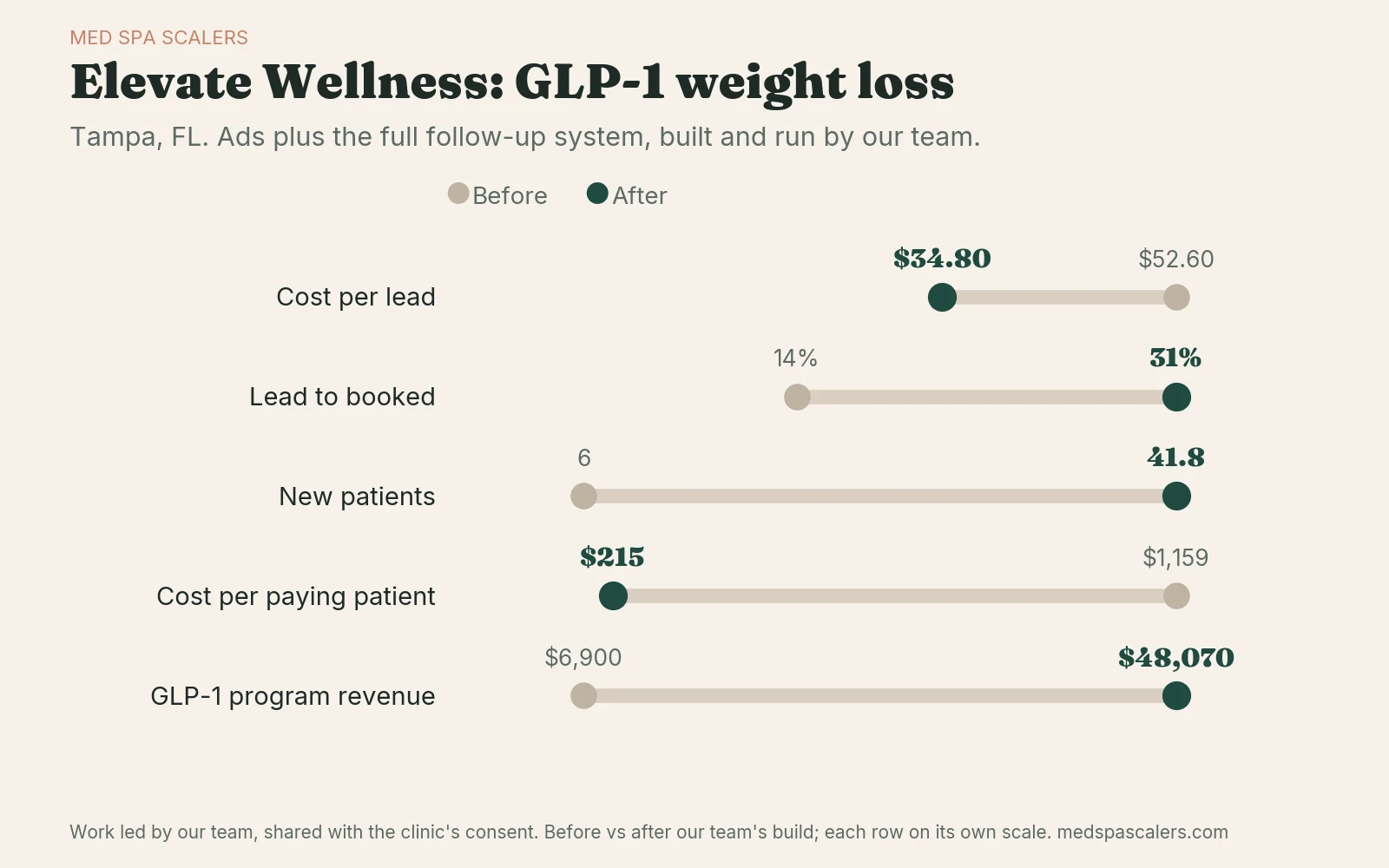
Elevate sells GLP-1 weight-loss programs. Our team ran the full stack: Meta ads plus the GoHighLevel follow-up system. Work led by our team, shared with the clinic's consent.
One clinic's results; yours will differ.
How we build it
From audit to live campaigns
Audit and compliance check
We review your ad account, certification status, offer, landing page and how fast leads get answered today.
Build the follow-up first
We set up the GoHighLevel pipeline, instant text and call, AI receptionist, two-week nurture, reminders and post-consult follow-up before spend goes up.
Launch, then report on programs sold
Our ads partner runs Meta and Google campaigns. Each month you see consults booked, shows, programs sold and cost per paying patient. Renewal reminders go out before month three ends.
Where it fits
GLP-1 marketing inside a full med spa system
Many clinics that sell weight-loss programs also offer aesthetic treatments, and one system can serve both. That is why we run GLP-1 next to Botox marketing and body contouring marketing, and, where it fits your menu, dermal filler marketing or laser hair removal marketing.
For campaign structure and creative rules, see our med spa Facebook ads page and the wider guide to med spa advertising. The nurture, reminders and consult follow-up live in your med spa CRM.
As a med spa marketing agency, we run the ads, the AI receptionist and the follow-up together, and we report on programs sold, not clicks.
FAQ
Semaglutide marketing questions
Can a med spa run Facebook ads for semaglutide?
Only certain advertisers can promote prescription drugs on Meta: those actively certified with LegitScript and authorized by Meta, targeting people 18 or older. Without that, ads should promote your weight-loss consult and program, not the drug. This is a summary, not legal advice.
Can we advertise compounded semaglutide or tirzepatide?
FDA says the shortages are resolved, the compounding grace periods have ended, and compounded drugs are not approved by FDA. Never call a compounded product FDA-approved or generic. Check what you can offer and say with your medical director and a healthcare attorney.
Do you use before-and-after weight-loss photos?
We avoid them in ads. Meta bans pinch-the-fat close-ups, and the FTC treats testimonials showing more than typical results as likely deceptive. We use provider videos and plain explanations of the program instead.
Why do GLP-1 leads need longer follow-up?
A three-month program is a bigger decision than a single treatment. In our team's data, a 14-day nurture lifted unbooked leads that later booked from 4% to 15%, and post-consult follow-up lifted 30-day purchases from 8% to 21%.
How much does semaglutide marketing cost?
It depends on your market, ad spend and what we build. We share exact pricing after a free audit.
See how many patients you're leaving on the table
Get a free marketing audit of your ads, follow-up and booking flow. No pressure, just a clear picture.
Book a free marketing audit