Meta Ads vs Google Ads: Which Fits a Med Spa Budget
The most common advice on Meta Ads vs Google Ads is to run both and split the budget. That skips the decision that matters: which platform can bring in a kept appointment for the treatment you want to grow, given how your patients find the service and how quickly your team follows up?
Google can capture someone actively searching for a provider. Meta can introduce a treatment to someone who wasn't looking for it yet. Those are different jobs, and neither platform's low click cost or lead count proves it's producing better patient economics.
Table of Contents
- Meta Ads vs Google Ads at a Glance
- How Each Platform Reaches Patients
- Cost per Click, Conversion and Benchmarks Compared
- Which Campaign Each Platform Suits
- Measuring Cost per Kept Appointment
- Split Your Budget and Choose the First Test
Meta Ads vs Google Ads at a Glance
Neither platform wins for every treatment. Google is built to meet existing search demand; Meta is built to create interest among people browsing. Use the comparison below to identify which kind of demand your priority treatment is most likely to generate.
| Criterion | Google Ads | Meta Ads |
|---|---|---|
| Primary intent | Searches with a treatment and location, such as “Botox near me” | Interest-based discovery through feeds, Reels and Stories |
| Typical buyer state | Already choosing a treatment and comparing providers | Browsing, not yet deciding on a treatment |
| Role of creative | Text ads, call and map extensions, landing-page match | Visual proof, testimonials, before-and-after content and offers |
| How it charges | Often on a cost-per-click basis for competitive treatment and city keywords | By impressions or actions such as clicks |
| Main risk | Expensive clicks on broad or low-quality queries | Cheap leads that never book |
| Core measure | Qualified calls and forms, plus booked consultations | Qualified lead rate, speed-to-lead and reactivation lift |
The table's first two rows explain why the platforms can produce different results even when they promote the same service. Someone searching “lip filler [city]” has already chosen a treatment category and is evaluating providers. Someone who sees an Instagram ad for lip filler may need an explanation, proof and a clear offer before they consider booking.
That distinction shapes the work each campaign requires. Google needs close alignment between the search term, ad and landing page; Meta needs creative that earns attention and gives a prospect a reason to act. A cheaper click on Meta isn't automatically a cheaper consultation, just as an expensive Google click isn't necessarily wasteful if it leads to a patient who attends.
Start with the treatment, not the platform. Ask which service earns the most revenue at your clinic, then note whether patients usually search for it by name or discover it through content. That answer points to the first channel worth testing.
How Each Platform Reaches Patients
Google Ads can appear on Search, Maps, YouTube and partner sites. That gives a med spa several ways to meet a potential patient, but search ads in particular depend on someone expressing a need through a query or looking up a place. Meta delivers ads across Facebook, Instagram, Messenger and other Meta properties, using predicted relevance and user behavior to reach people who may not have searched for a treatment at all.
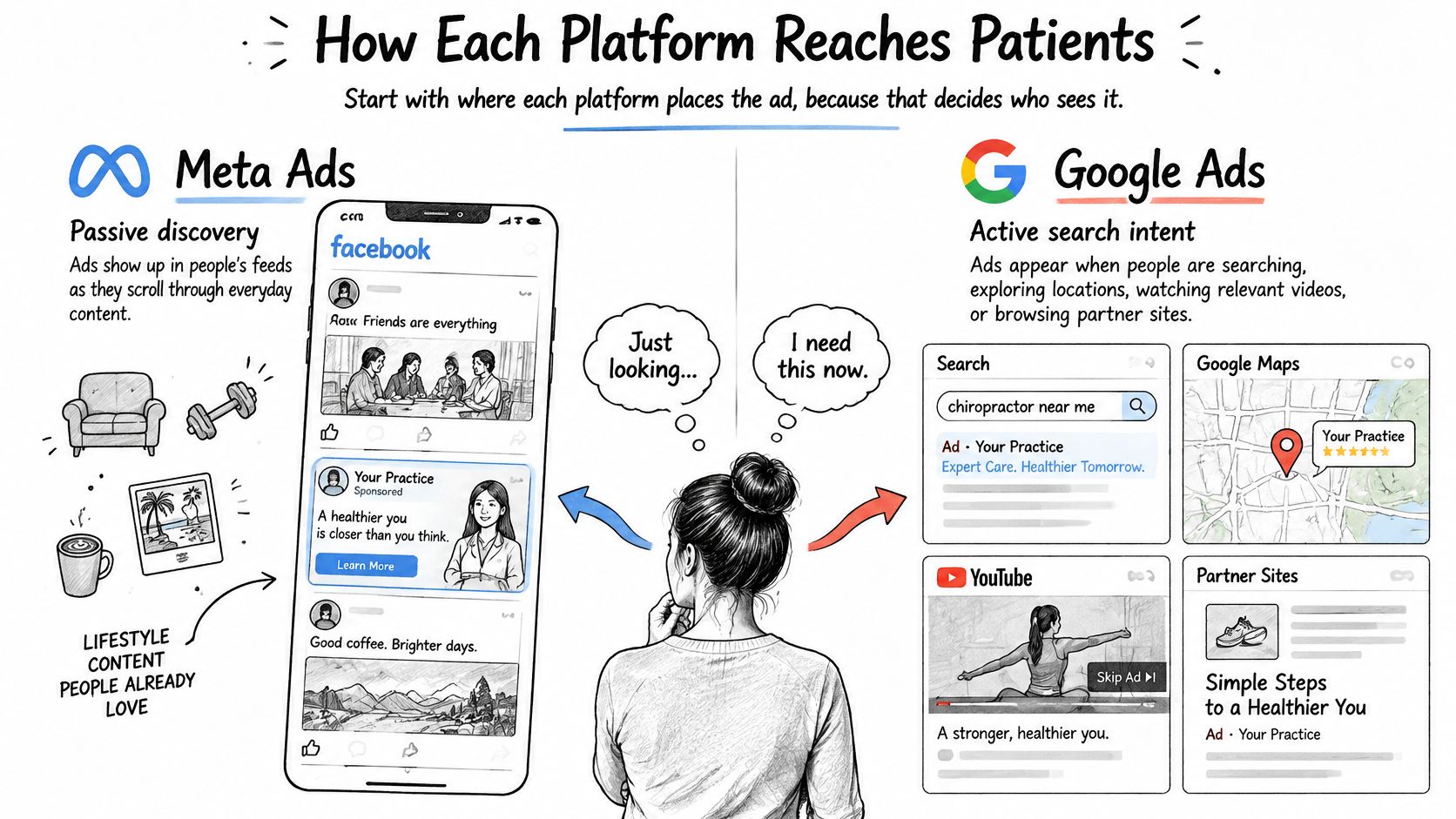
The platforms' business scale supports the view that both are established advertising channels, but scale alone doesn't tell a clinic which one will produce appointments. In fiscal year 2025, Alphabet reported $224.5 billion in Google Search and other advertising revenue, while Meta reported $196.175 billion in advertising revenue. Those company-wide totals describe the size of the platforms, not the profitability of a med spa campaign; the practical distinction is that Google captures searches while Meta can stimulate interest before a search happens. (Alphabet's fiscal year 2025 annual report reports Google's advertising figures and describes the platforms' different advertising models.)
Meta's reach is substantial: it reported an average of 3.58 billion daily active people across its Family of Apps in December 2025. That audience can support discovery, retargeting and creative testing, but reach doesn't mean those people are seeking a consultation. For Google, a more useful starting point is whether people search for a treatment in the clinic's service area. (Meta's 2025 results report Family of Apps activity and advertising delivery figures.)
Use these questions to connect platform surfaces to your own patients:
- Do your best patients search Google for the treatment, or discover it while scrolling Instagram?
- Do they look up providers on Maps before booking?
- Do they watch longer treatment reviews on YouTube?
- Do referrals bring in many patients who may never have searched for the service?
The answers help clarify where to start, but your ad creative still has to match the job. For guidance on building ads around the treatment and audience, see this med spa ad creative strategy guide.
A short video can also help teams visualize how search-led and feed-led campaigns differ:
Neither platform is a niche channel. Choose based on the surfaces your patients use, then judge the campaign by what happens after someone responds.
Cost per Click, Conversion and Benchmarks Compared
The widely quoted Google Ads healthcare figures are useful for one narrow job: checking whether a campaign's click economics sit in a plausible range. They are not a med spa forecast. The benchmark table is most valuable for the cells it leaves empty.
| Metric | Google Ads | Meta Ads |
|---|---|---|
| Click-through rate | 6.61% | About 0.68% |
| Cost per click | $4.76 | No figure reported |
| Conversion rate | 12.43% | No figure reported |
| Cost per acquisition | $40.04 | No figure reported |
The healthcare benchmark reports 6.61% CTR, $4.76 CPC, 12.43% conversion rate and $40.04 CPA for Google Ads. Its cited Meta healthcare cohort reports a CTR of about 0.68%. The benchmark gives no comparable Meta values for CPC, conversion rate or CPA, so those cells mean missing evidence, not zero cost or Google-level performance. (The healthcare advertising benchmark reports these platform figures and cautions that campaign conditions affect apparent performance.)
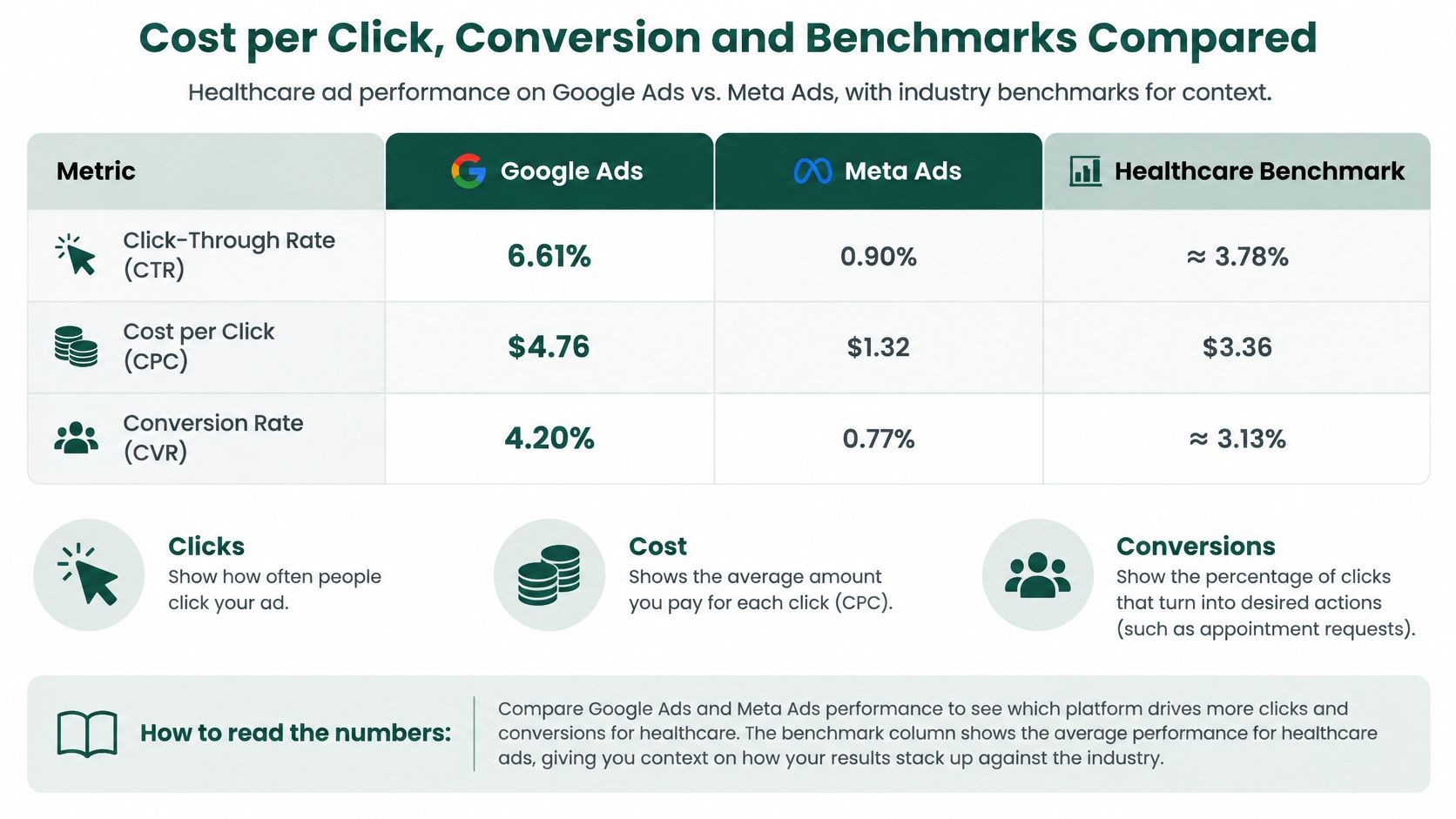
That asymmetry is the useful signal. Google has enough reported data to model a rough click-to-action path. Meta has a click rate low enough to show that feed audiences are not behaving like search users, but the benchmark does not price those clicks or say what share become consults. A 0.68% CTR can support discovery and creative testing. It cannot by itself prove cheaper patient acquisition.
The key trap is treating cost per click as cost per patient. A $4.76 Google click looks precise until the clinic asks what happened after the form or call. A platform CPA of $40.04 is built from platform-recorded conversions, not attended consultations. If a campaign counts every form as a conversion, its reported CPA can improve while the front desk sees more unqualified inquiries. That gap is where budget decisions go wrong.
Several operating details change the apparent acquisition cost: treatment category, local competition, landing-page speed, offer structure, call handling and whether low-quality calls count as conversions. A campaign can look efficient in an ad dashboard because it records every call or form as a conversion, even if some inquiries sit outside the service area or never reach the booking stage.
Consider a campaign that reports a $40 platform CPA because every form submission counts as an acquisition. If several people do not meet the clinic's criteria, cannot be reached or never book, that figure is not the cost of a booked patient. The clinic needs CRM records that connect each form or call to qualification, booking and attendance before it can calculate a meaningful patient cost.
Use the benchmark to sanity-check click economics, then calculate acquisition cost by treatment in your own CRM. Keep platform-reported conversions separate from appointments confirmed by your team. The comparison that should decide the first budget is cost per kept appointment, the only number that survives contact with the front desk.
Which Campaign Each Platform Suits
Google is a sensible first test for explicit, local searches such as “lip filler near me” or “laser consultation [city].” Those queries indicate that the searcher has named a treatment and is looking for a provider. Build campaigns around treatment-plus-location terms, and give each clinic location a relevant landing page and contact path rather than sending every searcher to a generic homepage.
Local intent can also change acquisition economics. One benchmark estimates 40% to 60% lower CPA for local-intent keywords than for broader condition-oriented searches. That's a reason to test location-specific terms carefully, not a guarantee that every city or treatment will produce the same savings. (The Google Ads versus Facebook Ads comparison discusses local-intent acquisition costs and the need to measure downstream outcomes.)
| Clinic situation | Start with | Campaign type |
|---|---|---|
| Launching a high-intent treatment such as lip filler or laser | Google Ads | Treatment-plus-city search campaigns |
| Opening a service with little search volume, such as body contouring | Meta Ads | Education video and consultation offer |
| Multi-location group promoting urgent treatments | Google Ads | Location-specific search campaigns for each site |
| Large dormant patient list | Meta Ads | Retargeting and reactivation audiences |
| Membership or weight-loss program | Meta Ads | Offer tests with lead forms |
| Slow phone answering or unanswered forms | Neither yet | Fix reply speed and follow-up first |
Meta fits campaigns that have to explain or demonstrate a treatment before a prospect searches for it. A strong visual, patient testimonial or clearly framed consultation offer can help introduce services such as body contouring, a new treatment or a membership program. It can also reconnect with people who showed interest but didn't book, or help reactivate past patients where the clinic has an appropriate audience.
AI-powered search makes the Google decision less straightforward than a keyword list alone. Google reported that AI Max for Search campaigns produced 27% more conversions at a similar CPA or ROAS than campaigns relying mainly on exact- and phrase-match keywords. That result doesn't prove the same uplift for a med spa; broader matching may also bring in searches for treatments, locations or appointment times the clinic doesn't offer. (Google's AI Max for Search announcement reports the conversion finding and describes expansion in AI-driven search.)
Review search terms and lead quality regularly when automation broadens reach. Count a conversion as valuable only when the inquiry fits the clinic's treatment, geography and availability, then track whether it books and attends. If calls go unanswered or forms wait too long for a response, fix that first. Adding spend to either channel won't solve a broken follow-up process.
Measuring Cost per Kept Appointment
A lead is an opening in the funnel, not proof of a patient. Platform reporting can reward low-cost form completions, while the clinic needs to know whether a person was qualified, booked, attended and generated treatment revenue. That's why cost per kept appointment is a more useful comparison than headline cost per lead.
| Stage | What to track on Google | What to track on Meta |
|---|---|---|
| Lead | Qualified call and form rate by treatment and city | Qualified lead rate after the first reply |
| Response | Time from call or form to first reply | Time from lead to first reply, with a target under a minute |
| Booking | Booked consultation rate by ad group | Lead-to-booking rate after follow-up |
| Attendance | Show rate for consultations booked from Google | Show rate for consultations booked from Meta |
| Revenue | Cost per kept appointment and treatment revenue | Cost per kept appointment and reactivation lift |
For each platform, connect click identifiers and call or form records to the CRM, then reconcile bookings, attendance, deposits and revenue by source. Keep the stages distinct: a lead becomes qualified, a qualified lead books, and a booked consultation may or may not be attended. If the clinic sends only form completions back to the ad platform, Meta can be rewarded for generating inexpensive forms without learning which leads become patients.
Response time belongs in the measurement plan because the first follow-up happens before the clinic can judge a lead's true value. Record when a call or form arrived and when someone first replied. If the team can't consistently answer inquiries, a campaign comparison may be measuring follow-up gaps as much as it measures media performance.
Compare like with like: Use the same treatment, market and measurement period for both channels, and record response time and no-show rate alongside cost per attended appointment.
When forms and calls are tracked back to the ad, page or channel that produced them, the clinic can connect marketing activity to actual bookings instead of relying only on a platform's conversion label. Med Spa Scalers uses this kind of tracking and, in months 4 to 6 with the full system running, reports a median cost per new patient from ads of $160. That is the company's own client median, not an external benchmark or a promised result; outcomes vary by market, offer and team.
A consistent lead follow-up system helps make the comparison more useful by giving every inquiry a defined response and follow-up path. The decision measure is the marginal cost per kept appointment for each treatment and market, considered alongside revenue, response time and no-shows.
Split Your Budget and Choose the First Test
Set up the first test so it can answer a business question, not just generate a report full of clicks. If one channel produces leads that your team can't reach or convert, adding spend can increase activity without improving appointments.
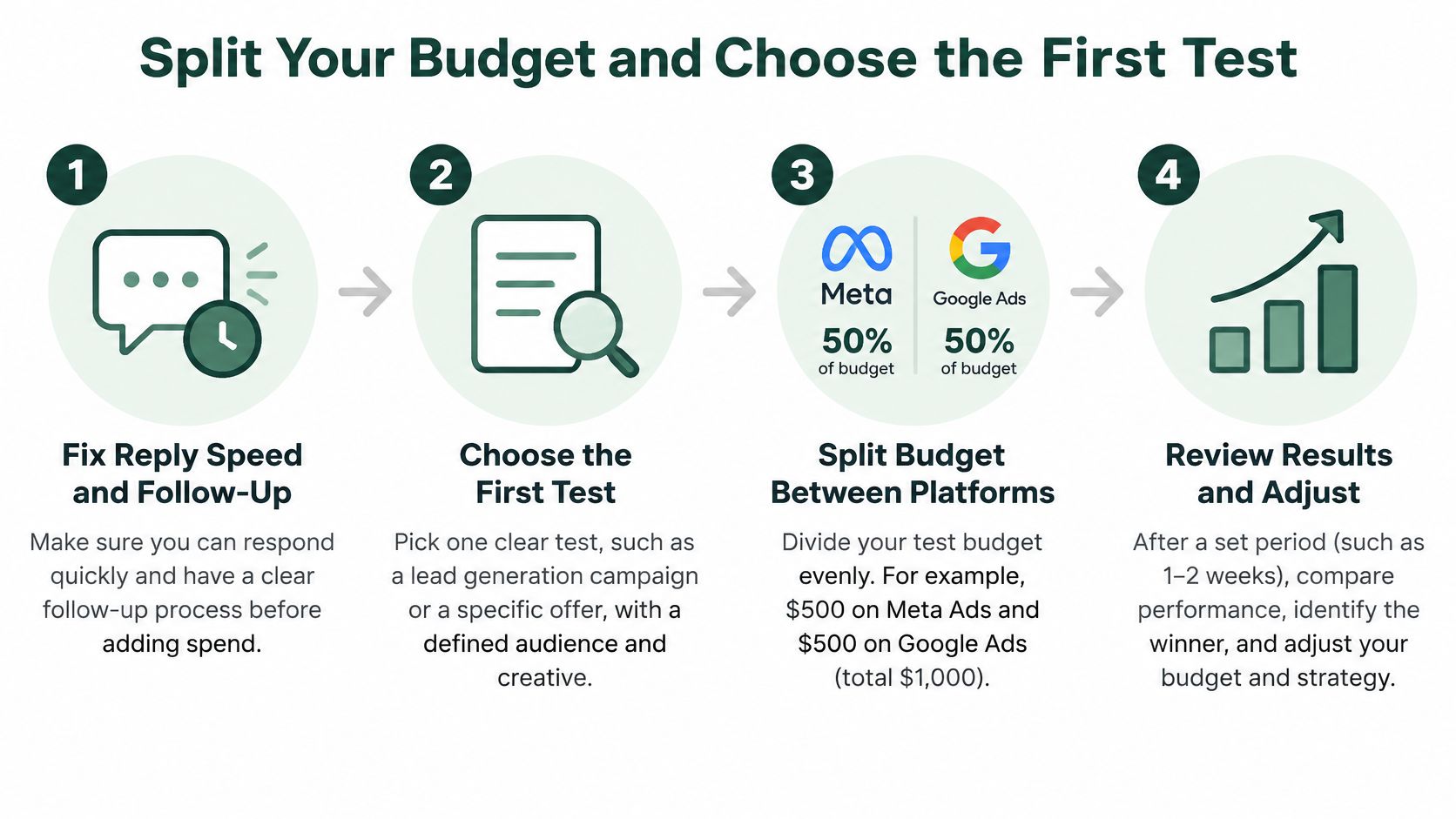
Fix response and follow-up before increasing spend. Make sure someone owns incoming calls and forms, replies promptly, follows up when a lead doesn't book, and records the outcome. Med Spa Scalers focuses on reply speed, reminders and reactivation before recommending more ad spend.
Choose the first treatment to test. Write down your two highest-revenue services and mark each one as usually searched by name or usually discovered through content. That gives you a practical starting point: treatment-plus-city searches point toward Google, while an offer that needs visual explanation points toward Meta.
Give each channel a distinct job. Put the first search test on Google for a service people actively look for. Use Meta for a new or aspirational offer, creative testing and retargeting non-bookers. Don't make an arbitrary equal split the goal; give each campaign enough room to test its intended audience and message.
Connect calls and forms to bookings. Track the source in your CRM, including whether the lead qualified, booked and attended. Without that connection, you can't tell whether a low-cost campaign generated kept appointments or just more inquiries.
Allow the campaigns time to learn. Ads typically need 60 to 90 days to optimize fully, so treat early results as signals rather than a final verdict. Keep tracking during that period, and avoid changing the campaign, offer and follow-up process all at once if you want to understand what drove a change.
Review performance by treatment. Compare cost per kept appointment, show rate and treatment revenue over the same period. Then shift budget toward the channel with the lower marginal cost per kept appointment, and pause campaigns whose leads consistently fail to book.
A useful marketing plan checklist can help organize the campaign, offer and follow-up decisions before launch. Med Spa Scalers' free marketing audit reviews current ads, offers and landing pages, as well as how quickly and consistently the clinic follows up with leads.
For the first test, start with Google when patients already search for the treatment and the clinic can respond promptly. Start with Meta when the service needs visual education or the offer is new, aspirational or membership-based. If the front desk is slow to reply, improve speed-to-lead and follow-up before giving either channel more budget. Set one target, cost per kept appointment for your top treatment, and review it after the campaigns have had time to develop.
Med Spa Scalers runs Meta and Google campaigns for high-value treatments and connects them with follow-up and tracking to booked consultations. If you want to see whether your current budget is producing kept appointments or losing leads between inquiry and booking, request a free marketing audit by visiting Med Spa Scalers.
See how many patients you're leaving on the table
Get a free marketing audit of your ads, follow-up and booking flow. No pressure, just a clear picture.
Book a free marketing audit