10-Step Marketing Plan Checklist for Med Spas in 2026
Most med spa marketing plans lose the booking after the click. The ad works. The form works. Then the inquiry sits while a provider is in a room, and the patient books the clinic that answers first.
In 2024, only 38% of global marketers evaluated ROI across the full picture by measuring traditional and digital marketing together, according to Nielsen. A clinic can look profitable inside one ad account and still not know what a kept consultation cost once calls, no-shows, and return visits are counted.
A marketing plan checklist closes that gap by forcing one path, not a pile of channels.
- Score the chair, not the click: Booked consultations and show rate decide whether a step stays.
- Keep the order: Goals, patient, offer, budget, ads, page, reply, follow-up, local search, then reactivation.
- Name an owner: Every step needs a person, a target, and a stop rule.
I score each handoff the same way. Did a consultation get booked, and did the patient show? Pull the last three to six months of CRM and booking history before you change spend. Without that baseline, the next campaign will look better than it is.
Table of Contents
- 1. Define Measurable Goals and KPIs
- 2. Define the Ideal Patient Profile and Market Research
- 3. Build Treatment-Specific Offers and Positioning
- 4. Set Budget and Allocate Channels
- 5. Launch Paid Campaigns on Meta and Google with Conversion Tracking
- 6. Create High-Converting Landing Pages and Lead Forms
- 7. Implement Speed-to-Lead Response Systems
- 8. Automate Follow-Up Sequences and No-Show Recovery
- 9. Optimize Local SEO and Google Business Profile
- 10. Run Patient Reactivation Campaigns
- How the 10 marketing plan checklist items compare on primary metric, key tools, and best use
- Turn the Checklist Into a 90-Day Operating Rhythm
1. Define Measurable Goals and KPIs
Goals come before media. A usable marketing plan covers the business description, market research, pricing, the customer profile, competitors, strategies, methods, budget, and performance measurement. The elements that earn a place on your scorecard are the ones you can count. Impressions and reach do not qualify. Booked consultations and kept appointments do.
Say a one-location clinic wants 40 consultations this month. Export booked consults, shows, and revenue by treatment for the prior quarter. That history gives you a baseline show rate and a realistic ceiling on cost per booked patient. Track both together, because a cheap lead that never sits in the chair still costs money.
Lock the scorecard in writing:
- One owner per number: Booked consults, show rate, and cost per booked patient each have a name.
- Kept appointments, not leads: Cost per inquiry flatters channels that never fill a room.
- A monthly meeting: Change tactics only when a metric misses its target.
Practical rule: If you cannot calculate cost per kept appointment by channel, the goal is still a wish.
Write each goal the SMART way: the treatment, the count, the month, and the cost ceiling. "Grow injectables" is not a goal. Forty injectable consults this month at a cost per booked patient the front desk can honor is. Vanity metrics stay off the agenda.
2. Define the Ideal Patient Profile and Market Research
Picture a three-location group that finally exports its top fifth of patients by lifetime value. The same ZIP clusters, the same treatment history, and the same reason for the first visit show up again and again. That export is the ideal patient profile. A generic "women 25 to 54" audience is not.
Build one short profile per treatment line. Injectables, lasers, and body contouring do not share price sensitivity, search language, or how long someone waits before booking. Geography is a radius you can staff, not a whole metro you cannot.
What belongs on the profile:
- Need and trigger: Event, life stage, or a result they have already tried to get.
- Where they compare you: Google reviews, Maps, and neighborhood search, not only Instagram.
- What they reject: Read competitor reviews for price shocks, rude front desks, and unclear aftercare.
Seasonality belongs in the same research pass. Treatment demand, promo timing, and staffing move together. If summer laser interest spikes and your providers are already full, buying more clicks only creates a longer wait and a worse show rate.
3. Build Treatment-Specific Offers and Positioning
An offer is the reason someone takes the next step. Positioning is why they pick you instead of the clinic two miles away. Mixing those two jobs produces ads that sound busy and pages that do not book.
Injectables often convert on a complimentary, provider-led plan. A laser package usually needs a session count and a deposit to hold the slot. Body contouring sits in between, with a longer decision and a higher ticket. One clinic-wide discount flattens all three.
I test two or three offers per line and keep the winner by cost per booked consultation, then by show rate. A free consult that no-shows is more expensive than a paid consult that arrives.
A deposit or card on file cuts no-shows on high-value consults only when your state rules, your consent language, and your front desk can actually enforce it.
Have compliance review claims, prices, and testimonials before launch. Provider credentials, the device you use, and a written plan are stronger positioning than a race to the lowest price. Price shoppers fill the funnel and miss the chair.
4. Set Budget and Allocate Channels
In 2024, 70% of global marketers planned to prioritize performance marketing over brand-building initiatives, according to Nielsen. For a med spa, that tilt is useful only if performance means kept appointments. Platform return on ad spend is not the same number.
Work backward. Start from revenue per patient and the share of revenue you will allow for marketing. That math sets a maximum cost per booked consult. Split the monthly budget by location and by treatment line across Meta, Google, local SEO, and a reactivation pool. I hold 10 to 20 percent back for tests. Spending the whole budget on last month's winner leaves you blind when costs rise.
How the reallocation works:
- First 90 days: Check channel cost per booked patient every two weeks.
- After that: Move money monthly toward the lowest cost per show, not the lowest cost per lead.
- Kill rule: Pause a line that books but does not show, and fix the offer or the follow-up before you refund it.
Brand content still earns trust on Maps and on the site. It should not be the place you hide untracked spend.
5. Launch Paid Campaigns on Meta and Google with Conversion Tracking
A 2025 MarTech industry survey found that 86.4% of organizations use a CRM and 62.1% reported using more marketing tools than two years earlier, based on figures in the LeadSpot benchmark notes. More tools do not create a booking. A shared lead ID does.
Wire Meta (Pixel and Conversions API), Google Ads conversion tags, and call tracking into the CRM before you scale. The acceptance test is simple. Can you report cost per booked consultation and cost per kept appointment by channel? If you only have cost per lead, you are not ready to spend.
Separate campaigns by treatment line. A seasonal laser package on Meta lead ads and neighborhood-plus-treatment keywords on Google Search should not share one budget. Review health-advertising policies on both platforms before creative goes live.
The short walkthrough below shows how a booking event, not a click, should be the optimization goal.
Document field mapping, consent, pipeline stages, and who gets the alert when a lead is unassigned. For the Meta side of that build, the med spa Facebook ads setup is the practical companion to this step. Give every automation an owner and a fallback for missed calls, failed texts, and duplicates.
6. Create High-Converting Landing Pages and Lead Forms
The page has one job. It must repeat the ad's promise and ask for the consult. Sending paid traffic to a general homepage makes people choose among every service you offer. Most of them leave.
A body-contouring ad should land on a body-contouring page with local photos, one offer, provider credentials, a short review, and a single call to action. The same paid audience sent to the homepage will book less, because the next step is unclear.
Keep the form from becoming the leak:
- Four or five fields: Name, phone, email, treatment, and preferred location. Ask for detail on the call.
- Match the ad: Headline and image should be the ones that earned the click.
- CRM on submit: The form creates the lead and starts the reply. A spreadsheet export at noon is already late.
Test one element at a time. Headline, offer, or form length. Stop the test when the booked-consult gap is obvious, not when click-through moves a little. Trust blocks belong above the fold. Safety notes, who performs the treatment, and what happens after they submit.
7. Implement Speed-to-Lead Response Systems
A Botox inquiry submitted at 8 pm is still warm at 8:05 and cold by morning. Prospects who get a fast first reply qualify and book at a meaningfully higher rate than those who wait, because the paid lead is most responsive while your page is still on their screen. That gap is where med spa bookings disappear.

Treat speed-to-lead as a service level with a clock on it. Stamp the time on the form or missed call. Send an SMS or place a call attempt within 60 seconds. Route anything unanswered to a staffed queue, and log every attempt on the lead record so the follow-up sequence starts with context instead of a cold dial.
Report response in bands, then tie the bands to shows:
- Under one minute, one to five minutes, five to 30 minutes, and over 30 minutes.
- Compare booking rate and show rate inside each band, since a contacted lead who never books still burns the same ad spend.
- Track the monthly share of new inquiries that got a documented first response inside the window, plus median response time and cost per booked patient.
The AI or the template can cover hours, price ranges, and the booking link. Clinical questions go to a licensed person. Put opt-out language on the first text and honor it. The med spa speed-to-lead study breaks this workflow down step by step. Test your own form and missed-call path every month. Workflows often break without warning after a software update, and a dead auto-reply reads as a clinic that never called back.
8. Automate Follow-Up Sequences and No-Show Recovery
The first reply books some patients. It does not book most of them. A consult is a high-ticket decision, and people stall. A sequence of five to seven touches over two weeks, mixing SMS, email, and a live call, is enough. A 20-message blast trains people to ignore you.
Write the cadence around the appointment, not around your content calendar. A reminder 24 hours before the visit, with one tap to confirm or reschedule, protects show rate. A rebooking text within two hours of a no-show recovers the slot while the patient still remembers why they booked.
What makes the sequence safe to run:
- Consent on the form: Say they will get texts about this consult, and process STOP the same day.
- Different jobs per message: Answer a question, offer times, then a last call. Do not repeat the same discount.
- A human exit: Once they book or ask a clinical question, the automation stops.
If show rate is weak, do not raise the ad budget. Fix reminders and the offer first. Media cannot compensate for a calendar full of people who were never asked to confirm.
9. Optimize Local SEO and Google Business Profile
Paid demand stops when you stop paying. Maps demand compounds when the profile, the citations, and the service pages agree. Queries like "botox near me" or "laser hair removal" plus your city are won on Google Business Profile completeness, reviews, and a page that matches the search.
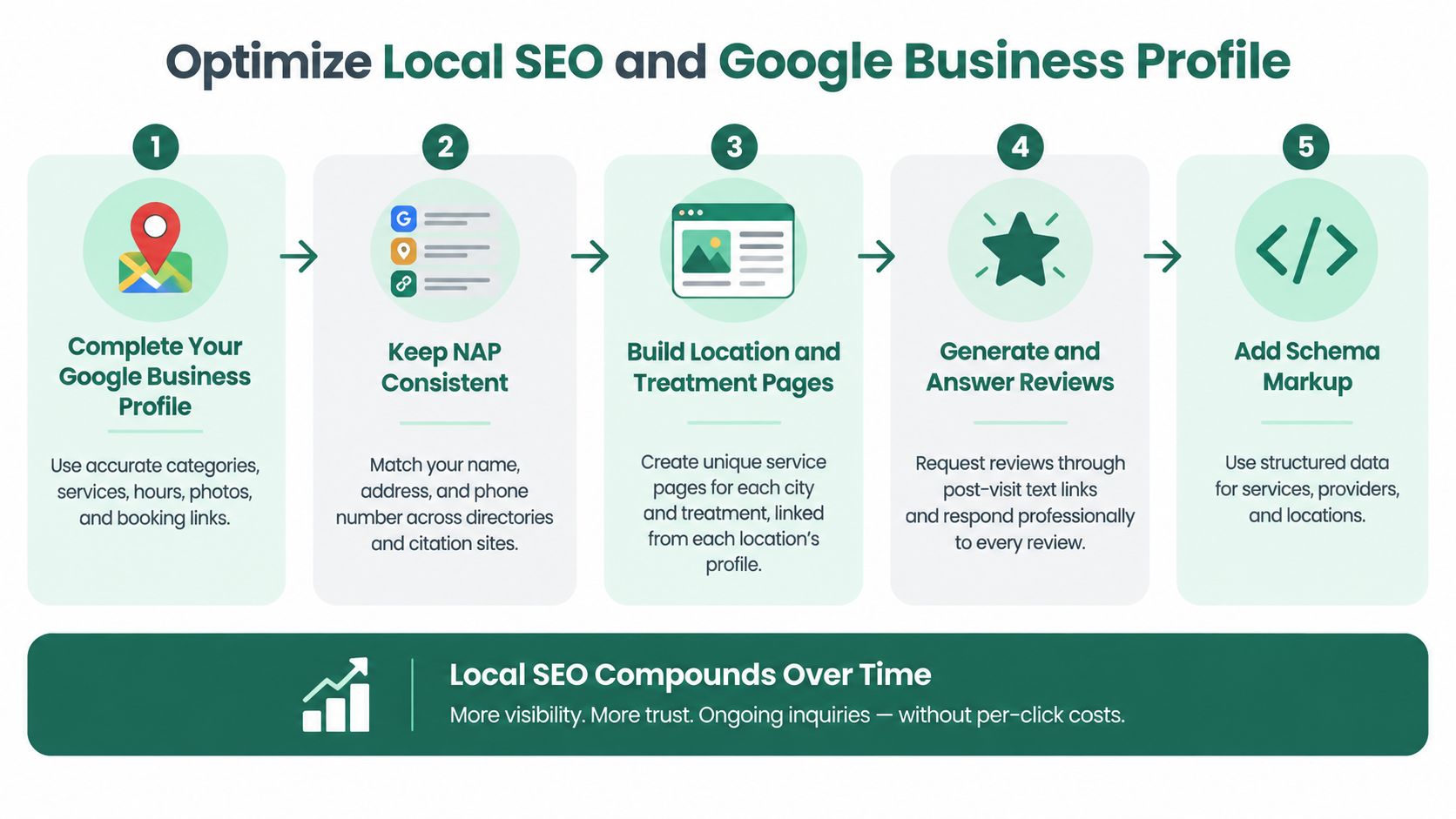
A multi-location group should give each city and each core treatment its own page, with local photos and provider bios, then link that page from the matching profile. NAP (name, address, phone) has to match on the major directories. Audit it once a quarter.
Reviews are an operating task, not a marketing campaign:
- Ask by SMS after the visit. Do not pay for stars.
- Answer every review within a few days, including the hard ones, and never include protected health details.
- Track calls and direction requests from the profile through the same booking path as paid leads, so local SEO has a cost per booked patient too.
A local SEO audit is the right checkpoint before you add pages. Clear service and location facts also help you show up in AI-written search summaries. Vague bios do not.
10. Run Patient Reactivation Campaigns
Existing patients are usually the cheapest booked visits you will buy. They already trust the clinic. They already have a treatment interval. A dormant list, often no visit in six to 18 months, is not a blast audience. It is a set of schedules you missed.
Take neurotoxin patients whose last visit was four to five months ago. Send two steps, SMS then email, with a real booking window. Do the same for a laser series that stopped after session one. Time the message to the treatment interval, not to the week you need revenue.
Before you hit send:
- Clean the list. Drop bad numbers and anyone who unsubscribed.
- One offer tied to their history. A membership pitch to a patient mid-series feels like spam.
- Report reactivation rate and revenue per reactivated patient. If those two numbers work, the campaign earns a monthly slot in the budget.
Compare that cost per booked patient with new-patient ads. If reactivation wins, it gets budget before you buy another cold audience. New-patient spend still matters for growth. It should not be the only engine.
How the 10 marketing plan checklist items compare on primary metric, key tools, and best use
| Item | Primary Metric | Key Tools or Platforms | Best For |
|---|---|---|---|
| Define Measurable Goals and KPIs | Booked consultations and cost per booked patient | CRM and booking data | Aligning marketing with business outcomes |
| Define the Ideal Patient Profile and Market Research | Patient fit by treatment and location | Patient data, reviews, CRM, Meta, Google | Targeting relevant local audiences |
| Build Treatment-Specific Offers and Positioning | Cost per booked consultation | Treatment offers and compliance review | Differentiating services and improving bookings |
| Set Budget and Allocate Channels | Cost per booked patient | Meta, Google Ads, local SEO, reactivation | Distributing spend by location and treatment |
| Launch Paid Campaigns on Meta and Google with Conversion Tracking | Cost per booked consultation | Meta Ads Manager, Google Ads, Pixel, Conversions API, CRM | Generating and measuring paid demand |
| Create High-Converting Landing Pages and Lead Forms | Landing-page conversion rate | Landing-page platforms, CRM, booking widget | Converting traffic into qualified inquiries |
| Implement Speed-to-Lead Response Systems | Time to first response | CRM, SMS, email, AI receptionist | Responding quickly to new inquiries |
| Automate Follow-Up Sequences and No-Show Recovery | Consultation conversion and no-show recovery | SMS, email, CRM, Twilio | Converting leads and recovering missed appointments |
| Optimize Local SEO and Google Business Profile | Local search visibility and inquiries | Google Business Profile, citations, schema markup | Building ongoing local discovery and trust |
| Run Patient Reactivation Campaigns | Reactivation rate and revenue per reactivated patient | CRM, SMS, email | Bringing dormant patients back for care |
Turn the Checklist Into a 90-Day Operating Rhythm
A checklist that nobody owns is a poster. Put one person on the marketing plan checklist for the quarter, with a backup at the front desk. Score the work on cost per booked patient and show rate. Clicks can sit in an appendix.
Larger teams often combine marketing-mix modeling, incrementality testing, and multi-touch attribution, but most med spas do not need that stack on day one. Start with a simpler holdout. Run a channel, a ZIP cluster, or a two-week window with the campaign and a comparable one without it. Compare booked-and-kept appointments with the cost. Last-click credit from an ad platform will not settle a budget argument.
Use the first 90 days in this order:
- Days 1 to 30: Baseline the CRM. Set targets for booked consults, show rate, and cost per booked patient. Write the patient profile and treatment offers, then connect each offer to its landing page, form, pipeline stage, and follow-up path.
- Before you raise spend: Fix the 60-second reply, the form-to-CRM handoff, reminders, and no-show recovery. Confirm consent language. These handoffs decide whether a click becomes a consult.
- Every two weeks: Read cost per booked patient and show rate by channel. Shift budget toward the sources producing kept appointments. Do not add a new tool because a dashboard looks thin.
- Days 60 to 90: Turn on reactivation for one treatment interval. Audit the Google Business Profile against the service pages so the treatment, location, and booking path match what the campaigns promise.
Checklists that stop at cost per lead and a vague return on ad spend make a cheap lead that never sits down look like a win. Track the handoffs in order: inquiry, contact rate, booked consultation, show rate, treatment sold, revenue, and contribution by source. Write rules for duplicates, missed calls, and patients who saw two channels. Otherwise, the same person gets counted twice and the wrong campaign gets the money.
Med spa owners and multi-location directors do not have a media problem as often as they have a handoff problem. When ads, pages, texts, and the front desk sit with different vendors, bookings die in the gaps. A twice-monthly review of the same operating rhythm shows whether the leak is the audience, the offer, capacity, or follow-up.
If you want that leak located before you add budget, Med Spa Scalers runs a free audit of the path from inquiry to kept appointment. Bring your last quarter of leads, bookings, and show rate. You will leave with the step that is losing patients.
Med Spa Scalers builds marketing plans for U.S. med spas that are scored on booked consultations, show rate, and cost per booked patient, from Meta and Google through CRM follow-up and reactivation. If your marketing plan checklist still stops at clicks, the free audit shows which handoff is dropping appointments. Visit Med Spa Scalers to start with your current funnel.
See how many patients you're leaving on the table
Get a free marketing audit of your ads, follow-up and booking flow. No pressure, just a clear picture.
Book a free marketing audit