Local SEO Audit: A Practical Playbook for Med Spas
Your clinic appears in Google Maps. The marketing report shows visibility, and the front desk says the phone rings. Yet the consultation calendar still has gaps, and nobody can explain which searches produced patients who showed up. That's the situation a useful local SEO audit should resolve, not disguise behind another ranking report.
Table of Contents
- Measure appointments without overstating attribution
- Use a staged implementation plan
- Questions about cadence and ownership
Why a Med Spa Local SEO Audit Has to Connect to Bookings
Consider a hypothetical laser hair removal inquiry. A prospective patient finds your profile, clicks through, and reaches a booking form that doesn't explain whether they're requesting a consultation or purchasing treatment. They submit it, receive no clear confirmation, and call another clinic while your team sorts through incoming leads.
The profile generated interest. The clinic didn't secure an appointment. Treating that interaction as an SEO success would hide the problem that matters.
A booking-focused audit connects discovery to the operational record. Reconcile profile actions with CRM stages, booking timestamps, deposits where applicable, attendance, and eventual treatment revenue. Review call recordings only where recording and access are appropriate, and keep sensitive patient information out of general marketing reports.
Define the outputs before opening an audit tool
The deliverable should distinguish:
- Profile accuracy: Can prospective patients find the correct clinic, service, hours, and appointment destination?
- Prominence signals: Do reviews, local references, and directory information support the clinic's credibility?
- Conversion infrastructure: Can staff identify, qualify, book, and follow up with an inquiry?
- AI recommendation accuracy: Do generated answers describe the clinic and its treatments correctly?
Practical rule: A call click is evidence of intent, not evidence of a booked consultation.
Response handling belongs in this assessment. Incorrect listings deter 53% of consumers, according to the local-search accuracy and reputation findings published through Business Wire. An accurate listing still needs a working handoff to reception.
Use the med spa speed-to-lead study as a companion when examining that handoff. The practical question is whether an interested person receives a useful response and a clear next step, not merely whether an automated message went out.
What a Med Spa Local SEO Audit Actually Covers
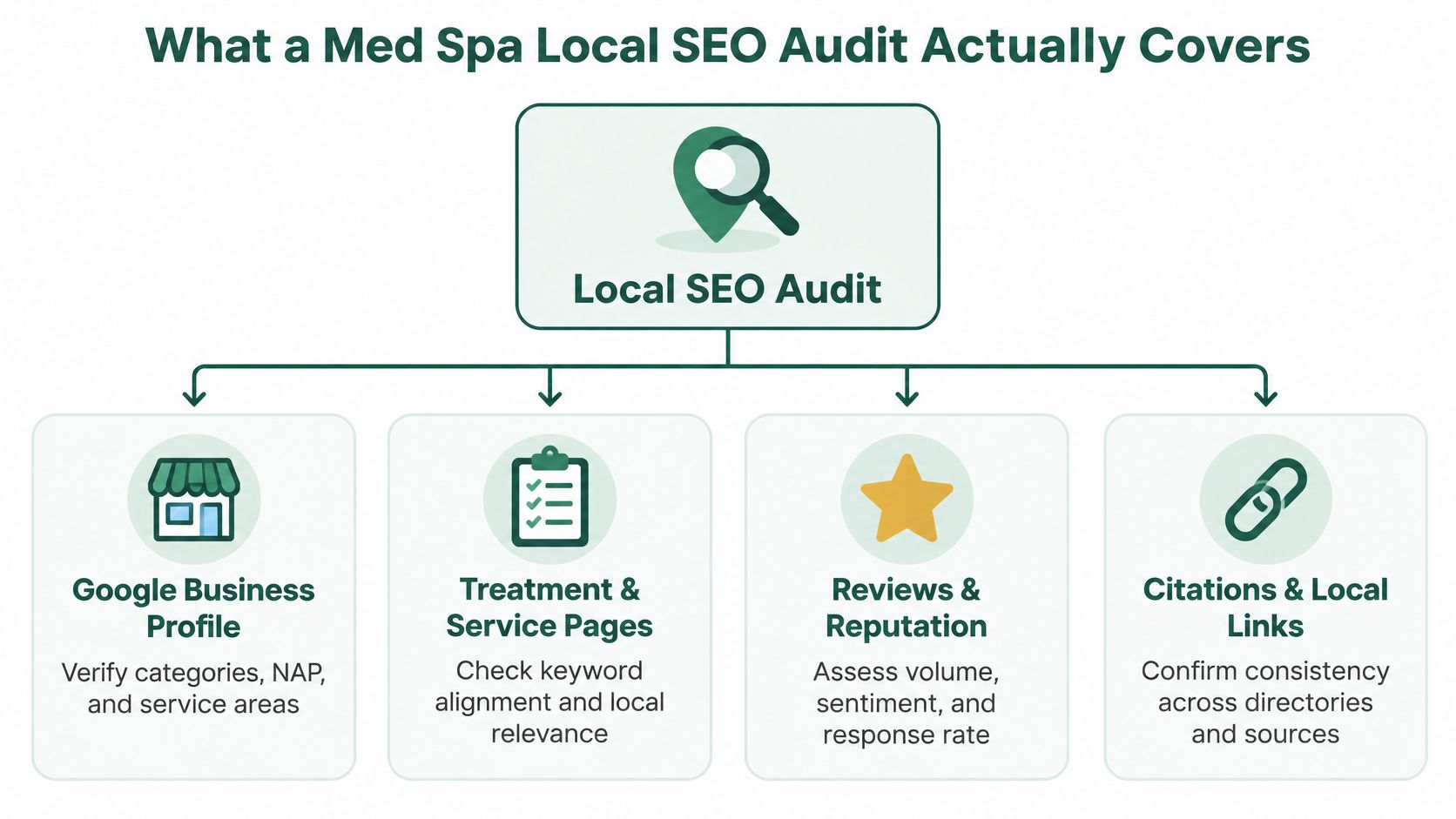
A local SEO audit evaluates whether people can find, understand, and trust a business in geographically relevant search results. Google's local-ranking framework centers on relevance, distance, and prominence, as summarized in BrightLocal's local SEO reference. For a med spa, that means evaluating the clinic against a particular treatment search in a particular area, rather than treating visibility as a single clinic-wide score.
Start by separating the map results from the website results. A Google Business Profile can appear for a nearby search while the clinic's treatment page remains difficult to find in local organic results. Record those outcomes separately so you don't prescribe website copy changes for a profile problem, or directory cleanup for an indexing problem.
Set boundaries around the audit
Choose revenue-driving treatments and a realistic geographic area before collecting results. An injectables consultation, pigmentation assessment, and body-contouring inquiry shouldn't automatically share the same keyword set or landing page.
| Audit layer | What to inspect | Booking question |
|---|---|---|
| Business profile | Identity, categories, services, location, access | Does the listing send the right inquiry to the right clinic? |
| Website | Treatment pages, technical accessibility, booking paths | Can someone evaluate the treatment and request a consultation? |
| Off-site reputation | Reviews, citations, relevant local links | Can someone independently verify the clinic? |
| AI recommendations | Inclusion, cited references, factual accuracy | Is the clinic recommended for services it actually provides? |
The diagram organizes the foundational profile, website, and reputation checks.
Don't confuse geographic ambition with evidence of demand. If your clinic wants patients from a neighboring community, audit treatment-specific searches there before commissioning pages for every surrounding city. Document what appears, which clinics compete, and whether your service offering answers the search.
Keep a shared inventory of profiles, pages, directories, and appointment destinations. That inventory becomes the reference for resolving conflicting information, rather than letting each vendor maintain a different version of the business.
Auditing the Google Business Profile for Treatment Searches
The primary category deserves scrutiny before photos or posting frequency. Google's guidance on improving local ranking emphasizes accurate, complete business information and explains relevance, distance, and prominence. Choose the available category that best represents the clinic's actual core business, then check whether appropriate secondary categories describe services it provides.
Don't select categories just because a competitor uses them. A clinic emphasizing injectables may need a different configuration from a practice built around laser services or weight-loss consultations. Record the reasoning behind category choices so later changes aren't based on whoever last accessed the account.
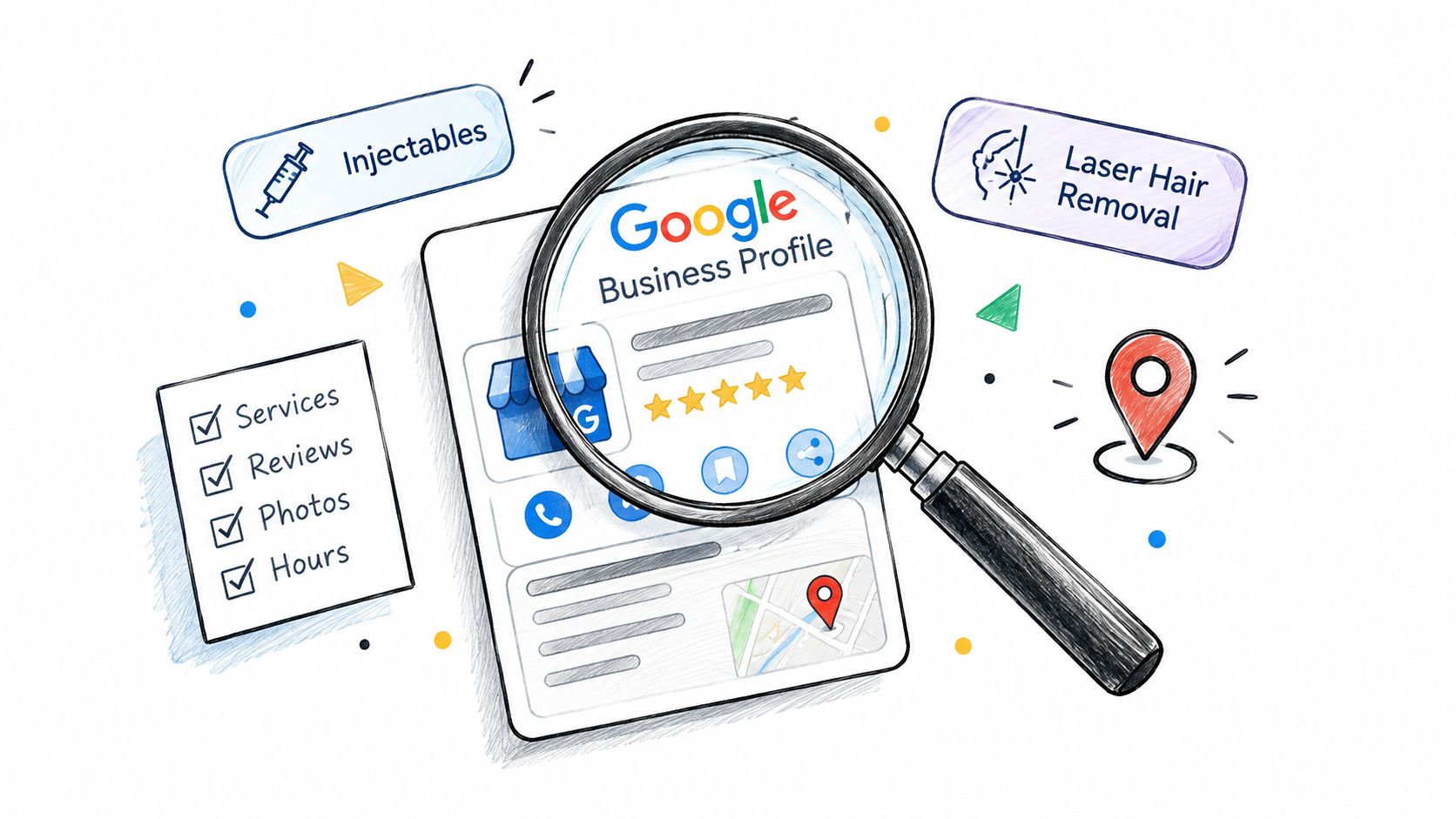
The profile review should connect every visible detail to the treatment inquiry.
Inspect identity and access together
Build a profile record that includes:
- Business identity: Exact real-world name, address, phone, map pin, and appropriate storefront or service-area configuration.
- Appointment details: Regular and special hours, website destination, appointment URL, and whether the linked calendar opens the correct location.
- Treatment representation: Services, attributes, and current photos that accurately reflect the clinic.
- Account health: Verification, ownership access, duplicate listings, and suspended or inaccessible profiles.
Test the appointment link yourself on a phone. Follow it through treatment selection and location selection without assuming the homepage button and GBP button lead to the same place.
Keep the business name faithful to the actual name. Adding treatment and city keywords because competitors do it isn't a defensible substitute for accurate profile information.
Benchmark beyond the clinic's doorstep
Use a fixed location grid and a controlled treatment keyword set. Record the grid points, search terms, tool settings, and collection dates so subsequent checks are comparable. A city-center ranking alone won't show how visibility changes across the area you're trying to serve.
Compare nearby competitors at the same points. If you suspect spam, document the listing and the specific discrepancy before pursuing an appropriate correction. Don't label a competitor fraudulent merely because it ranks above you, and don't create another profile to work around an existing duplicate or suspension.
Export available profile actions separately from CRM outcomes. Calls, directions, and website clicks belong in the discovery record; confirmed appointments belong in the booking record.
Auditing Treatment Landing Pages and Local Organic Visibility
A broad services page can describe the clinic without adequately answering a treatment-specific search. Build a map from each priority treatment to its intended landing page, geographic intent, and consultation destination. Flag missing pages, competing pages, and pages that attract inquiries for services the clinic no longer offers.
The 2023 Whitespark expert survey assigned 36% of aggregate local-organic importance to on-page signals and 26% to links, as reported in Search Engine Land's local ranking-factor analysis. These are expert assessments, not a guaranteed ranking formula. Use them to justify careful page and link evaluation, not to calculate a predicted position.
Check whether the intended page can compete
For each treatment URL, inspect:
- Technical eligibility: Crawlability, indexation in Google Search Console, canonical destination, and accidental exclusion.
- Search alignment: A descriptive title and heading, clear treatment intent, and meaningful location information.
- Content quality: Unique explanations, accurate service availability, useful consultation questions, and realistic expectations.
- Internal connections: Relevant links from navigation, related treatments, practitioner pages, and supporting content, including the GBP landing page.
- Conversion readiness: A working mobile booking path, understandable form, and appropriate structured data that matches visible information.
Don't treat a successful crawl as proof of indexation. Check the intended URL directly, especially when a redesign or booking-platform migration has changed page addresses.
Evaluate the evidence patients need
A treatment page should help someone decide whether to request a consultation. Audit practitioner bios, credentials, clinic information, and any before-and-after gallery for accuracy, appropriate permissions, and context. Avoid presenting a gallery as a promise of an individual outcome.
For example, a pigmentation page should identify the treatments the clinic offers and explain that suitability requires assessment. A generic paragraph about advanced technology won't answer a patient's question about who evaluates them or what happens next.
A polished treatment page with an unusable booking button is still an unfinished patient journey.
Check mobile loading and the booking interaction together. If the calendar fails after treatment selection, rewriting the introduction isn't the priority.
Use the med spa SEO guide when translating page findings into a broader content plan. Improve substantive treatment pages before publishing near-duplicate city pages. If a proposed location page adds nothing beyond a swapped city name, reconsider whether it deserves to exist.
Auditing Citations, NAP Consistency, and Review Quality
Directory work becomes wasteful when completion means adding listings rather than correcting information patients encounter. Start with an approved NAP record, the clinic's name, address, and phone, plus its current website and appointment destination. Compare that record against major directories, relevant treatment directories, social profiles, and location pages.
For a directory such as RealSelf, inspect an existing clinic or practitioner presence where relevant. Don't assume every directory deserves a submission, and don't purchase a package because it promises a large inventory of listings.
Fix consequential conflicts first
Use a reconciliation log rather than a submission count.
| Finding | Recommended action |
|---|---|
| Old address on a visible listing | Correct it and verify the public update |
| Duplicate clinic entry | Document ownership and pursue consolidation or removal |
| Wrong phone or booking destination | Repair it and test the patient path |
| Inaccurate treatment description | Replace it with approved service information |
| Low-relevance directory opportunity | Defer unless it serves a clear patient or credibility purpose |
Prioritize accuracy and uniqueness over mass distribution. A consistent error is still an error, so verify the approved record against clinic operations before copying it everywhere.
Review relevant local links with the same restraint. Check whether partner, community, or professional references point to the correct clinic page. Pursue legitimate relationships and corrections, not a quota of unrelated mentions.
Read reviews as operational evidence
Classify reviews by treatment mentions, staff, location, reported outcomes, and service experience. Track rating, incoming review pace, sentiment, and response coverage separately for each location. A group-wide average can obscure an appointment-handling problem at a particular clinic.
- Booking friction: Route comments about unanswered calls or confusing scheduling to the practice manager.
- Expectation gaps: Compare treatment-related concerns with the landing page and consultation explanation.
- Staff recognition: Identify the behaviors patients appreciate without turning praise into unsupported clinical claims.
- Response gaps: Assign an owner to unanswered feedback and define an escalation path for sensitive complaints.
Never ask patients to disclose treatment details publicly. In responses, avoid confirming a patient relationship or adding health information, even when the reviewer shares it first.
Privacy check: Move sensitive discussions into the clinic's approved private channel instead of trying to resolve them in public.
Review recurring themes quarterly and assign operational changes alongside listing corrections.
Auditing AI Recommendations and Local Discovery Beyond Google
A clinic's absence from an AI answer isn't necessarily a reason to publish more location pages. The more useful question is whether the system can identify the clinic accurately for a treatment, patient need, and place. The AI-readiness discussion of local discovery and profile accuracy provides context for assessing this alongside conventional local search.
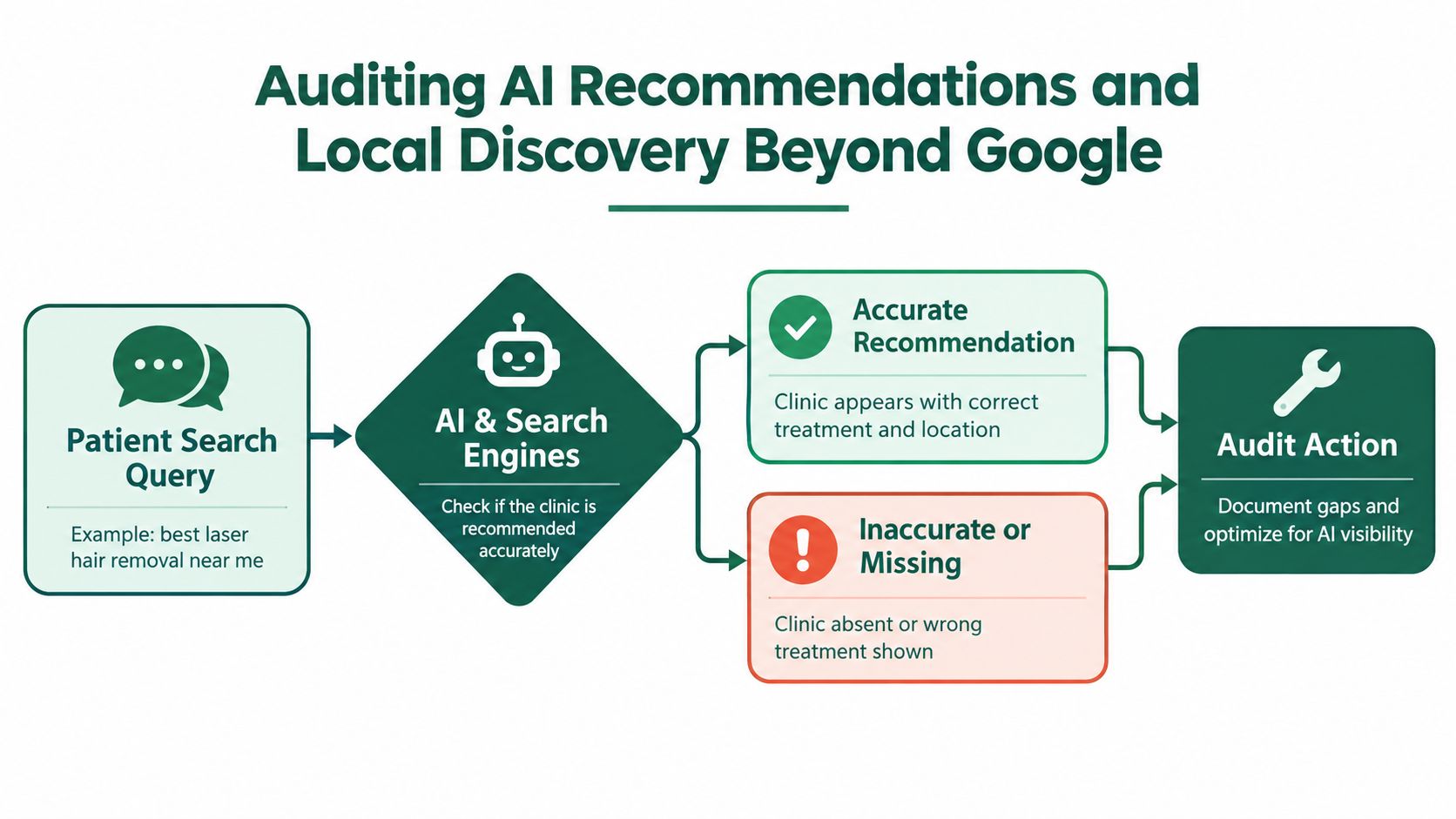
Treat generated recommendations as an audit surface, not a reliable clinical directory. Record what the answer says and which references it provides. A named clinic with the wrong treatment is a factual failure, not a visibility win.
Build a repeatable prompt log
Use a controlled set of prompts in Google's available AI search experiences and other AI search tools you're evaluating. Keep the wording consistent between checks.
- Treatment and geography: Best laser clinic for pigmentation near [city].
- Specific constraint: Which clinic offers [treatment] with [specific constraint] near [neighborhood]?
- Provider verification: Who performs consultations for [treatment] at [clinic]?
- Practical access: Where is [clinic], and how can I request an appointment?
These are test prompts, not endorsements of the language or recommendations an AI system returns. Record the tool, date, stated location context, exact response, named businesses, and cited pages.
The workflow should distinguish an accurate recommendation from a mention that could mislead a patient.
Score inclusion and truth separately
Define recommendation share as the proportion of your logged test responses that recommend the clinic. Keep factual accuracy separate by checking services, provider credentials, locations, booking destinations, and any quoted prices against approved clinic information.
Flag unsafe implications immediately. An answer that claims universal treatment suitability needs a different response from an answer that omits the clinic.
For each error, identify the underlying reference if one is available. Correct outdated clinic content or third-party information you can legitimately update, then rerun the same prompt and document the result. Don't assume a correction will produce an immediate or stable change.
Clear treatment explanations and consistent provider records are more defensible investments than generic pages written solely to trigger mentions. Report AI findings separately from map rankings, and don't promise control over generated recommendations.
Turning Audit Findings Into Booked Consultations
Prioritize findings by patient impact, revenue relevance, and implementation effort. A broken consultation form deserves attention before a cosmetic profile improvement. An inaccurate AI answer about treatment eligibility may warrant urgent escalation even if it produces little measurable traffic.
Use an effort-versus-impact matrix to organize the work without pretending every item has a precise financial forecast.
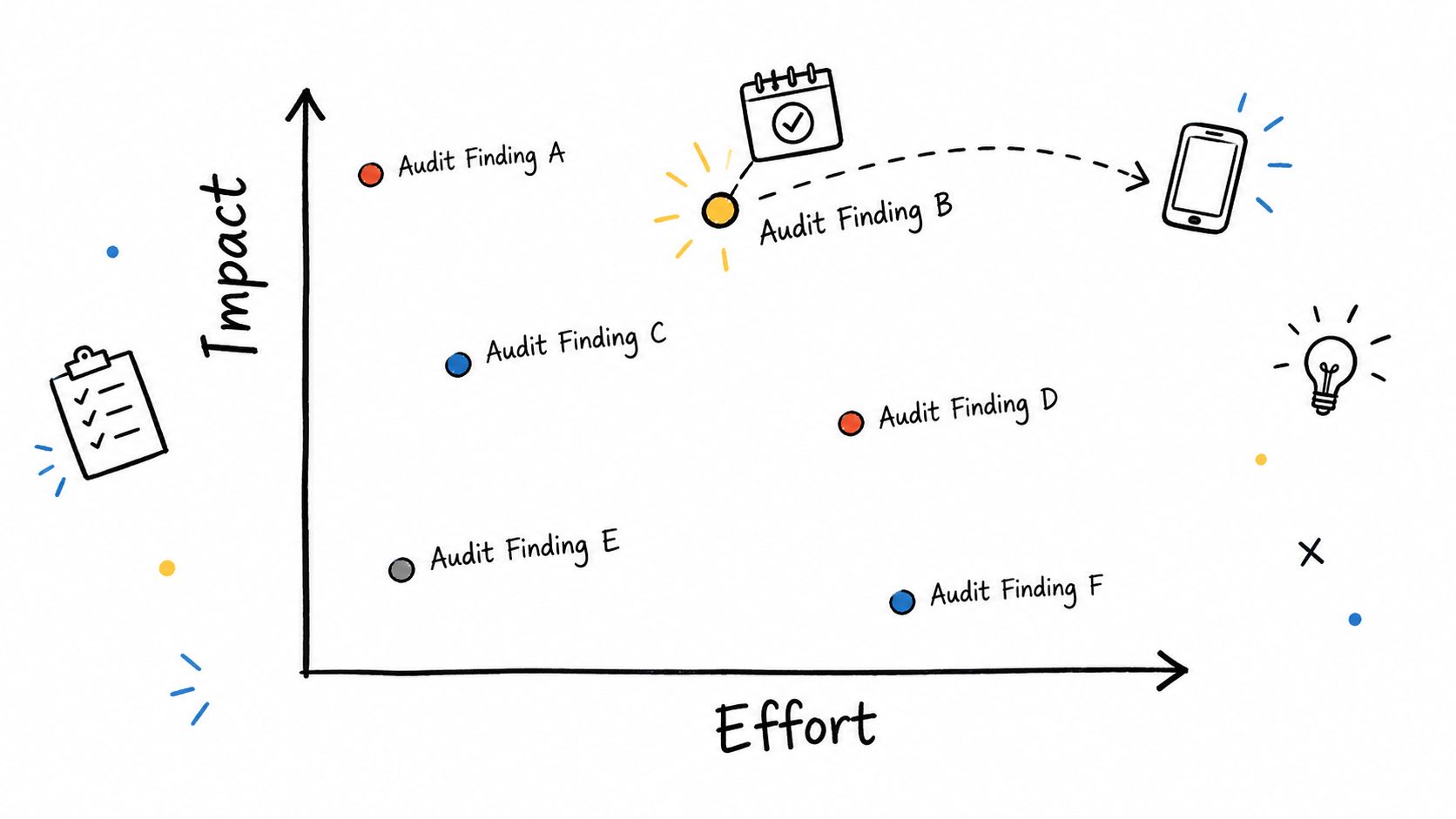
Assign every task an owner, affected treatment and location, completion evidence, and outcome to monitor. In GoHighLevel or the clinic's existing CRM, link relevant tasks to the same pipeline reception uses. Keep technical implementation details in the project system if needed, but don't make front desk staff hunt through an SEO spreadsheet to find their responsibilities.
Measure appointments without overstating attribution
Segment results by treatment, location, device where observable, and new versus returning patient. Preserve an unknown-source category rather than guessing where every booking originated.
Use consistent definitions:
- Cost per booked consultation: Attributable acquisition cost divided by confirmed booked consultations.
- Cost per kept consultation: The same cost basis divided by consultations attended.
- Treatment revenue: Revenue recorded against the resulting patient journey, with a consistent reporting window.
Distinguish channel spending from allocated agency, software, and implementation costs. Don't compare a fully loaded cost figure with a media-only figure and call the difference an improvement.
The med spa lead generation guide can support the acquisition side of that measurement. Judge qualification changes by attendance and downstream value, not merely by whether they reduce inquiry volume.
Use a staged implementation plan
The following 30-, 60-, and 90-day roadmap is a suggested work schedule, not a performance promise.
| Milestone | Work to complete | Evidence of completion |
|---|---|---|
| First 30 days | Audit GBP, NAP, tracking, and booking infrastructure; address indexing blockers and suspension issues | Tested appointment paths, documented profile status, captured source information |
| Next 30 days | Improve treatment pages, reconcile priority citations, and assign review operations | Verified page changes, indexation checks, corrected listings, response ownership |
| Final 30 days | Run the AI recommendation audit, connect findings to CRM tasks, and establish quarterly reviews | Prompt log, assigned corrections, appointment-outcome dashboard |
Start CRM measurement early; use the final stage to make the reporting and task handoffs routine. Don't postpone fixing a dangerous factual error or broken booking path because it falls outside the current phase.
Use the video as a discussion aid while your team reviews the implementation priorities.
Questions about cadence and ownership
How often should we repeat the audit? Use a quarterly review as an operating cadence, with focused checks after moves, website changes, service changes, or profile problems.
Who should own it? Assign accountability to the practice manager or growth lead. Reception validates appointment handling, the clinical team approves treatment accuracy, and the technical team implements website fixes.
Should we hire an agency? Keep it in-house if your team can investigate and implement the findings. Bring in specialist help when access, technical work, or cross-location coordination exceeds that capacity, but retain ownership of accounts and patient data.
The final test is whether completed work changes the number and quality of kept consultations, not whether the audit spreadsheet looks finished.
Med Spa Scalers combines local SEO with CRM setup, appointment follow-up, and reporting tied to booked consultations and kept appointments. Visit Med Spa Scalers to request a free audit and identify where your clinic needs better visibility, a stronger booking process, or both.
Published via Outrank app
See how many patients you're leaving on the table
Get a free marketing audit of your ads, follow-up and booking flow. No pressure, just a clear picture.
Book a free marketing audit