Ad Creative Strategy for Med Spas: How to Plan and Test
The most popular advice about ad creative strategy is to produce more variations and chase the strongest hook. For a med spa, that's incomplete. An ad can earn cheap clicks while attracting people who won't qualify, can't commit to the treatment plan, or never answer the front desk.
Start with the hesitation that prevents a suitable patient from booking. Then build the ad, consultation offer, landing page, and follow-up around answering it.
Table of Contents
Why Creative Decides Who Books a Consult
Med spa marketers often judge ads by clicks, cost per click, and impressions, then wonder why the front desk has nothing useful to book. Those metrics describe attention. They don't tell you whether someone understands the treatment or wants an assessment.
Ad creative strategy is the plan for what an ad says, shows, and asks someone to do, tied to a specific treatment and next step. Think of the ad as a handshake that gets a prospective patient to sit down. A clear consultation invitation explains why they should book.
The receptionist's calendar is where that distinction becomes visible.

In WARC's analysis of advertising-award data from 2015 through 2023, 20% of creatively awarded ideas subsequently received effectiveness recognition, rising to 39% for campaigns appearing in its Creative 100. That's association from historical award data, not a causal test or a promised improvement for your clinic.
Commercial standard: Creative needs a business objective, distinctive execution, and a measurable path to action.
The practical sequence is to plan by treatment, test with discipline, and measure through kept appointments. Judge each concept by the consultations it books and keeps, not just the clicks it attracts.
Treatment Creative Map by Service Line
Lead angle and proof for each med spa treatment
| Treatment | Main Hesitation | Lead Creative Family | Proof to Show | Booking CTA |
|---|---|---|---|---|
| Neurotoxin injections | Will I look frozen? | Natural-result education | Before-and-after under identical lighting, with disclosure | Book a consult to map your goals |
| Dermal fillers | Will it look fake? | Provider credibility | Injector credentials and a consult walkthrough | Book a facial assessment |
| Laser hair removal | Is it safe for my skin tone? | Safety and skin-type screening | Skin-type chart and estimated session count | Check your eligibility |
| Skin resurfacing | How much downtime will I have? | Recovery timeline | Day-by-day recovery explainer from a real provider | Book a skin consult |
| Body contouring | Is it worth the cost and time? | Value and series-cost framing | Session plan with total cost range | Book a body plan consult |
| Weight-loss programs | Is this medically supervised? | Clinical oversight | Intake-to-plan process walkthrough | Book a medical intake |
| Memberships and packages | Am I locked in? | Flexibility and value | Pricing terms and cancellation policy | Start with a consult |
Treat this map as a starting hypothesis, not a diagnosis of every patient's motivation. Your front desk's unanswered questions, consultation notes, and patient messages should determine which hesitation deserves the lead position.
Take neurotoxin injections. Someone worried about looking frozen doesn't need a faster montage of treatment footage. They need a provider explaining how goals, facial movement, and assessment inform the proposed approach.
Where appropriate and permitted, support that explanation with consented before-and-after photographs under identical lighting and comparable positioning, plus a clear disclosure about typical results and individual variation. Invite the viewer to discuss their goals rather than implying the photographed outcome is guaranteed.
Let the hesitation choose the angle
Fillers call for a different emphasis: show the injector's credentials and how they assess facial balance. For laser hair removal, make eligibility screening visible and explain that the provider must assess skin type and treatment suitability.
Body contouring needs an honest explanation of the proposed series, total cost, and commitment. Weight-loss advertising should show the clinical intake and oversight process without implying that every applicant qualifies for the same treatment.
- Verify permission: Document patient consent before using images or stories, and review disclosure needs and current platform policies.
- Check delivery: Every result, price, inclusion, and cancellation statement must match the clinic's actual offer.
- Get clinical review: Have the medical director assess clinical language and obtain appropriate review for applicable state requirements.
Use the same approved explanations in your med spa social media marketing, so prospective patients don't encounter conflicting promises when they inspect your profile.
Choose a single service line for the initial campaign. Combining unrelated treatments makes it harder to identify which concern, proof, and invitation produced the booking.
How to Build and Score Creative Concepts
A concept is a reason someone might book. An execution is how you express that reason through a provider video, patient journey, demonstration, or graphic. Separate those decisions before production, or you'll end up testing edits rather than ideas.
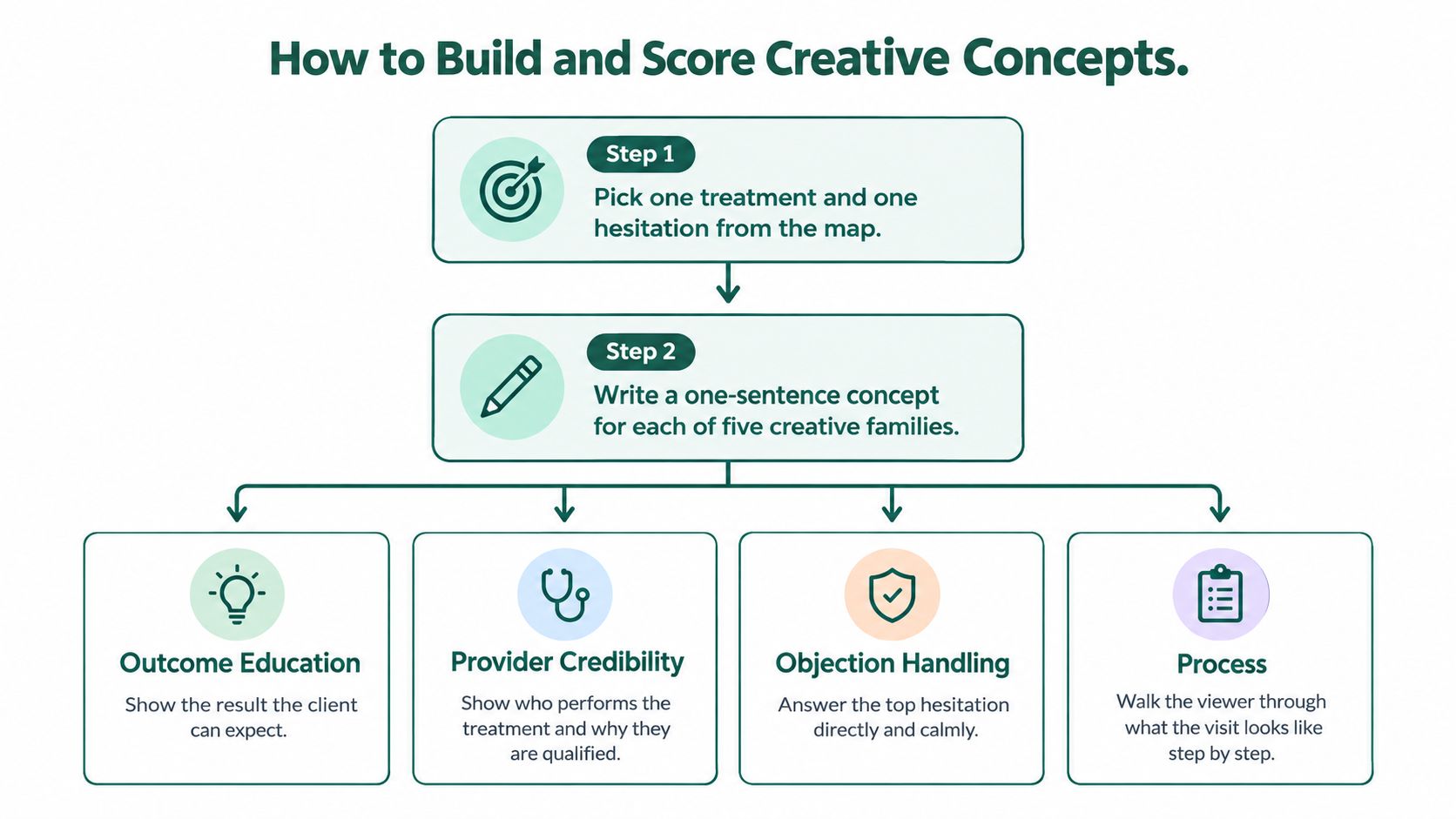
Use this workflow to move from a treatment hesitation to a production brief.
Build the idea before the asset
Choose the treatment and hesitation. Write the concern in the patient's language, such as fear of an unnatural appearance rather than aesthetic optimization. This keeps the team focused on a booking barrier instead of a product feature.
Write concepts across creative families. Include outcome education, provider credibility, objection handling, process walkthrough, and value or offer framing. Different families test different reasons to act, so don't give every concept the same sales pitch with a new introduction.
Develop materially different executions. Change the opening frame, person on screen, proof format, or question answered. A provider explaining recovery and a visual recovery diary offer different information; changing caption color doesn't.
Run a claims check before filming. Remove unsupported outcome promises, unverified patient images, and urgency the clinic can't honor. Send clinical explanations to the medical director early, before the team spends time polishing unsuitable content.
Score the concept against explicit criteria. Assess how clearly it addresses the hesitation, how strong the proof is, how distinct it is from other concepts, and how obvious the next step feels. Reject a draft with weak proof even if its opening is entertaining.
Match the landing-page experience. Make sure the first screen answers the same concern and offers the same next step. An educational ad about suitability shouldn't drop someone onto a generic discount page.
Make approval useful to production
Use a scorecard with clear judgments such as ready, needs revision, and reject. Require a written reason for each judgment, especially when creative and clinical reviewers disagree.
A polished ad with unsupported proof isn't ready. A plain provider explanation with a clear assessment invitation may be.
The final handoff should name the hypothesis, required shots, approved claims, proof asset, and booking action. Include instructions for subtitles, framing, and the exact provider explanation the editor must preserve.
For example, a neurotoxin concept might test whether transparent photography conditions help patients concerned about unnatural results feel comfortable requesting an assessment. That's a useful hypothesis because the team can compare booking quality, not merely decide whether the video looks good.
Using AI in Ads Without Losing Patient Trust
AI can generate hooks, images, and edits quickly. But production speed and patient confidence aren't the same objective: in Kantar's 2025 global study of 21,300 consumers across 30 markets, more than 60% worried generative AI could produce fake or misleading advertisements, while more than 70% of marketers embraced it for creative work.
For a med spa, the distinction matters because the viewer is evaluating a clinic, not just an advertisement. An exaggerated image can attract an inexpensive click while creating expectations the provider cannot responsibly meet.
Give AI production work, not clinical authority
Use AI where a reviewer can easily compare the output with an approved original.
- Caption variants: Rephrase approved messaging without introducing stronger promises.
- Resizing and transcription: Adapt formats and generate subtitles, then check treatment names and clinical terms manually.
- Background cleanup: Remove distractions without changing skin texture, anatomy, treatment effects, or evidence.
- Controlled angle testing: Draft alternative introductions that preserve the same approved claim and offer.
Keep human accountability explicit for anything that shapes a patient's understanding of treatment.
- Outcome claims: A clinician checks what the wording promises and what limitations it omits.
- Before-and-after representations: Preserve source images and reject edits that alter apparent results.
- Patient stories: Confirm consent and accuracy rather than generating a testimonial.
- Clinical explanations: Have the responsible provider approve suitability, risks, recovery, and expectations.
- People shown: Review any provider or patient image for authenticity and the possibility of misleading viewers.
Check trust as well as performance
Assign a named clinician to approve clinical claims and a marketing owner to retain the approved asset and version history. Disclose synthetic or edited visuals where applicable rules or platform policies require it.
Ask the front desk what people believed the ad promised. Questions about guaranteed outcomes, nonexistent inclusions, or a provider who doesn't work at the clinic indicate a messaging problem, even if click-through looks strong.
AI can multiply versions. A person must decide which promise the ad makes.
Measuring Creative by Booked and Kept Consults
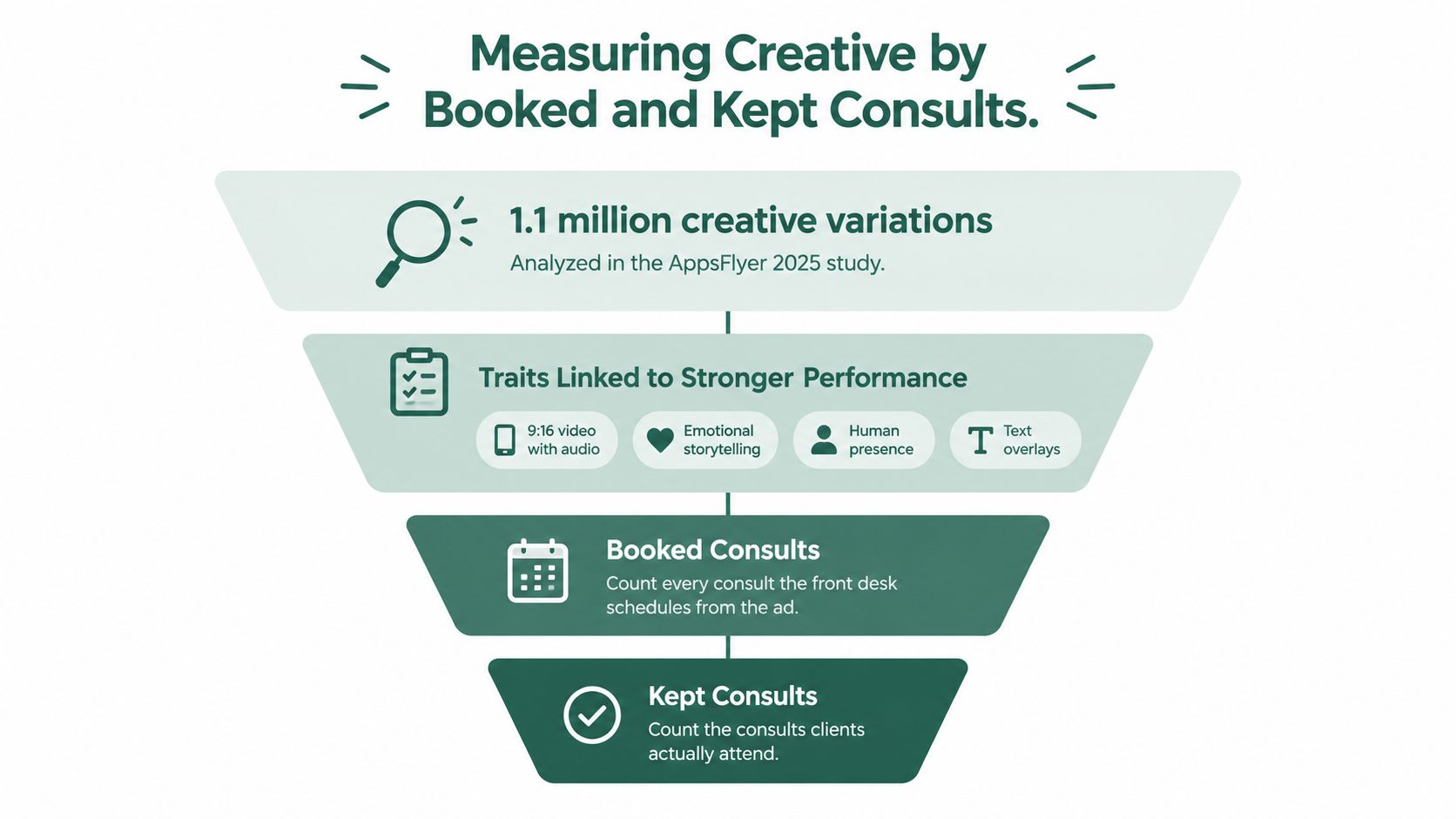
Use platform conversion for early signal, booked consultation for business relevance, and kept appointment or treatment start for the final judgment. That order prevents the cheapest form submission from becoming the automatic winner.
AppsFlyer's 2025 creative-optimization analysis examined 1.1 million creative variations and reported that combinations including 9:16 video with audio, emotional storytelling, human presence, and text overlays were associated, in Meta internal data, with 16% lower CPA and 29% higher conversion rate. Those are associations, not guaranteed results, and they don't establish the value of a local clinic's consultation.
Use the funnel to distinguish an advertising response from an attended appointment.
Read each metric for its actual purpose
Funnel metrics for judging creative concepts
| Stage | Metric | What It Tells You | Common Trap |
|---|---|---|---|
| Ad platform | Cost per link click | Interest in the hook | Rewards curiosity clicks that never book |
| Ad platform | Cost per qualified inquiry | Lead cost at acceptable quality | Counts unqualified forms as wins |
| Front desk | Speed to first reply | Whether leads can be served while interest is high | Ignored when voicemail is the only reply |
| Calendar | Booked consultation rate | Whether the concept moves people to act | Treats booking as success before attendance |
| Calendar | Show rate | Quality of intent behind the booking | Blamed on the creative when reminders are missing |
| Revenue | Cost per kept appointment | True acquisition cost by concept family | Slow to read, so teams stop tests too early |
Consider a hypothetical comparison, not a clinic benchmark. Concept A costs $40 per qualified inquiry and books 30% of those inquiries, giving a cost per booked consultation of about $133; concept B costs $55 per qualified inquiry and books 50%, giving a cost per booking of $110.
Concept B wins on booking cost despite its more expensive leads. Attendance could change the verdict again, which is why the CRM must connect inquiries, bookings, cancellations, and attended consultations.
Preserve the source through the booking
Store the treatment, campaign, concept family, and creative identifier with each inquiry in GoHighLevel or your existing CRM. Carry those fields into the appointment record, including when a patient calls after submitting a form.
A practical med spa lead generation system also records qualification, deposit completion where applicable, and eventual treatment revenue. Don't send sensitive patient details into advertising tools without appropriate privacy review.
Review leads and bookings weekly, then assess kept appointments and revenue monthly using cohorts with enough time to attend. Investigate delayed replies or missing reminders before blaming a concept for weak attendance.
Use the accompanying video alongside the funnel review.
Testing Creative Families Without Wasting Budget
Change the creative family while holding the audience, offer, landing page, and optimization event steady. Otherwise, you may credit the ad for an improvement caused by a better audience or easier booking page.
In North American campaigns, TikTok reports that using at least 10 unique creatives produced 2.6 times higher ad recall and 3 times higher purchase intent than campaigns using fewer than five. Those measures support diversification, but they aren't consultation-booking benchmarks.
Fund distinct ideas before extra versions
Start with a manageable set of different concepts and expand only when the budget can support meaningful delivery. An outcome-education video, a provider's explanation of eligibility, and a walkthrough of the consultation test different motivations.
A new headline on the same footage is an iteration. It can help refine a winning concept, but it doesn't provide the same learning as a different creative family.
- Define qualification first: Agree on service area, treatment interest, valid contact details, and the nonclinical criteria the front desk can assess.
- Set a spend boundary: Decide what the clinic can afford to spend learning about each family before launch.
- Compare equivalent periods: Allow for response delays, weekday differences, and appointment availability.
- Separate delivery from preference: An ad receiving little platform spend hasn't necessarily been rejected by patients.
Don't declare a family ineffective because the platform barely delivered it. Use a controlled split when you need a fair comparison.
Pause for a business reason
Pause immediately for misleading claims, broken forms, or an offer the clinic can't fulfill. For performance decisions, look for a persistent disadvantage in qualified inquiry cost and booking outcomes, not an isolated expensive day.
When setting up med spa Facebook ads, distinguish an exploratory campaign from a controlled experiment. Platform allocation can help find likely winners, but uneven exposure makes it harder to isolate why they won.
Keep a test log with the family, hypothesis, spend, qualified inquiries, inquiry cost, bookings, and unresolved limitations. Record operational changes too, including staff coverage or calendar restrictions, so the next decision doesn't depend on someone remembering what happened.
Spotting and Replacing Creative Fatigue
Refreshing ads because the calendar says it's time can retire useful creative and leave tired ads running too long. Watch what the audience and booking funnel are doing instead.
TikTok and System1 studied 8,000 users across the United States, United Kingdom, Germany, France, Italy, and Spain, including health and beauty advertising, while deliberately varying ad-frequency exposure to measure fatigue. That supports monitoring repeated exposure, not assuming every asset has the same lifespan.
Use a combined trigger
Look for rising frequency alongside weakening attention and business outcomes.
- Attention: Falling video completion or thumb-stop rate.
- Intent: Declining landing-page conversion.
- Booking economics: Increasing cost per booked consultation.
No isolated signal proves fatigue. Check tracking, site function, auction changes, and appointment availability before replacing the ad.
When the pattern is convincing, preserve the productive offer and audience while changing the dominant creative mechanism. Replace the opening frame, spokesperson, proof format, or objection addressed.
For example, replace a laser hair removal opener about shaving inconvenience with a provider explaining how skin-type screening works. Keep the offer and audience unchanged so you can interpret the result.
Replace the exhausted explanation before rebuilding the entire campaign.
Put frequency, video completion, landing-page conversion, and booking cost in a weekly view. Use controlled comparisons and CRM outcomes to distinguish a genuine creative improvement from auction movement or a temporary change in lead quality.
Launch Your First Treatment Creative Test
Start with the consultation slot, not the camera roll. Choose a treatment with a recognizable hesitation, workable margins, and real appointment availability. The best-looking service is a poor first test if the calendar is full or the front desk cannot respond quickly, because the ad then creates demand the booking system cannot capture.
Follow a single launch route
- Select the concern. Use actual questions from calls, messages, and consultations.
- Approve the concepts. Give production a short list with distinct hypotheses and proof the clinic can stand behind.
- Prepare the destination. Answer the advertised concern prominently and make the consultation request easy to complete.
- Test the response process. Submit a form, place a call, and send a text yourself. Confirm who responds and what happens outside staffed hours.
- Authorize the learning budget. Fund the comparison without pulling money from payroll, rent, inventory, or current patient care.
- Verify attribution. Confirm that a test inquiry retains its source through booking and attendance.
If tracking or follow-up is broken, fix it before spending. A cheaper click cannot rescue an inquiry no one answers, and a booked consult loses value if the CRM cannot show which creative produced it.
At the initial review, compare qualified inquiry cost, booking rate, show rate, and booking cost by family. Keep the concepts with credible downstream evidence, revise uncertain ones, and replace clear underperformers with a new hypothesis.
Launch one focused treatment test this month. Judge it by consultations booked and kept.
For implementation support, Med Spa Scalers offers treatment-focused Meta and Google advertising alongside CRM setup, AI reception, and structured follow-up. Request a free audit of your ad-to-appointment process through the Med Spa Scalers site to identify whether creative, response handling, or booking attribution needs attention first.
See how many patients you're leaving on the table
Get a free marketing audit of your ads, follow-up and booking flow. No pressure, just a clear picture.
Book a free marketing audit