How to Build a Lead Follow Up System for Med Spas
57.1% of first-call attempts happened more than a week after the lead arrived, according to a 2021 InsideSales analysis of more than 55 million sales activities involving 5.7 million inbound leads across over 400 companies. That's a follow-up problem, not a lead-generation problem.
For a med spa, the fix isn't an instant text alone. A lead follow up system needs a defined cadence, a person responsible for each inquiry, and rules that stop outreach when it's no longer appropriate. Speed opens the conversation. Relevant messages, sensible booking options, consent controls, and human judgment determine what happens next.
Table of Contents
Speed Targets Every Lead Follow-Up Must Hit
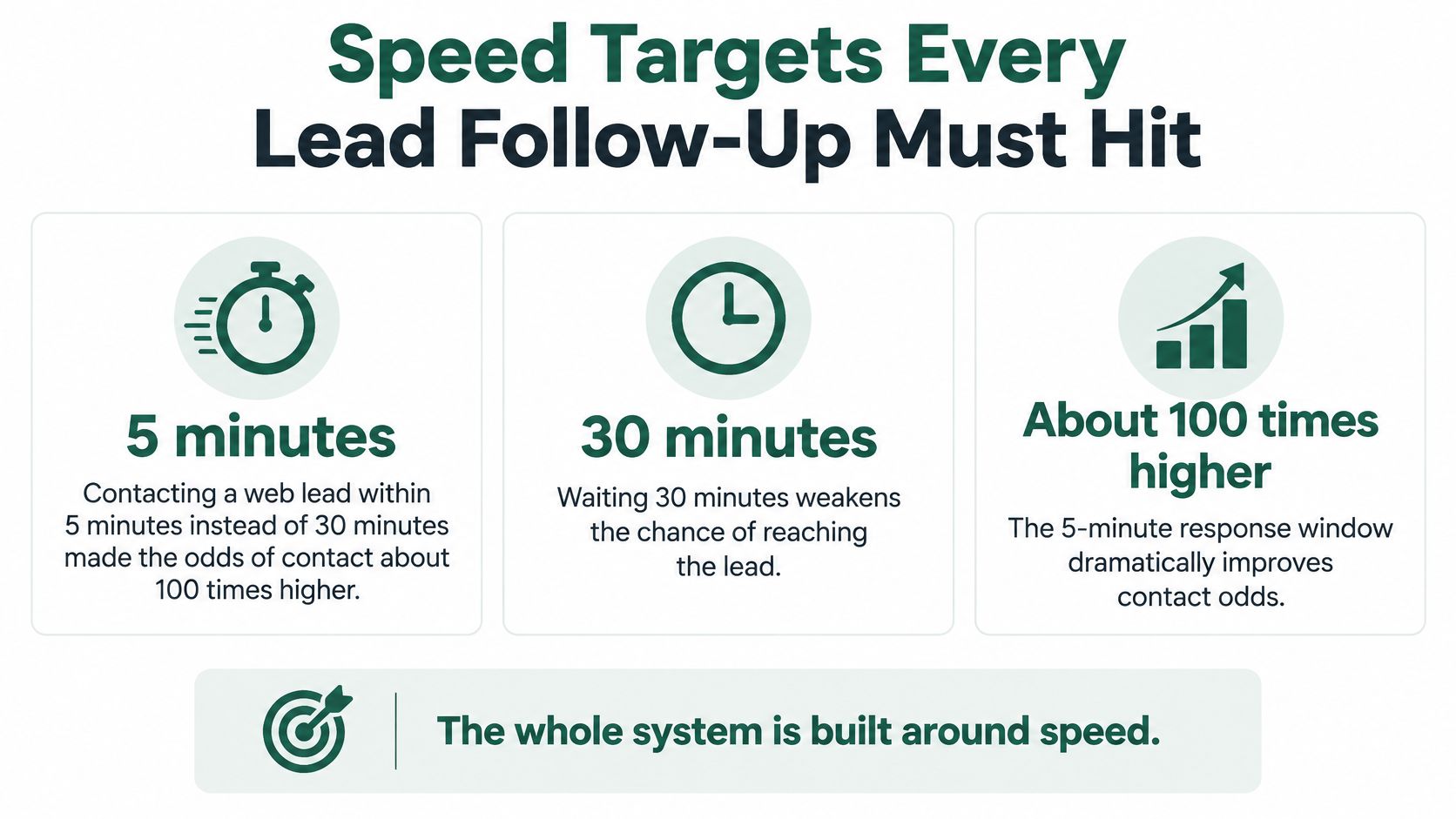
Attempting contact within 5 minutes rather than 30 minutes made successful-contact odds 100 times higher and qualification odds 21 times higher under the conditions of Dr. James Oldroyd's lead-response study. Those are relative odds from historical web-lead research, not proof of a guaranteed increase in med spa sales.
Use the findings to set an operating standard, not a revenue promise. An acknowledgment tells someone their inquiry arrived. A call or two-way conversation moves the inquiry toward a decision.
Response speed benchmarks for inbound leads
| Stage | Benchmark | Evidence |
|---|---|---|
| First automated reply | Under 60 seconds | Our median first reply was 47 seconds in months 4 to 6 with the full system running |
| First call attempt | Within the rapid-response window above | Oldroyd's findings support prioritizing immediate contact |
| Same-day follow-up if no contact | Same business day | Operating rule: change the time block instead of immediately redialing |
| Share of leads given any response | Every valid, contactable inquiry | In a Conversica audit summarized by Reploom, 25% of 100 mid-market and enterprise companies never responded |
| Time to first call attempt in typical practice | Before the next business day as an internal ceiling, not the preferred target | The InsideSales analysis cited above documents substantial delays |
| Point to stop repetitive dialing | End repeated dialing when the planned call sequence ends | Switch to permission-based follow-up rather than an indefinite dial queue |
The targets below distinguish an immediate acknowledgment from meaningful follow-through.
Find the failure before changing the ads
Our med spa speed-to-lead study examines response time and bookings. At the desk, keep automated reply time separate from live contact time so a fast bot doesn't conceal an unattended queue.
Practical rule: Find the benchmark your clinic misses most. Fix that handoff before adding another campaign.
A clinic that acknowledges immediately but never calls has a different problem from one whose forms never reach the CRM. Don't buy the same solution for both.
How to Set Up First Response in Four Steps
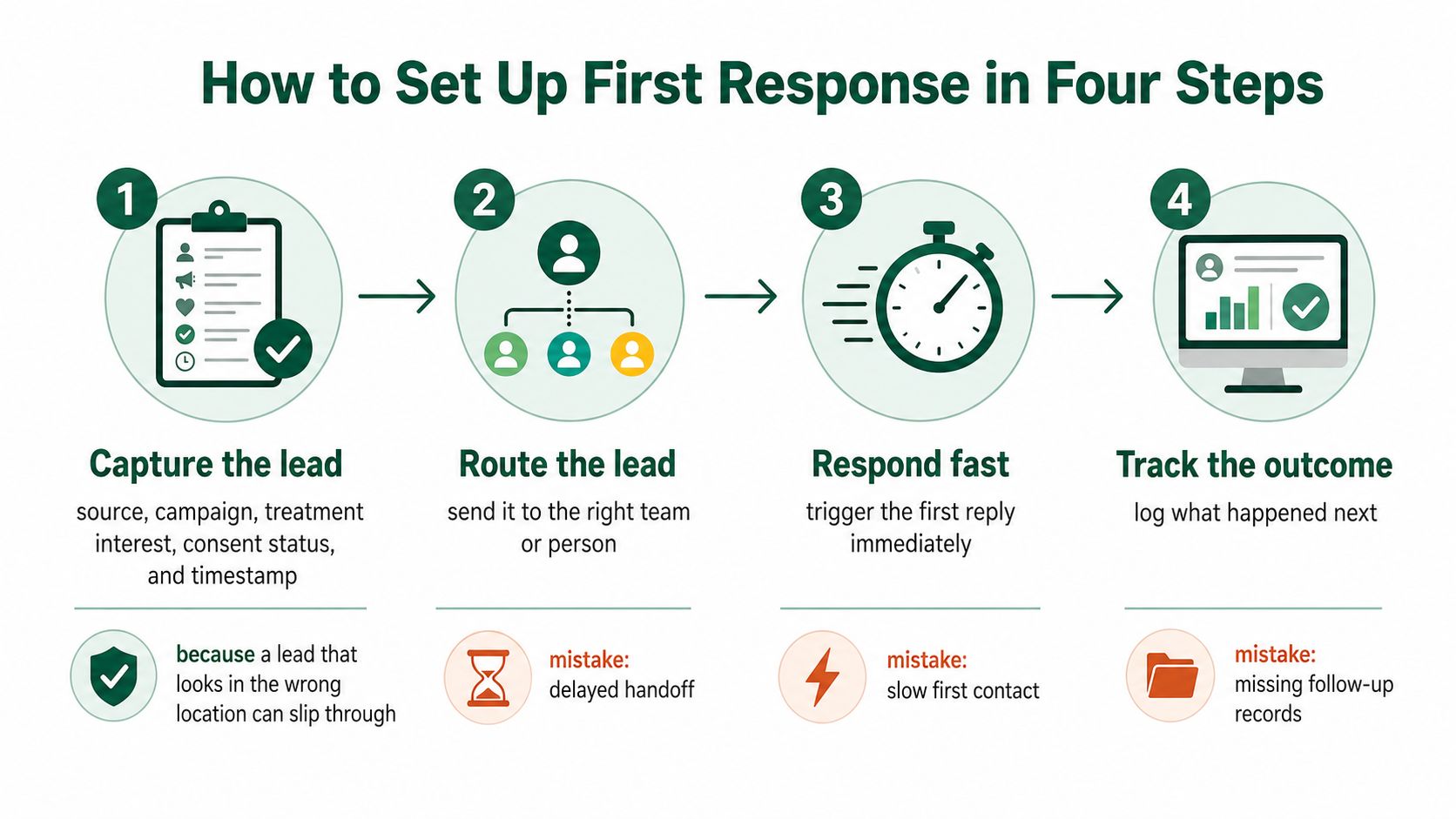
Build the workflow around a record that staff can act on, not an email notification they might notice. The InsideSales lead-response analysis supports a call-attempt target within 60 seconds as part of the practical workflow described here. Treat that as an operating target, not a guarantee that someone will answer.
Configure the first-response workflow
Capture the lead and its context. Require source, campaign, treatment interest, consent status, and submission timestamp in the CRM. Don't overwrite the original source when someone returns through another channel, or you'll lose the acquisition history.
Trigger the acknowledgment and assign a task together. Send a confirmation text only when the contact permissions support it, and create an owned CRM task at the same time. A shared inbox alone isn't an assignment, especially while the desk is checking patients in.
Route the call to someone available. Ring the on-duty front desk first, with an explicit fallback to a trained backup or appropriately scoped AI receptionist. Routing everything to a general mailbox creates the appearance of coverage without an accountable responder.
Give an unanswered call a useful next action. Leave a concise voicemail and follow with a permitted text offering a choice of appointment windows. Specific options reduce scheduling work for the prospect, but don't invent availability or imply that a consultation establishes treatment eligibility. Our missed call text back page shows the open-hours and after-hours wording we use.
The sequence should preserve context through every handoff.
Test the closed-desk scenario
Say a lip filler consultation inquiry arrives on Friday evening after reception closes. A permitted automated acknowledgment can explain that the desk is closed and offer available consultation windows that night. If staff return at 9 a.m. in this scenario, queue the first live call for reopening rather than letting the inquiry disappear into the weekend inbox.
Don't claim someone will call shortly when nobody is scheduled. If automated scheduling is available, make clear whether the appointment is confirmed or still awaiting staff approval.
Before launch, check the actual tools:
- CRM fields: Make lead source mandatory and preserve the original submission timestamp.
- Two-way SMS: Verify that STOP replies trigger suppression, not merely an inbox alert.
- Call routing: Test the on-duty desk, backup route, and closed-hours behavior.
- Shared dashboard: Display the timestamp, logged attempt, owner, and booked or pending status.
- Calendar integration: Confirm that offered slots match real provider and consultation availability.
Submit test inquiries through each active form and channel. A working dashboard should show what happened and who acts next, without requiring the manager to reconstruct the conversation from separate apps.
Consent Rules for Reminders and Marketing Texts
An appointment reminder and a cosmetic-treatment promotion aren't interchangeable. For U.S. practices, reminders are generally informational, while promotional messages generally require prior express written consent, as explained in Medical Economics' guide to patient texting. The applicable requirements still depend on the message, technology, and circumstances.
A phone number in the CRM isn't blanket permission to send every campaign. Someone asking about appointment availability hasn't necessarily agreed to unrelated treatment offers.
Separate permission from contact information
Create distinct consent fields and campaign eligibility rules for reminders, inquiry nurturing, reactivation, and offers. Store the actual consent wording, timestamp, phone number, capture method, and intended sending purpose. A checkbox labeled consent, without its wording or history, leaves staff guessing.
Keep message templates minimal. Avoid unnecessary treatment details or other protected health information in a text that someone else might see on a lock screen.
The switch point is easy to miss. A Botox appointment reminder that adds a discounted laser package now includes a promotional purpose. Don't let a copy edit move an operational message into an advertising campaign.
Permission belongs to the message's purpose, not just to the contact record.
Process STOP replies immediately and propagate suppression across connected workflows. Don't let a reactivation upload restart outreach to someone who already opted out. Blurring care coordination with advertising can also create carrier-filtering problems and patient distrust.
Questions for healthcare counsel
Before launch, take these questions to a healthcare attorney:
- Message classification: Which templates are informational, and which count as marketing under the rules applicable to our practice?
- Consent evidence: Does our capture language authorize the specific channels, automation, and purposes we intend to use?
- Suppression handling: How should opt-outs, resubscriptions, and requests for essential appointment communication be handled across our systems?
This is planning guidance, not legal advice. Have counsel review the forms and message templates, not just a diagram of the workflow.
Follow-Up Cadence for Leads Who Do Not Answer
Follow-up cadence after the first attempt
Use this as a pilot schedule, not a proven optimum. Apply the lead's local time, contact preferences, and consent eligibility before releasing any touch.
| Touch | Timing | Channel | Content | Stop when |
|---|---|---|---|---|
| Touch 2 | Same day, late afternoon, if different from the original call block | Call | Second attempt with a choice of consultation times | Booked, opted out, invalid number, or callback requested |
| Touch 3 | Same evening, within permitted sending hours | Text | Brief education tied to the requested service | Booked, opted out, or no applicable permission |
| Touch 4 | Next business day, mid-morning | Call | Clarify the inquiry and confirm a suitable window | Booked or lead asks to be called later |
| Touch 5 | Day 3 to 5 | Text or email | Simple reminder with a direct booking link | Booked or no response to this touch; end active pursuit |
| Touch 6 | Second week, as a separate eligible campaign | Reactivation or offer only where marketing permission allows | Booked, opted out, or ineligible for marketing |
Change the time block, not just the wording
The MIT/InsideSales lead-response findings identified 4–6 p.m. as the strongest contact period and reported that Wednesday and Thursday performed about 49.7% better than the weakest days for contact. The same findings warn that additional dialing after 20 hours can reduce contact and qualification effectiveness.
Those historical patterns don't justify waiting to answer a fresh inquiry. They're useful for choosing a different retry window, not postponing the first attempt. Nor does the dialing finding mean all communication must end at that point.
For treatment education, explain the consultation process rather than trying to close a clinical decision by text. A laser inquiry might receive a short explanation that the clinician will assess suitability and discuss expectations. Avoid promising outcomes or deciding candidacy remotely.
Make the stop rules executable
Booking stops acquisition follow-up. Opt-outs stop the relevant messaging. Invalid numbers leave the dial queue, and a request to call later replaces the default cadence with the requested callback.
A reply should also pause automated pursuit while staff handle the conversation. Otherwise, someone can receive a generic reminder while actively discussing availability with reception.
Configure these conditions in the med spa CRM workflow, not in a receptionist's memory. Log every attempt, including voicemail, failed delivery, reply, and reschedule request.
Persistence means following a plan. It doesn't mean continuing until someone complains.
Once booked, move the person into confirmation and reminder messaging. For a pilot, a clinic could test an immediate confirmation plus reminders 48 hours and 2 hours before the appointment, adjusting for booking notice and patient preferences.
Compare contact, booking, and attendance by source, treatment, and first-contact channel. A text-first group may behave differently from a call-first group. Blending them can hide which sequence needs changing.
When AI Should Hand Off to a Human
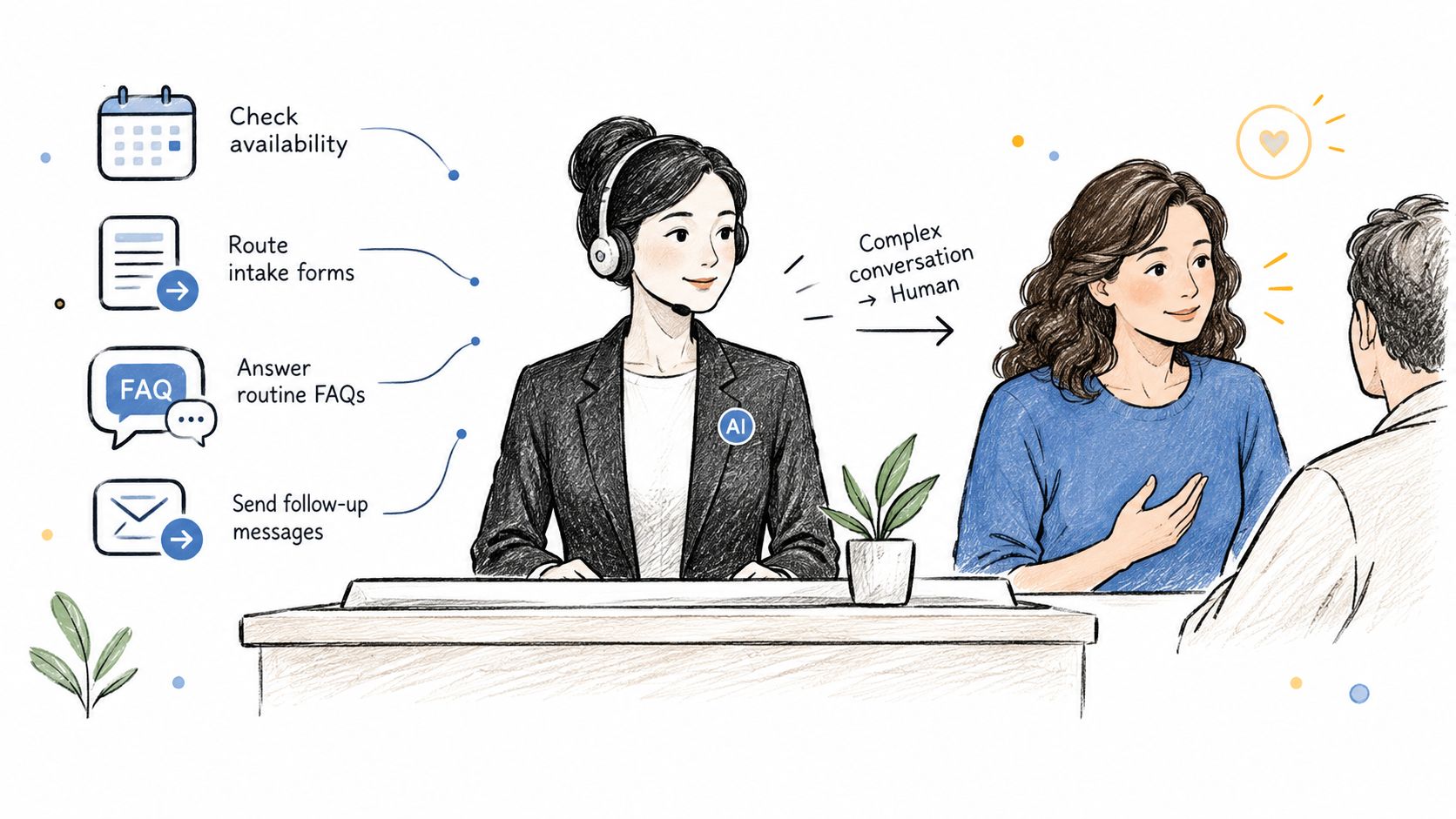
Give AI a narrow job with a clear exit. Availability checks, intake routing, approved administrative FAQs, and confirmations fit that job. Clinical judgment and sensitive exceptions don't.
Keep the administrative role distinct from the person responsible for decisions.
Consumer findings reported by the Cove Leader-Press found that 64% questioned the accuracy of AI-generated answers and 40% expressed privacy concerns. Don't assume a smooth conversational tone resolves either concern.
Define the transfer triggers
- Clinical suitability: Contraindications, medication use, pregnancy, and questions about whether treatment is safe.
- Complications: Symptoms or concerns after previous treatment, routed through the practice's clinical escalation protocol.
- Financial exceptions: Financing questions, disputed charges, or requests outside approved administrative answers.
- Expectations: Requests for guaranteed results or outcomes the system can't responsibly assess.
The system should identify itself as automated and make a human option easy to reach. Transfer the conversation summary and original question so the prospect doesn't have to start again.
Use this video alongside a review of your own escalation workflow.
Our AI receptionist for med spa overview is a starting point for defining administrative coverage. In months 4 to 6 with the full system running, 4% of inbound calls went unanswered. Coverage still needs measurement, even with automation in place.
Track unanswered questions, completed transfers, opt-outs, and kept appointments. A transfer request isn't a successful handoff until the right person receives it.
Automation handles the queue. People handle the judgment.
Metrics That Show Consults Are Being Booked
Follow-up metrics, formulas and reference values
| Metric | How to calculate | Reference value | Review |
|---|---|---|---|
| Median first reply | Median elapsed time from creation to first touch | Compare with your established response target | Daily |
| Contact rate | Unique leads reached ÷ unique leads worked | Establish a baseline by source and channel | Weekly |
| Booked-consult rate | Leads booking a consult ÷ leads | 34% across our tracked work in months 4 to 6; 37% in the single-clinic case below | Monthly |
| Unanswered inbound calls | Unanswered calls ÷ inbound calls | Compare by staffed and closed hours | Weekly |
| Show rate | Kept consults ÷ booked consults | Establish a treatment-specific baseline | Monthly |
| Cost per new patient | Ad spend ÷ new patients | $108 in the single-clinic case below | Monthly |
| Opt-outs per 100 messages | Opt-outs ÷ messages sent, multiplied by 100 | Compare by campaign purpose | Weekly |
Read company results in context
At Lumière Aesthetics, an injectables clinic in Scottsdale, Arizona, adding instant SMS follow-up, self-booking, three-step reminders, and review requests produced a 38-second reply time alongside the booking and acquisition-cost results listed above. These are company and single-clinic results, not guarantees.
That clinic changed several parts of the workflow together. You can't responsibly attribute the result to reply speed alone. Use the example to identify components worth testing, not to forecast your own patient count.
Review exceptions, not just averages
Review speed and unanswered calls weekly, with daily visibility into stalled inquiries. Review booking, attendance, and acquisition cost monthly. Keep the denominator consistent, especially when duplicate inquiries or rescheduled appointments enter the report.
A rising booked rate with a flat show rate deserves investigation. Staff may be pushing unsuitable times, or prospects may not understand the consultation commitment. Listen to booking conversations before rewarding appointment volume.
Our monthly reporting covers leads, booked consults, cost per booking, changes made, and next steps. Ads, follow-up, and reactivation run monthly, but the report should make clear which adjustment you're evaluating.
A booking is an intermediate outcome. A kept consultation tells you whether the booking process worked for the patient.
Confirm Your Pilot Before Scaling Ad Spend
Run a small audit this week. For a practical sample, pull the last month of inbound inquiries and compare first-reply timestamps with your response targets. Separate automated acknowledgments from actual conversations.
Inspect the consent wording attached to the first message. Then trace quiet leads through their last completed touch, next scheduled action, and current owner. You're looking for broken transitions, not just slow averages.
Make the next investment match the problem
- Replies are slow: Repair routing, staffing coverage, or notification failures before buying more traffic.
- Replies are fast but bookings are weak: Review the offer, landing page, consultation availability, and booking flow.
- Bookings rise but attendance doesn't: Check expectations, confirmation delivery, and rescheduling options.
- Messages continue after closure: Fix suppression before expanding the sequence.
You can run this check internally or use our free marketing audit. We review follow-up speed and consistency, ads, offers, landing pages, booking flow, and the patient list.
We don't guarantee a specific number of patients because results depend on the market, offers, and team. Our commitment is fast follow-up on every lead, clear reporting on booked consults, and continuous improvement month to month.
Med Spa Scalers offers a free marketing audit to identify where inquiries stall between the ad, first response, and appointment. Visit Med Spa Scalers to request a review of your follow-up cadence, booking flow, and current marketing before increasing ad spend.
See how many patients you're leaving on the table
Get a free marketing audit of your ads, follow-up and booking flow. No pressure, just a clear picture.
Book a free marketing audit