Medical Spa Digital Marketing: Channels That Book Patients

89% of patients surveyed by Experian Health in 2024 said the ability to schedule appointments anytime using digital tools was important, according to Experian Health findings reported by MGMA. That expectation changes what medical spa digital marketing has to do. A campaign doesn't end when someone clicks an ad, reads a treatment page, or sends a DM. It ends when that person can book a consultation quickly, attends it, and comes back for the next treatment at the right time.
I treat response speed and repeat visits as channels in their own right. They're measurable, they're fixable, and they decide whether expensive traffic becomes revenue or disappears to the clinic down the street that replied first. The work also has to stay inside HIPAA and FTC limits, because a tracking setup that leaks treatment information or an ad that promises more than the evidence supports creates risk that no lead volume justifies.
Table of Contents
Which Channels Bring in Medical Spa Patients
Medical spa marketing has three jobs. Get found by people who already want a treatment, create demand among people who don't know you yet, and turn both groups, plus your existing patients, into booked and attended consultations. Search catches people already looking, social creates demand among people who aren't looking yet, and follow-up turns both into booked consults.
Medical Spa Marketing Channels by Job
| Channel | Main Job | Best Fit | Metric That Matters |
|---|---|---|---|
| Google Search ads | Capture people already searching for a treatment | Injectables, lasers, body contouring | Cost per booked consult |
| Meta ads (Facebook and Instagram) | Create demand and retarget site visitors | New treatments, memberships, launch offers | Cost per booked consult and show rate |
| Local SEO and Google Maps | Earn free visibility for treatment and location searches | Neighborhood demand and near me searches | Calls, direction taps and organic bookings |
| Social content and DMs | Build trust and turn comments into conversations | Education, provider credibility, compliant before-and-after | DM-to-consult rate |
| YouTube | Explain treatments in depth before a consult | Treatment explainers and provider introductions | Form submissions from video viewers |
| SMS and email follow-up | Move inquiries to booked consults and rebook patients | Every lead and every existing patient | Reply time, booked rate and rebook rate |
| Reviews | Confirm trust at the decision point | Comparison shoppers choosing between clinics | New reviews per month and average rating |
Read the table as a map, not a ranking. Google Search works when intent exists. A patient typing a treatment plus your city wants price context, proof of provider skill, and a fast way to book. Meta works in the opposite direction. You're interrupting a feed, so creative has to earn attention, explain the result clearly, and give a low-friction next step.
Local SEO and reviews do the quiet work between those two. They determine whether a patient who compares three clinics trusts yours enough to call. Social content and YouTube build familiarity over weeks, which matters because aesthetic purchases are personal and researched like medical decisions. None of that demand matters if follow-up is slow. SMS and email carry the conversation from inquiry to appointment, and later from first treatment to maintenance visit.
Practical rule: A clinic with strong reviews and a slow front desk will get more from fixing follow-up than from launching another ad campaign.
Don't try to run all seven channels well at once. Look at where inquiries drop out. If calls arrive but don't convert, fix follow-up. If the calendar is empty and nobody finds you on Maps, fix local presence first. Pick the two weakest points, fix those, then add budget elsewhere. I would rather see two channels measured to booked consultations than seven channels reported in impressions.
Repeat Visits and Compliant Measurement
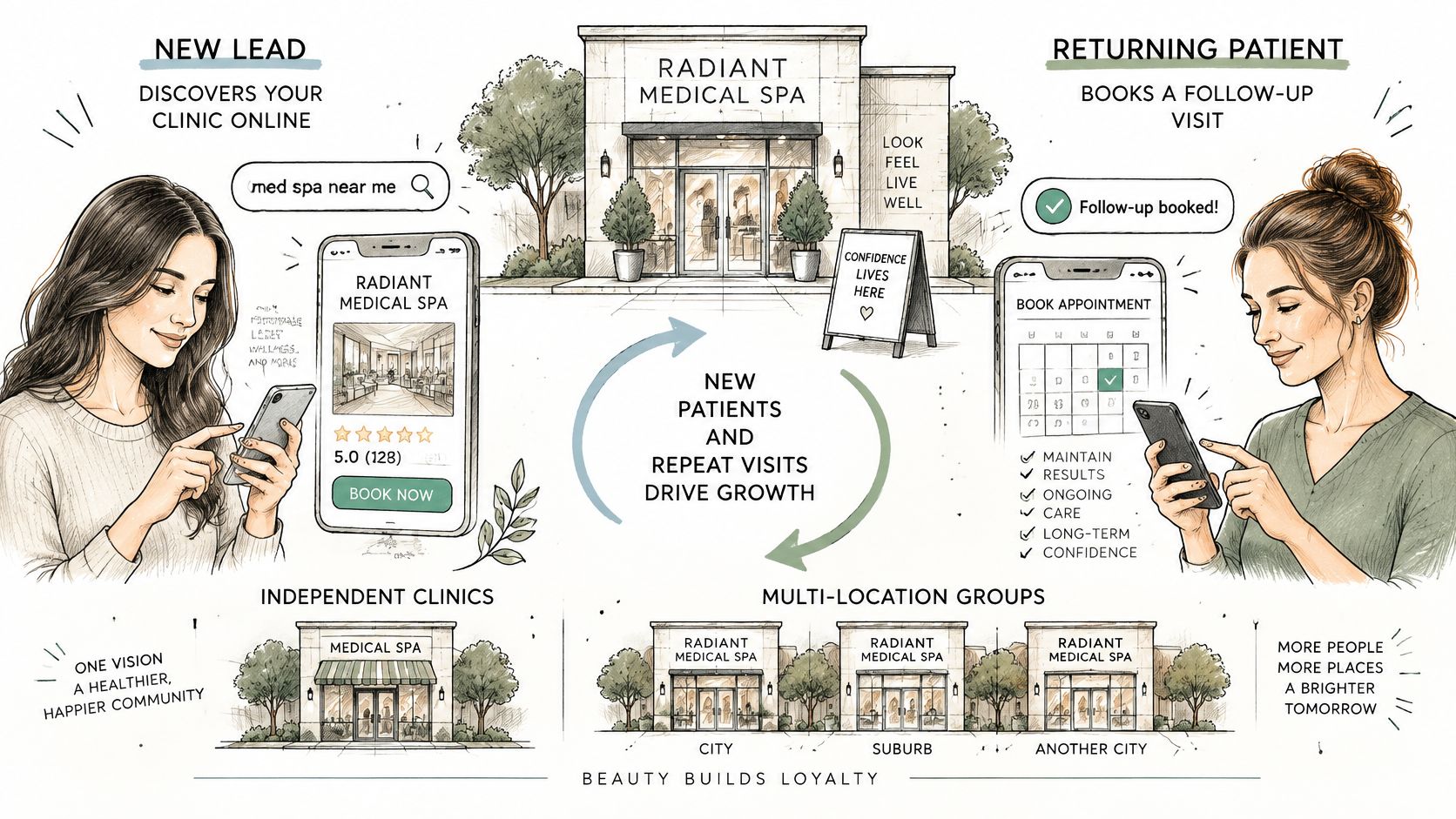
The retention math is why I measure marketing past the first booking. The American Med Spa Association's 2024 industry reporting found that patients spend an average of $527 per visit, and 73% of patients are repeat patients. A Botox patient who never rebooks isn't one lost sale. It's a full dining room that never fills its return bookings, recurring revenue walking out after the first sitting.
Competition makes that math urgent. That same reporting counted medical spa locations rising from 8,899 in 2022 to 10,488 in 2023, with 81% of medical spas being single-location businesses and multi-location operators averaging nine locations. An independent clinic needs locally targeted search, lead capture, and automated follow-up to hold its ground. A group needs centralized attribution and location-level booking data so one strong site doesn't hide three weak ones. Both need the same four numbers: booked consultations, attended appointments, repeat visits, and revenue per patient.
Funnel Metrics and Where to Get Them
| Funnel Stage | Metric | Where to Get It |
|---|---|---|
| Click or call | Cost per click and call volume | Ad platform and call tracking |
| Inquiry | Cost per qualified inquiry | Form and CRM records |
| Reply | Median response time and share contacted within five minutes | CRM timestamps |
| Booking | Cost per booked consultation | CRM booking events |
| Attendance | Show rate | Scheduling system |
| Revenue | Revenue per patient and repeat visit rate | Aggregated point-of-sale totals |
Each stage answers a different question. Cost per click tells you what attention costs. Cost per booked consultation tells you whether attention was worth buying. Show rate tells you whether reminders and deposits are working. Repeat visit rate tells you whether the treatment plan and recall timing are working. Reporting impressions without the later stages lets a bad funnel hide behind busy dashboards.
Measure Without Creating Privacy Exposure
Set the compliance rules before any tracking goes live. HHS guidance on the use of online tracking technologies states that HIPAA obligations apply when online-tracking data collected or disclosed to third parties includes protected health information, and regulated entities may not use tracking technologies in ways that create impermissible disclosures. A treatment-page visit, intake form, call event, or URL carrying condition or treatment details can require a documented privacy analysis before you deploy a standard advertising pixel.
Keep the architecture boring on purpose.
- Strip treatment details from URLs and event parameters. Send a generic booked event, not a string that names a condition or procedure.
- Minimize what ad platforms receive. Reconcile platform aggregates with first-party CRM records using consent-aware server-side or offline conversion processes.
- Document every vendor and its purpose. Record who can access call recordings, SMS logs, CRM automations, and retargeting audiences, plus how long each record is kept.
- Check the paperwork before disclosure. Verify whether a business associate agreement or patient authorization is required, and don't assume a marketing tool qualifies because it markets itself as healthcare friendly.
Separate marketing data from treatment data. Your monthly report needs cost per qualified inquiry, booked consultation, kept appointment, and revenue, using the minimum necessary information. It does not need exported clinical detail to make a budget decision.
More tracking isn't better. An aggressive attribution stack can increase regulatory and reputational risk while producing false precision, numbers that look exact to three decimals and are wrong in ways you can't see. Claims discipline works the same way. FTC business guidance on advertising and marketing requires health-related advertising claims to be truthful, nonmisleading, and supported by evidence before publication. If an unsupported promise generates cheap inquiries, your attribution report will reward it. Build the claim review into campaign approval so cost per booked consult never becomes an incentive to overpromise.
A lead without a reply is wasted ad spend.
We measure our work by booked consults and cost per booking, and that only stays credible if the funnel behind it is compliant. Fix the measurement rules first, then optimize. Reversing the order means rebuilding dashboards later, usually after someone asks a hard question about a pixel.
Running Paid Ads for High-Value Treatments
Google and Meta do different jobs, and mixing them up wastes money. Google Search captures people with a treatment already in mind. Meta builds demand and brings back site visitors who left without booking. I run Google when consultation slots need filling now and Meta when a treatment needs an audience before search demand exists, such as a launch, a membership, or a body contouring program patients don't yet search for by name.
This comparison shows how the two platforms divide that work.

Set Up Each Campaign in Five Steps
- Pick one high-value treatment per campaign. Injectables, lasers, body contouring, or a weight-loss membership, one per build. One treatment means one message, one page, and one cost per booked consult you can judge clearly. Bundling treatments into one campaign blurs which one earns its spend.
- Build a dedicated landing page. Name the treatment, show provider credentials, explain candidacy in plain language, set expectation and pricing context where you can, and offer one booking action. Sending every treatment to a generic homepage is the most common mistake I see owners make. It lowers relevance, forces patients to hunt, and inflates cost per click because the page doesn't match what the ad promised.
- Set the conversion event to a booked consultation. Not a form view, not a button click. Optimizing toward shallow events trains the platform to find people who browse, not people who book, and it has to respect the data minimization rules your measurement setup already defined.
- Add call tracking. Plenty of high-value patients, especially for injectables and lasers, still phone before they commit. Without call tracking tied to the campaign, you'll kill ad groups that are producing phone bookings and keep ad groups that only produce form fills nobody answers.
- Review after two to four weeks, then cut before you raise. Pause ad groups with a high cost per booked consult. Move budget only to treatments that book and show. Scaling before the cut step just makes the waste bigger.
Judge Ads by Bookings Not Leads
Cost per booked consult beats cost per lead because cheap inquiries can be the most expensive thing in your funnel. Say a campaign produces inquiries at a low cost, but most never answer a call, never book, or book and don't show. Your front desk burns time, your provider's slot sits empty, and the true cost per treated patient climbs past the campaign you almost paused for looking pricey. Cost per lead hides all of that. Cost per booked consult, paired with show rate, exposes it.
Watch for two leaks that disguise themselves as ad problems. The first is a landing page that converts on desktop and fails on a phone, where most patients will land. Test the booking action on your own phone before launch, every time. The second is lead handling. An ad that delivers inquiries at 7 p.m. into an inbox nobody checks until morning isn't underperforming. Your follow-up is.
Plan budgets from your own economics, not a benchmark. Available provider capacity, treatment margin, and how long patients stay on a treatment plan decide what a booked consult is worth to you. A clinic with a waiting list for one injector and empty laser slots should push budget to laser, even if injectable leads look cheaper. Our breakdown of how med spa PPC campaigns are structured around booked consultations covers the account build in more detail.
Local SEO, Google Maps and AI Search Answers
Most owners assume more visibility is always better. I don't. Visibility that misstates your treatments, overpromises results, or sends unsuitable patients to your front desk costs consultation time and can create compliance problems. Local SEO still matters enormously. It just has to produce accurate referrals, not maximum noise.
Start with your Google Business Profile. Use correct categories, list each treatment as a service, keep hours exact, add real photos of the space and team, and answer every review in public, including the unhappy ones, calmly and without confirming anything about the reviewer's treatment. A profile that's thin or inconsistent with your website gives both Google and patients a reason to pick the clinic that looks more established.
Then build one page per core treatment. Name the provider who performs it. Explain who it's for, who should wait, what risks and downtime look like, and what happens during a consultation. Put location details naturally in the copy. One focused page can rank for a treatment search in your city. A single services page listing twelve treatments can't rank for twelve searches, and it gives AI systems nothing specific to quote.
What AI Answers Change
Patients now read AI-generated summaries before they click anything, and those summaries can get your treatments, provider qualifications, pricing context, candidacy criteria, or location wrong. Cardinal Digital Marketing's Healthcare Marketing Trends 2026 report says FTC guidance requires objective health claims to have adequate substantiation before dissemination, including claims implied by advertising context. If an AI answer repeats an overstatement sourced from your own page, that's your substantiation problem, not the tool's.
Run a monthly check that takes about an hour.
- Ask patient-style questions. Which clinics near your city offer each treatment, what should someone ask at a consultation, who's a good candidate.
- Record the answers. Note factual errors about your providers, treatments, pricing context, or location in a simple log with the date.
- Correct at the source. Update the treatment page, FAQ, or business profile where the wrong information likely came from. You can't edit the AI answer, but you can fix the material it pulls from.
- Measure quality, not presence. Track qualified inquiries, consultation bookings, show rates, and how often patients arrive with expectations that don't match clinical eligibility.
That last metric, the mismatch rate, is the one nobody reports and everybody feels. If AI answers claim a laser treatment has no downtime and your consults fill with patients unwilling to accept recovery time, visibility hurt you. Fewer, more accurate referrals beat broad visibility that produces low-quality leads. Ask new patients how they found you, and log AI referrals the same way you'd log a Google Maps call, so the trend is visible rather than anecdotal.
Med spa SEO works to rank a med spa's treatments in local search and Google Maps, and the same clear pages serve human readers, Map listings, and AI summaries. If you want a structured starting point, our local SEO audit walkthrough for med spas lists the fields and pages to check first. Fix accuracy before chasing extra mentions.
Social Media Content That Turns Followers into Consults
The audience is already there. Pew Research Center's social media fact sheet, from a survey of 5,626 U.S. adults conducted from February 1 through June 10, 2024, found that 85% of adults use YouTube, 70% use Facebook, and 50% use Instagram. Pew also reported that 74% of adults under 30 use at least five of the platforms measured. Younger patients don't discover you in one place. They cross-check you in several, which is why your Instagram, Google profile, and website need to tell the same story.
Give each content type a job. Short vertical video earns awareness and shows the treatment experience. Provider-led education builds trust and answers the questions patients are too embarrassed to ask in person. Testimonials work when you hold written consent for that exact use. Before-and-after images belong only where platform rules, state rules, and your consent all allow them, with context that doesn't imply one patient's outcome applies to everyone.
From Comment to Consult
Say someone comments on a reel asking about lip filler. The reply isn't a price quote. It's a question about the result they want and whether they've had filler before, followed by an offer of a consultation slot. That conversation moves to DM, where your team qualifies basic fit, avoids medical advice, and sends the booking link. Once they engage, move the conversation to SMS with permission, so reminders and rescheduling don't depend on an app notification.
That workflow only works if someone owns the inbox, including evenings. A DM left for a day reads as indifference, and the patient books with the clinic that answered. We help med spas turn Instagram and Facebook DMs into consults through med spa social media marketing, and the discipline is the same as any inquiry: reply within minutes, ask one useful question, give one clear booking step.
Keep claims general in DMs and route medical questions to the provider. A DM is a sales conversation with health implications, and screenshots travel. Post three to five pieces a week across two platforms you can sustain, and review monthly by consults booked, not likes. If a content format gets saves but never starts conversations, it's decoration. Keep the formats that start conversations.
How to Set Up Speed-to-Lead Follow-Up
Response time is the most measurable revenue variable in medical spa digital marketing. Vida's summary of the speed-to-lead audit reports that in an audit of 2,241 U.S. companies, only 37% of businesses responding to web inquiries replied within one hour. Organizations contacting a lead within that hour were nearly seven times more likely to qualify the lead than those waiting an additional hour. Our first Med Spa Scalers study looks at how response time affects med spa bookings across 186,400 leads, and the direction of that finding is exactly why I fix follow-up before I touch ad budgets.
This flow shows the sequence I build for every inquiry source, ads, organic, DMs, and missed calls alike.

The Seven Step Routine
- Send an automated SMS the moment an inquiry lands. Trigger it on form submission or missed call, but only to contacts who gave SMS consent. The message confirms receipt, names a real person who will follow up, and sets timing. The common slip is a missed call with no automatic text, so a patient who called during a treatment hears nothing and dials the next clinic.
- Create the CRM record and assign a named owner. The record needs source, treatment interest, and a call task due within five minutes. A shared inbox with no owner means everyone assumes someone else replied. Named ownership is the entire fix.
- Put a self-booking link in the first message. Patients who inquire outside business hours shouldn't wait for a callback to do something they've already decided. Let them grab a consult slot, and let the front desk confirm details when the clinic opens.
- Stop promotional messages once a consult is booked. Continuing to pitch someone who's already booked erodes trust and drives opt-outs. Switch the workflow to confirmation mode the moment the booking event fires.
- Run a three-step reminder sequence. Confirmation at booking, a reminder before the appointment, and a same-day nudge with parking and arrival details. The common slip is reminding a patient who already cancelled. Check that cancellation excludes people from the sequence.
- Start no-show recovery the same day. A polite message with two or three concrete reschedule options beats silence. Same-day contact recovers people who got busy. A message three days later recovers almost nobody.
- Ask for a review after treatment. Send it while the experience is fresh, make it one tap, and never condition the request on the review being positive.
This short video walks through how the follow-up sequence looks from the patient's phone.
After Lumière Aesthetics, an injectables clinic in Scottsdale, AZ, added instant SMS follow-up, self-booking, three-step reminders, and review requests, reply time was 38 seconds, booked rate was 37%, and cost per new patient was $108. Treat that as one clinic's documented outcome, not a promise for your market. It shows what's mechanically possible when the routine runs without gaps.
Track median response time, share contacted within five minutes, contact rate, booking rate, and show rate next to paid-media results every week. If cost per booked consult rises while response time slows, you don't have an ads problem. Our guide to building a lead follow-up system for med spas covers the CRM build behind these steps.
Fix Response Time Before Buying More Traffic
Fix reply speed and follow-up before adding ad spend. More traffic into a slow funnel doesn't produce more patients. It produces more people who inquired, waited, and booked somewhere else, at a higher total cost.
Build Your 30 Day Baseline
- Export the last 30 days of inquiries with timestamps. Include calls, forms, and DMs, not just ad leads.
- Calculate median reply time and the share contacted within five minutes. Use the median, not the average, so one terrible weekend doesn't distort the picture.
- Count booked consults per inquiry and the show rate. This is your current conversion truth.
- Compare cost per booked consult across treatments. Use booked consults, not leads, as the denominator.
- Run the speed-to-lead routine and hold response times steady for two weeks. One good week isn't a system.
- Only then raise budget on the treatment with the lowest cost per booked consult. If reply times are still slow, keep budget flat and fix the front desk first.
The free marketing audit reviews a med spa's ads, follow-up speed, booking flow, and patient list, and shows where bookings are slipping through. That audit is useful because it starts from your baseline, not a benchmark from another market. We don't guarantee a specific number of patients, because results depend on the market, offers, and team. We commit to fast follow-up on every lead, clear reporting on booked consults, and continuous improvement month to month.
Check one metric next week: median reply time for new inquiries. Everything else in your marketing gets easier to judge once that number is small and stable.
If your ads generate inquiries your front desk can't answer fast enough, Med Spa Scalers builds the follow-up, booking, and reactivation system that turns those inquiries into attended consultations, then measures it by booked consults and cost per booking. Visit Med Spa Scalers to request the free marketing audit and see exactly where your bookings are slipping.
See how many patients you're leaving on the table
Get a free marketing audit of your ads, follow-up and booking flow. No pressure, just a clear picture.
Book a free marketing audit