Med Spa PPC That Books Consults in 2026
The cheapest lead in your report is often the most expensive mistake in med spa PPC. Most advice tells you to chase a lower cost per lead, add budget when form fills rise, and trust the platform's count. That scoreboard rewards price shoppers, slow front desks, and ads that look busy while chairs stay empty. I would judge every treatment by cost per kept consult instead. It's less flattering, and it's the number that connects ad spend to revenue.
Table of Contents
- Planning Costs for Med Spa PPC by Treatment
- The Math That Changes the Decision
- Set a Pause Rule Before You Spend
What Med Spa PPC Is Built to Do
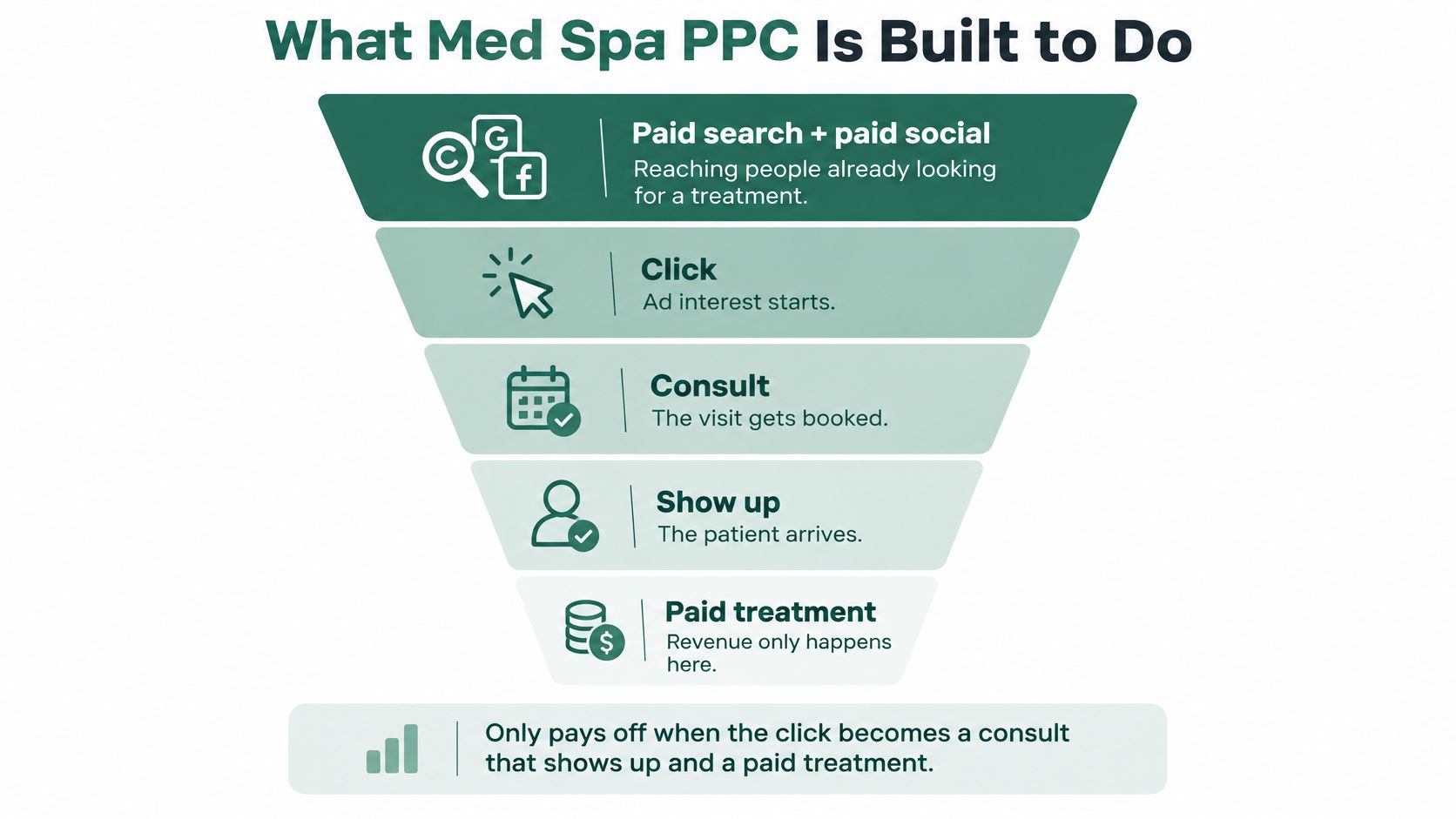
Med spa PPC uses paid search and social ads to reach people looking for, or likely to be interested in, a specific treatment. The goal is to turn ad exposure into a paid treatment through seven stages: query or ad, click, inquiry, reply, booked consult, kept appointment, and paid treatment.
Ads bring people to the front door. The front desk guides them toward a consult, and the consult gives the clinic an opportunity to earn the treatment. A high number of form fills means little if inquiries go unanswered or booked consults do not hold.
Channel Fit by Intent
Google Search captures active demand. Someone searching “Botox near me” or “lip filler consultation” is often looking for a provider, price information, or a way to book. Match the search with a relevant treatment page, then make sure the team can respond promptly.
Meta can introduce a treatment or offer to people who were not actively searching. It can suit a skin package, seasonal injectable event, or membership introduction. Since these clicks may show less immediate intent, clear qualification and prompt follow-up help determine whether interest turns into a consult.
The U.S. medical spa market generated approximately $7.1455 billion in revenue in 2023 and is projected to reach $17.5871 billion by 2030, according to Grand View Research's U.S. medical spa market report. The report also cites American Society of Plastic Surgeons data showing 13.2 million minimally invasive procedures in the United States in 2020. For clinics, that breadth of treatment demand supports building campaigns around specific services rather than relying on one general ad.
Operating test: If your report cannot show how many inquiries became kept consults, it measures traffic, not PPC performance. Costs, campaign structure, compliance, reply speed, results, and the decision to scale each affect a different stage of the path.
Med Spa PPC Costs by Treatment
There's no single national CPC worth managing to. The same treatment costs differently by city, radius, competitor density, offer, and how quickly your team replies. Compare cost per qualified inquiry, cost per booked consult, and cost per kept appointment by treatment instead.
The bands below are planning ranges for a U.S. single-location clinic to sanity-check a 2026 account. They aren't guarantees, and they aren't a quote for your market.
Planning Costs for Med Spa PPC by Treatment
| Treatment | Typical search CPC | Cost per booked consult | What usually changes the number |
|---|---|---|---|
| Injectables such as Botox or filler | $4-$12 | $40-$150 | Offer, radius, and same-day reply speed |
| Laser and skin | $6-$18 | $80-$250 | Package price and whether the page matches the device or concern |
| Body contouring | $8-$25 | $150-$450 | Longer consults, higher ticket, more unqualified form fills |
| Weight-loss or membership | $5-$20 | $70-$300 | Policy limits and whether medication is mentioned |
| Branded provider or clinic name | Often under $3 | Usually lowest | Must be split out so it doesn't hide non-brand cost |
Branded searches deserve their own campaign for a simple reason. People searching your clinic name already know you, so those cheap clicks can make weak non-brand campaigns look healthy. Separate them before you make budget calls.
The Math That Changes the Decision
Say a treatment produces a booked consult for $90, and 60 percent of those patients show. Your cost per kept consult is $150, not $90. If the average first treatment is $400 and 40 percent of kept consults start treatment, your ad cost per started treatment plan is $375.
That worked example is why a low CPC can still lose money. A page that attracts bargain hunters, a consult booked too far out, or a missed after-hours inquiry raises the final cost without changing the click price.
A $40 booked consult that doesn't show is more expensive than a $90 booked consult that does.
Set a Pause Rule Before You Spend
Pick the share of first-visit revenue you're willing to spend to get one kept consult. Say average first-visit revenue is $400 and you'll accept half of that, or $200, as the ceiling. If a treatment stays above $200 per kept consult for two to four weeks, pause it until the page, offer, or reply speed changes.
Raise budget only on treatments clearing that bar. Meta may look cheaper per lead, while Google Search is often cheaper per high-intent consult, so don't compare channels at the lead stage. Compare them after booking and show rate. I would rather own one treatment with clean economics than spread a small budget across five campaigns that all generate inquiries nobody can evaluate.
Compliance Limits on Claims and Tracking
Policy isn't a legal footnote you check after launch. It's a campaign setting that can stop delivery while your budget sits untouched. Google's healthcare and medicines advertising policy states that healthcare and medicines content may be prohibited or allowed only in specified locations, and some categories require advertiser application or certification. Its examples include prescription-drug services and telemedicine.
Start with a treatment matrix. Put standard aesthetic services such as injectables, laser, and body treatments in one column. Put anything mentioning a prescription product, online prescribing, or medication fulfillment in another column, with certification and location requirements checked before a keyword goes live.
Audit the Whole Path
Read every surface a reviewer or automated system can see:
- Keywords and headlines: Remove guaranteed results, miracle language, and drug names the account isn't certified to advertise.
- Descriptions and extensions: Don't imply a personal attribute or promise an outcome you can't support for every patient.
- Landing pages and forms: Check before-and-after claims, eligibility language, disclosures, and prescription references, not just the ad itself.
- Locations: Confirm restrictions for each targeted market, because permission in one place doesn't settle another.
One disallowed claim can trigger limited eligibility, disapproval, or loss of delivery. Lead flow then falls even though bids and budgets look adequate, and owners often misread that as a demand problem.
The Tracking Trap
More tracking isn't automatically better. Recent platform-policy coverage on Meta health restrictions notes that Meta may restrict or limit conversion data for health-and-wellness advertisers, and it references the FTC's $1.5 million GoodRx settlement as evidence that sharing health information with advertising platforms can create material regulatory exposure.
Use three layers instead of sending platforms everything:
- Compliant platform events that signal a qualified consult request without revealing a specific diagnosis or sensitive treatment detail.
- First-party CRM events your clinic owns, including source, reply time, booked status, and follow-up stage.
- Offline outcomes such as attended and paid consults, used for internal economics and only shared after stripping detail the platform shouldn't receive.
A HIPAA-covered practice carries stricter consent and data duties than a non-covered spa, so get that classification right before choosing server-side or offline import. Optimize bidding toward a safe proxy, then judge real profit in the CRM.
How to Structure Treatment Campaigns
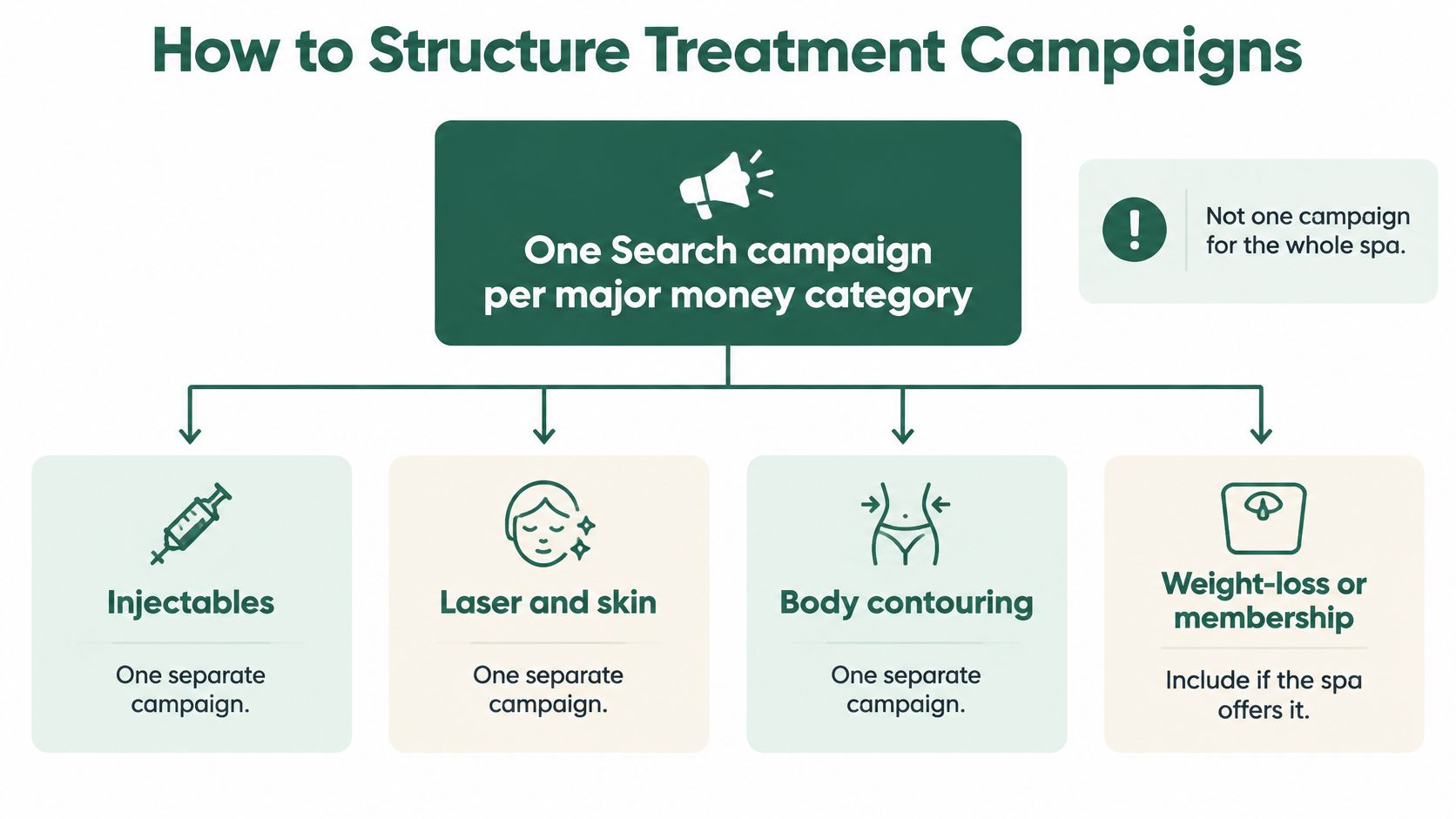
Don't build one campaign for the whole spa. Build one Search campaign per major money category, such as injectables, laser and skin, body contouring, and weight-loss or membership if you offer it. Treatments have different tickets, consult lengths, close rates, and policy risks, so one shared budget hides the winner and feeds the loser.
Inside each campaign, keep ad groups tight. "Botox near me," "lip filler," "laser resurfacing," and "body contouring consultation" express different intent and shouldn't share one generic ad. Send each group to a page repeating the treatment name, city or service area, eligibility basics, a real consult offer, and one clear booking or call action.
Use Quality Score as a Diagnostic
Google's Quality Score guide explains that Google evaluates ad quality through expected click-through rate, ad relevance, and landing-page experience, with Quality Score reported on a 1-10 scale. Higher-quality ads can contribute to lower prices and stronger positions, although Quality Score itself is not a direct auction input.
Read the components like fault codes. Low expected CTR suggests weak positioning or an unclear offer. Low ad relevance points to keyword-to-copy mismatch. Poor landing-page experience means the destination is slow, confusing, or not useful for that query. Don't chase the number alone, and our guide to improving ad creative strategy is useful when the copy is the weak link.
Add negatives from day one. A Botox campaign shouldn't pay for jobs, training courses, DIY supplies, or free-treatment hunters. Review actual search terms weekly at launch, because broad matching will find creative ways to spend money if you let it.
Launch in This Order
- Pick two treatments with strong margin and the shortest booking path.
- Name the treatment and city in the ad instead of leading with generic beauty language.
- Match the page headline to the ad and remove competing navigation goals.
- Import booked consults as conversions before turning on aggressive automated bidding.
- Review search terms weekly and cut queries that produce form fills without qualified bookings.
On Meta, mirror the same treatments as separate ad sets with the same offer and destination page. One broad aesthetics audience blended across injectables, lasers, and weight loss gives you no clean read. Automated bidding that only sees form fills will chase cheap, low-intent leads, so feed it the most bookable event you can send compliantly.
Why Reply Speed Changes Cost per Kept Visit
A low cost per lead can hide a costly gap: inquiries that never become kept consultations. Reply time affects how many leads book, while the time between booking and appointment affects how many show. Track both if you want to know what each paid click produces.
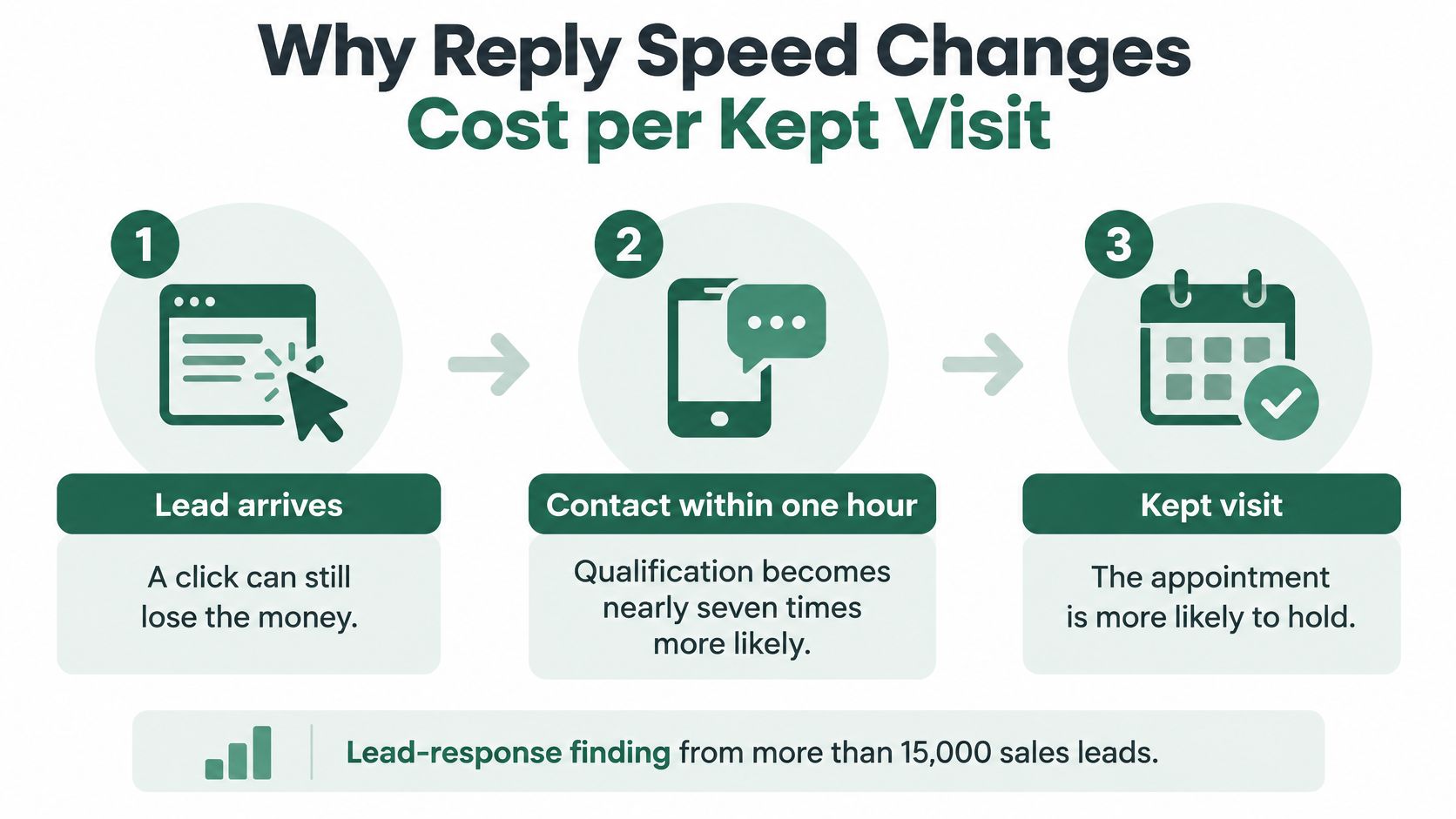
The Med Spa Scalers study of response time and bookings across 186,400 leads examines how quickly a clinic responds to inquiries. In practice, a long delay can mean a prospective patient contacts another clinic, while a consult booked far in advance has more time to fall through. Reminders and follow-up after a missed appointment help address the second problem.
Funnel from Inquiry to Kept Consult
| Stage | Metric to record | Worked example value |
|---|---|---|
| Inquiry | Cost per qualified inquiry | 100 inquiries |
| Booking | Booked rate by reply speed | 20% booked when replies take a day |
| Show | Show rate by appointment lead time | 60% show rate |
| Kept consult | Cost per kept consult | $150 at a $90 cost per booked consult and 60% show rate |
| Treatment | Ad cost per started plan | $375 at a 40% close rate and $400 first treatment |
With 100 inquiries and a 20 percent booked rate, 20 consults are scheduled. At a 60 percent show rate, 12 are kept. That puts the worked example's cost per kept consult at $150 when each booked consult costs $90. These figures illustrate the calculation, not a forecast for a particular clinic.
Three Owner Questions Answered Directly
Should you raise spend if nights and weekends go unanswered? Fix coverage first. Instant SMS, self-booking, or an after-hours answering workflow can give inquiries a next step while staff are unavailable. Med Spa Scalers prioritizes reply speed, reminders, and reactivation before asking a clinic to spend more on ads.
Is a cheaper lead worse? The lead price alone cannot answer that. Record first reply time, follow-up attempts, booking status, and show status. If leads receive no second touch, the follow-up process may be limiting bookings more than the campaign.
Which follow-up should you choose? Match it to the treatment and booking barrier. Self-booking can suit a straightforward injectable consult; SMS qualification can help when provider fit matters. For higher-ticket body contouring, a human call may be appropriate. Deposits can help address no-shows, while a shorter booking window can reduce the time between inquiry and consult.
Before increasing ad spend, check that inquiries receive a prompt first reply, unanswered leads get follow-up, reminders go out, and no-shows receive a recovery message. The goal is a lower cost per kept consult, not a higher count of inexpensive leads.
What Booked-Patient Results Look Like
Two single-clinic examples show what changes when operations improve around the ads. Treat the dollar figures as illustrations, not benchmarks for your market, and confirm case figures with a clinic before using them in your own planning.
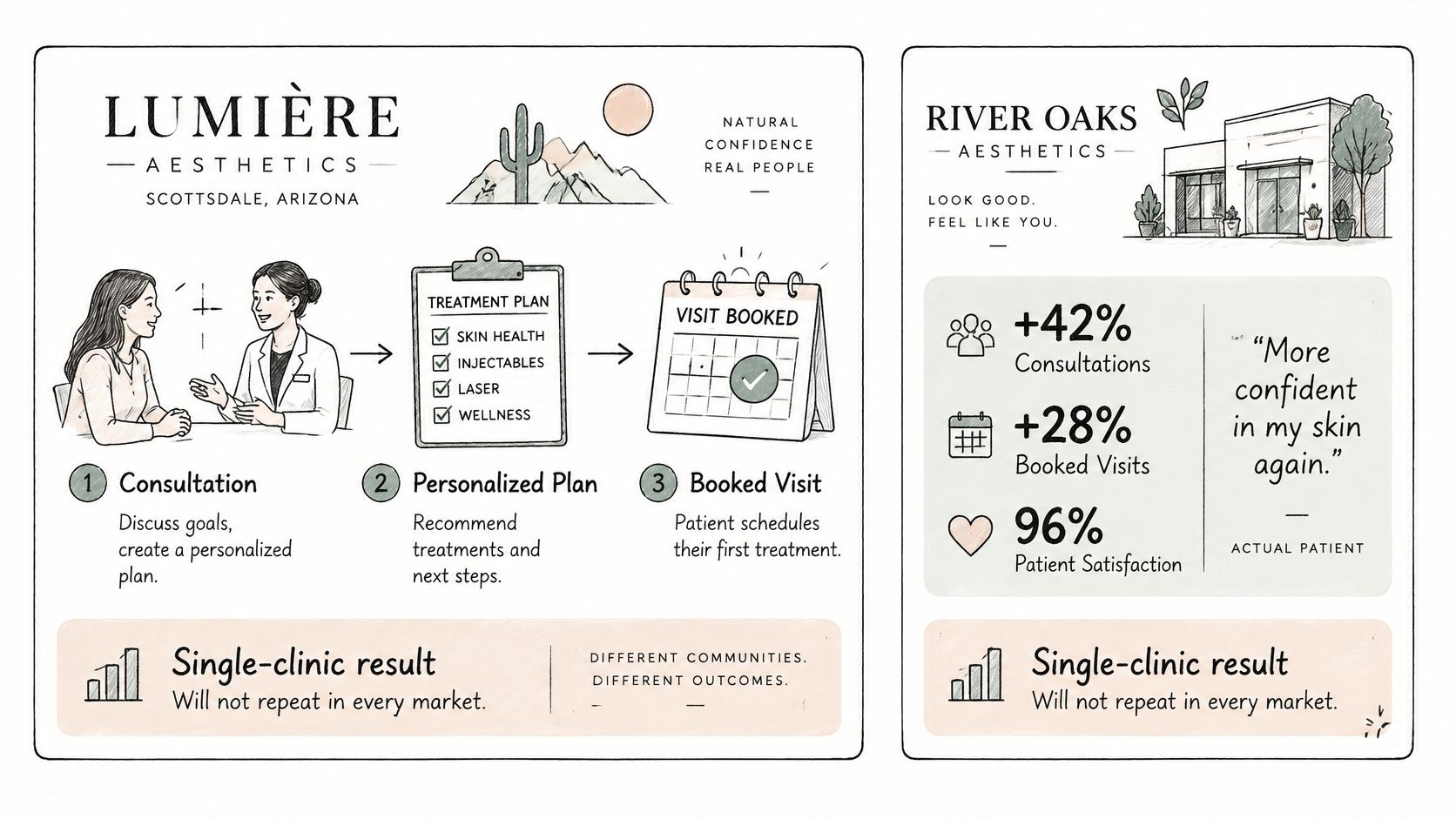
Lumière Aesthetics
Lumière Aesthetics, an injectables practice in Scottsdale, Arizona, added instant SMS follow-up, self-booking, three-step reminders, and review requests. After those changes, reply time was 38 seconds, the booked rate was 37 percent, and cost per new patient was $108.
Read that against the planning bands carefully. A $108 cost per new patient only means something because booked rate and follow-up speed are visible. If the clinic had stopped at form fills, you couldn't tell whether the ads improved or the front desk captured demand that used to leak.
Glow Theory Laser and Skin
Glow Theory Laser & Skin in Vancouver, British Columbia, added an AI receptionist, qualifying instant forms, and deposits at booking. Missed calls fell to 3 percent and cost per new patient fell to $88.
The ads didn't do that alone. Speed recovered calls, the form screened intent, and the deposit gave patients a reason to keep the appointment. Demand capture, qualification, and commitment each raised the value of the same kind of click.
The short walkthrough below is useful for seeing how those follow-up pieces fit together in practice.
Copy the Measurement Not the Dollars
Track these fields by treatment every month:
- Reply time: Median minutes or seconds to first human or automated contact.
- Booked rate: Qualified inquiries that become consults.
- Missed-call rate: Calls lost during and after business hours.
- Show and close rates: Booked consults that attend and start treatment.
- Cost per new patient: Ad spend divided by patients who start.
A med spa with a slow front desk should expect ad costs to look worse until those steps exist. A useful monthly report doesn't celebrate clicks and cheap leads. It names which treatment made money after no-shows and which one only looked efficient inside the ad platform.
Decide Whether to Scale Ad Spend
Scale a treatment only when four conditions hold for at least a few weeks. The landing page matches the query, claims sit inside policy, first replies arrive within minutes including after hours, and cost per kept consult is acceptable against first-visit revenue. If any condition fails, fix that constraint before adding budget.
The order is deliberate. Repair reply speed and reminders first, reactivate people who already inquired second, then spend more on treatments that already book and show. Increasing budget into a broken hallway just creates a larger pile of lost inquiries.
Your Monthly Scorecard
Keep it plain enough for an owner to act on:
- Spend and qualified inquiries by treatment
- Booked consults and show rate by treatment
- Cost per booking and cost per kept consult
- What failed and what changes next month
- Paused or scaled, with the reason stated for each treatment
Med Spa Scalers measures its work by booked consults and cost per booking. It also doesn't guarantee a specific number of patients, because results depend on the market, offers and team, while committing to fast follow-up on every lead, clear reporting on booked consults and continuous improvement month to month. If Quality Score is your constraint, our breakdown of Google Ads Quality Score helps separate copy problems from page problems before you raise bids.
Pull last month's spend now and count kept consults by treatment before buying another click. That one exercise usually tells you whether you need more traffic or a better path for the traffic you already have.
If your reports show cheap leads but your chairs aren't filling, ask for the free marketing audit that reviews your ads, follow-up speed, booking flow and patient list, and shows where bookings are slipping through. We'll help you judge med spa PPC by booked and kept consults, not vanity clicks, so visit Med Spa Scalers to request your audit.
See how many patients you're leaving on the table
Get a free marketing audit of your ads, follow-up and booking flow. No pressure, just a clear picture.
Book a free marketing audit