Med Spa Social Media: A Content Plan That Books Patients
35.9% of respondents said surgeons' advertisements affected their decision to seek a plastic-surgery consultation, according to a 2023 study in Aesthetic Surgery Journal Open Forum. That's reported influence, not a booking conversion rate. Still, it reframes the job of med spa social media: help someone feel informed enough to take the next step, not just stop scrolling.
For your clinic, that person may already have a referral, a Google result, or a review in mind. Your profile should help them verify the provider, understand the treatment, and decide whether a consultation makes sense. Build around that decision, then measure kept appointments, not follower counts.
Table of Contents
Content Mix That Moves Patients Toward Booking
A 2019 cross-sectional study of 816 people found that 48.5% said social media influenced them to consider undergoing a cosmetic procedure, which measures consideration rather than completed bookings.
Content types by patient-journey stage
| Stage | Content type | Example post | Next action |
|---|---|---|---|
| Awareness | Short educational videos | A brief explainer on how neuromodulators work | Follow or save the post |
| Consideration | Provider-led explainers and FAQ carousels | Who is and isn't a candidate for dermal filler | Visit the treatment page |
| Trust | Consented before-and-after cases with context | Filler result shown with timeline and stated limits | Check credentials and reviews |
| Action | Booking prompts and DM replies | Pinned post with consult link and a DM keyword | Book a consultation |
Give each post a specific job
Awareness content should explain, not diagnose. Have a provider describe how neuromodulators affect muscle activity, using plain language and a simple visual. Don't tell viewers that a facial feature needs fixing. Ask them to save the explanation if they're researching treatment.
Consideration content should answer the questions that make someone hesitate. For dermal filler, explain what the consultation evaluates, why some requests aren't appropriate, and which factors affect the treatment plan and price. Send viewers to the relevant treatment page, not a homepage that makes them search again.
Trust content needs more than an attractive result. A filler case should explain what was treated, when the follow-up photograph was taken, and what the image cannot demonstrate. Give the viewer a clear route to verify the clinician and evaluate the practice.
Action content should remove practical uncertainty. Pin a consultation post explaining where the clinic is, what happens during the visit, and how to request an appointment. A DM keyword can start that process, but it shouldn't become a substitute for clinical assessment.
Balance education with a usable next step
A feed made entirely of promotions asks for commitment before answering questions. A feed made entirely of education leaves an interested viewer unsure how to proceed. Use both, with the next action matched to the viewer's readiness.
Post test: Name the patient-journey stage and the single action you want the viewer to take before you approve the caption.
A post without a next action wastes its reach. That action doesn't always need to be booking; saving an explanation or reviewing candidacy can be the appropriate next step.
Which Platforms Deserve Your Time
Med spa role by platform
| Platform | Best med spa use | Funnel stage |
|---|---|---|
| Before-and-after carousels, reels and DM booking | Consideration to action | |
| Local event posts and retargeting audiences | Awareness and retargeting | |
| YouTube | Long treatment explainers and provider Q&A | Consideration |
| TikTok | Short education and behind-the-scenes content | Awareness |
In a 2025 survey published by Jenk of 1,400 U.S. aesthetic consumers, Instagram was the discovery source for 30% of respondents seeking aesthetic providers, compared with 26% for word-of-mouth referrals and 21% for Google Search. Treat that as a discovery benchmark, not a ranking of channels by completed appointments.
Social discovery and local search don't need separate strategies. Someone who hears your name from a friend should find the same providers, location details, and treatment descriptions across your profile and website.
Match the channel to the work you can sustain
Instagram is a practical home for visual cases, short provider explanations, and booking conversations. Organize highlights around treatments, providers, consultation details, and location information rather than leaving visitors to scroll through the feed.
Facebook suits local events and community-facing updates. For retargeting, check current platform restrictions and privacy requirements before using website or customer data; don't assume every clinic audience is eligible.
YouTube gives providers room to explain candidacy, recovery, and alternatives without compressing every answer into a short clip. The trade-off is production effort, so start with questions your front desk repeatedly receives.
TikTok can support discovery through concise education and behind-the-scenes clips. Don't assume entertaining content establishes clinical credibility; use it to introduce the provider and direct viewers toward fuller explanations.
Prioritize useful proof over platform decoration
In a U.S. survey of 651 people who had undergone aesthetic procedures, 70% considered before-and-after photographs important, and 55% preferred a provider with a verification badge. These are preferences, not conversion benchmarks. Apply for appropriate verification where available, but don't present a badge as proof of clinical competence.
I would start with two platforms the team can maintain with credible visuals and reliable replies. Add another only after the initial channels produce tracked inquiries and the clinic can handle the extra workload. None of these figures establishes which platform will produce the most bookings for your practice.
Building Trust With Before-and-After Content and Credentials
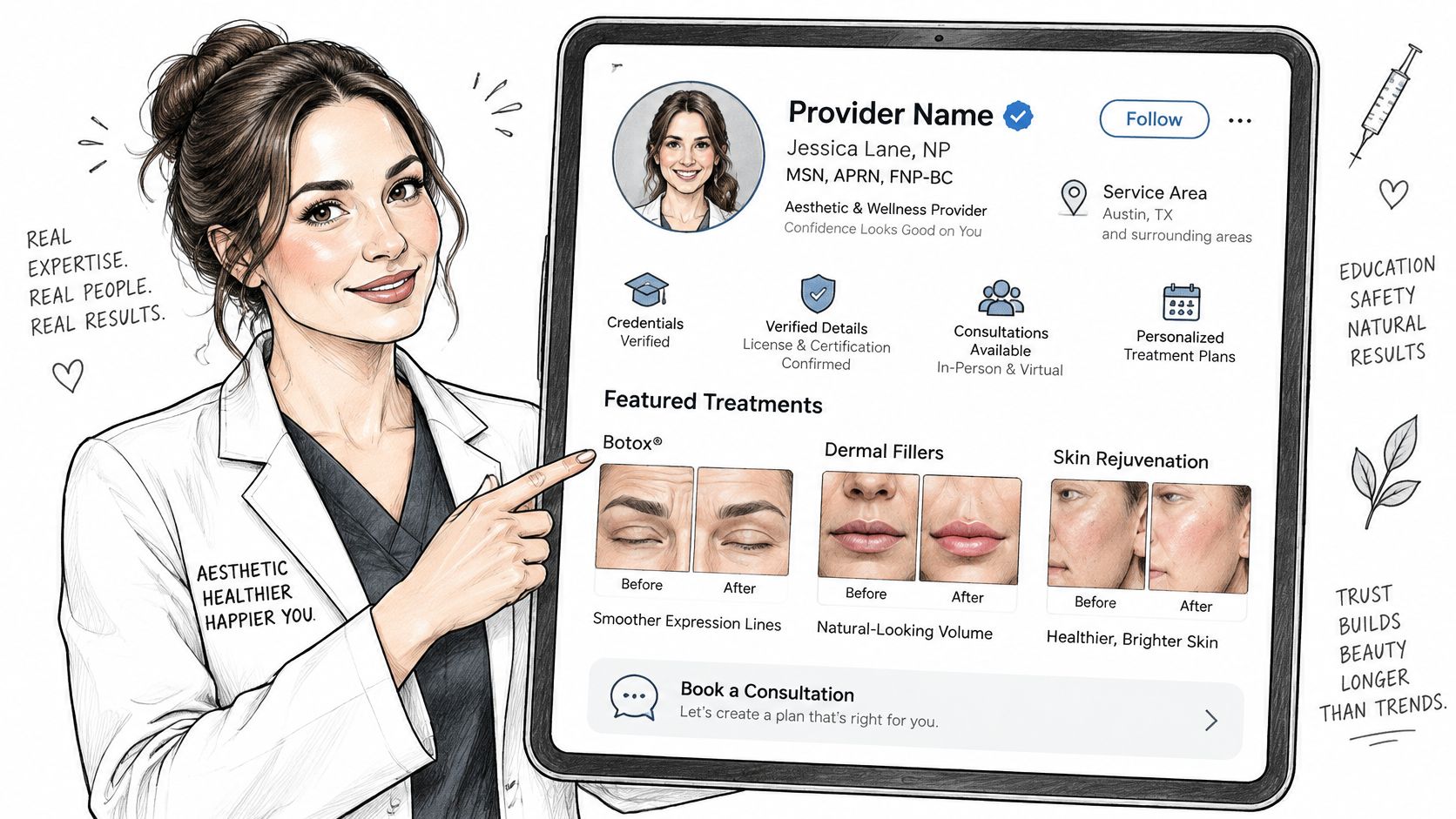
A cautious prospective patient needs verifiable details, not just a polished transformation. Make it easy to identify who provides treatment, what their qualifications are, and whether the clinic offers an appropriate consultation.
Your provider should be recognizable across the profile and treatment pages.
Make the profile easy to verify
- Provider identity: Show the clinician's name, accurate credentials, and role.
- Service area: State the city and clinic location plainly.
- Treatment scope: List services and direct visitors to candidacy information.
- Consultation access: Provide a working booking link and explain what visitors are requesting.
- Reply channel: Tell people where to send administrative questions and how clinical questions are handled.
Lifestyle posts can introduce the team, but they shouldn't displace the information patients need to evaluate care. A celebration photograph doesn't explain who performs laser treatments or how the consultation works.
Publish the case, not just the comparison
For before-and-after photography, use real patients with written permission covering the intended publication. Keep lighting, framing, expression, and camera position consistent, and avoid edits that alter the apparent result.
State the treatment date, elapsed time before the follow-up image, and relevant limits. Include a clinician-approved limitation or possible side effect rather than relying on a small results-vary disclaimer to supply all the context.
Use this caption structure for a neuromodulator case, replacing every field with verified case details before publishing:
Caption framework: Treatment performed by [provider's full name and credentials] on [treatment date]. Follow-up photographed [actual interval] later. Expected onset for the product used is [clinician-approved window]. Results vary, and [clinician-approved side effect] is possible. If you have [product-specific contraindication], don't book treatment without clinical assessment. Request a consultation to discuss suitability.
Don't copy an onset window from another clinic's caption. The responsible clinician should approve product-specific timing and exclusions.
Keep the publishing rule simple: no result without context, no guaranteed outcome, and no identifiable patient image without written permission. If the team can't verify the case details, hold the post.
Set Up Booking Tracking Before Scaling Posts
Social metrics ranked from attention to booked patients
| Metric | What it reveals |
|---|---|
| Reach and engagement | Attention only, not demand |
| DM-to-inquiry rate | Whether conversations start a booking path |
| Inquiry-to-consult rate | Whether interest becomes a scheduled consult |
| Show rate | Whether booked patients attend |
| Cost per kept appointment | Real acquisition cost from social |
A 2024 systematic review reported a positive correlation between social-media use and consideration of aesthetic procedures (r = 0.45, p < 0.001). Correlation doesn't establish that social media causes demand. Your clinic needs its own appointment records to determine whether content assists the booking process.
Connect the platform to the appointment record
Assign treatment-specific tracking. Use UTMs to identify platform, campaign, and content in Google Analytics. Send visitors to the matching treatment page, and never put medical details or patient identifiers into tracking parameters.
Record the inquiry source. Add source fields in your CRM, such as GoHighLevel, and distinguish original discovery from content that helped someone decide. Ask how they first found you and what prompted them to contact the clinic now.
Review consults against kept visits. Compare social-sourced inquiries, scheduled consultations, attendance, and completed treatments monthly. Separate acquisition costs from content-production costs so the team knows what each calculation includes.
Define each denominator before reporting rates. For example, calculate show rate from attended consultations divided by scheduled consultations within the same appointment cohort, rather than mixing this month's attendance with this month's new leads.
A cheap inquiry isn't a cheap patient if nobody attends.
Fix the handoff before increasing spend
At Med Spa Scalers, we help turn Instagram and Facebook DMs into consults through med spa social media marketing. Our free marketing audit reviews ads, follow-up speed, booking flow, and the patient list to identify where bookings are slipping through.
Before raising spend, test the links, confirm source fields populate, and assign same-business-day DM coverage. Use the Meta ads best-practices checklist to review the paid campaign alongside the booking flow.
Measurement isn't permission to overstate medical benefits. Keep health-related advertising claims substantiated regardless of which creative produces the lowest acquisition cost.
How to Build a Weekly Posting and DM Routine
Build a routine a front-desk lead can run when the marketer is away. Keep the content calendar, approved replies, booking links, and escalation contacts in one shared workspace.
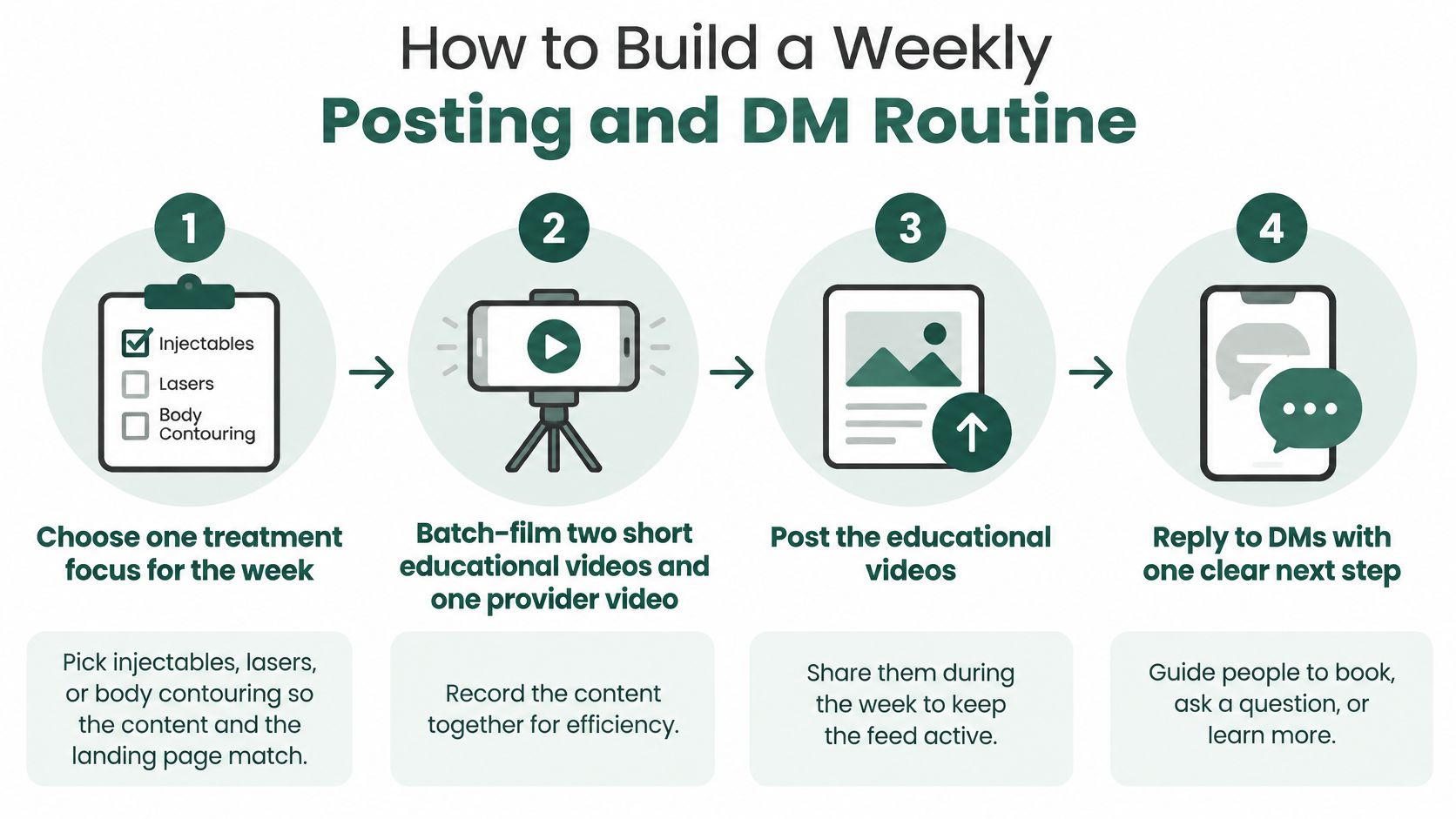
Use this workflow as the production overview.
Run the weekly loop
Choose one treatment focus for the week. Pick injectables, lasers, or body contouring so the posts and destination page answer related questions. Check appointment availability before promoting consultations the clinic can't accommodate.
Batch-film two short educational videos and one provider explainer. Record them together using a phone, stable tripod, clear audio, and an uncluttered background. Have the clinician approve the talking points before filming, and check that no patient information is visible.
Write each caption for a stage and a single action. Mark the intended stage in the internal calendar, then choose either a consultation link or a DM keyword for the published caption. Don't ask viewers to follow, comment, share, download, and book in the same post.
Schedule posts on two platforms only. Use your account analytics to choose times when the local audience already engages, rather than copying a universal posting timetable. Adapt the opening and crop for each platform instead of uploading an unreadable duplicate.
Reply to every comment and DM on the same business day. Start with a nonclinical routing question, such as which treatment the person wants to learn about. If treatment history is relevant, direct them to the approved private intake process rather than collecting sensitive details in public comments.
Send the consultation link and log the source. Once the person's request is clear, provide the correct location and treatment booking route, plus any practical instructions. Assign unanswered inquiries to a named staff member using a documented lead follow-up system, so conversations don't depend on someone remembering them.
Review the week's path from post to booking. Identify which posts started DMs, which conversations became inquiries, and which inquiries scheduled consultations. Check later appointment outcomes before deciding that a high-message post deserves more production time.
Make the handoff explicit
Keep a short exception list beside the calendar: medical questions, complaints, adverse-event reports, and requests involving sensitive information need designated handling. The front desk should know who takes ownership rather than improvise an answer.
Repeat the loop because the review improves the next treatment focus. Keep useful questions, revise weak handoffs, and retire formats that attract attention without relevant inquiries.
Engaging Local Audiences Without Overpromising
In the 2025 ASDS Consumer Survey, nearly half of respondents said a provider's social-media presence influenced their choice to book, while 94% relied on rating and review websites when selecting a provider. Those measures aren't mutually exclusive. A prospective patient can use social content and reviews together.
That makes local validation a practical priority. Don't assume a polished group account answers whether someone trusts the provider at the location they'll visit.
Apply local proof in a deliberate order
Identify the city and neighborhood. Add accurate location tags and natural place references to treatment posts. Name the actual clinic serving the viewer, rather than filling captions with nearby cities where you don't operate.
Provide access to relevant reviews. Where the format supports clickable links, direct viewers to the review page or Google Business Profile. Where it doesn't, use a clearly labeled profile destination rather than leaving a nonclickable address in the caption; keep the consultation action distinct.
Run a short weekly public Q&A. Answer general questions about how a laser consultation works, what affects recovery planning, or what visitors should bring. Have a clinician review treatment explanations, and don't turn an individual's comment into a public suitability assessment.
Give each location its own evidence. Use local reviews, staff photographs with written permission, and location-specific booking access. Check that the provider shown currently works at the location being promoted and that the booking calendar matches the post.
Treat replies as part of the profile
Say a prospective patient asks whether your downtown clinic offers a particular laser service. A useful reply confirms availability, names the consultation route, and explains where to find general preparation information. A vague invitation to send a message creates extra work when the question was administrative.
Questions involving a person's medical history or suitability need the private handling described under Compliance Rules for Comments, Creators and Disclosures. Public visibility doesn't make a comment permission to discuss someone's care.
Write every public reply for the next cautious person reading it, not only for the commenter.
Set same-business-day coverage as an operating standard for questions and review responses. Keep replies factual and specific without confirming patient status or making medical claims. For complaints, acknowledge the concern generally and offer a private route to the responsible team member.
Compliance Rules for Comments, Creators and Disclosures
A relatable creator doesn't remove the need for clinical review. In NIQ's 2025 global survey of nearly 19,000 adults across 19 countries, 18% considered influencers or sponsored social ads a significant influence on health-and-wellness purchases, while 38% described them as having some influence.
Those findings concern broader wellness purchases, not med spa booking rates. Use creators for accessible explanation, not as substitutes for qualified clinical judgment.
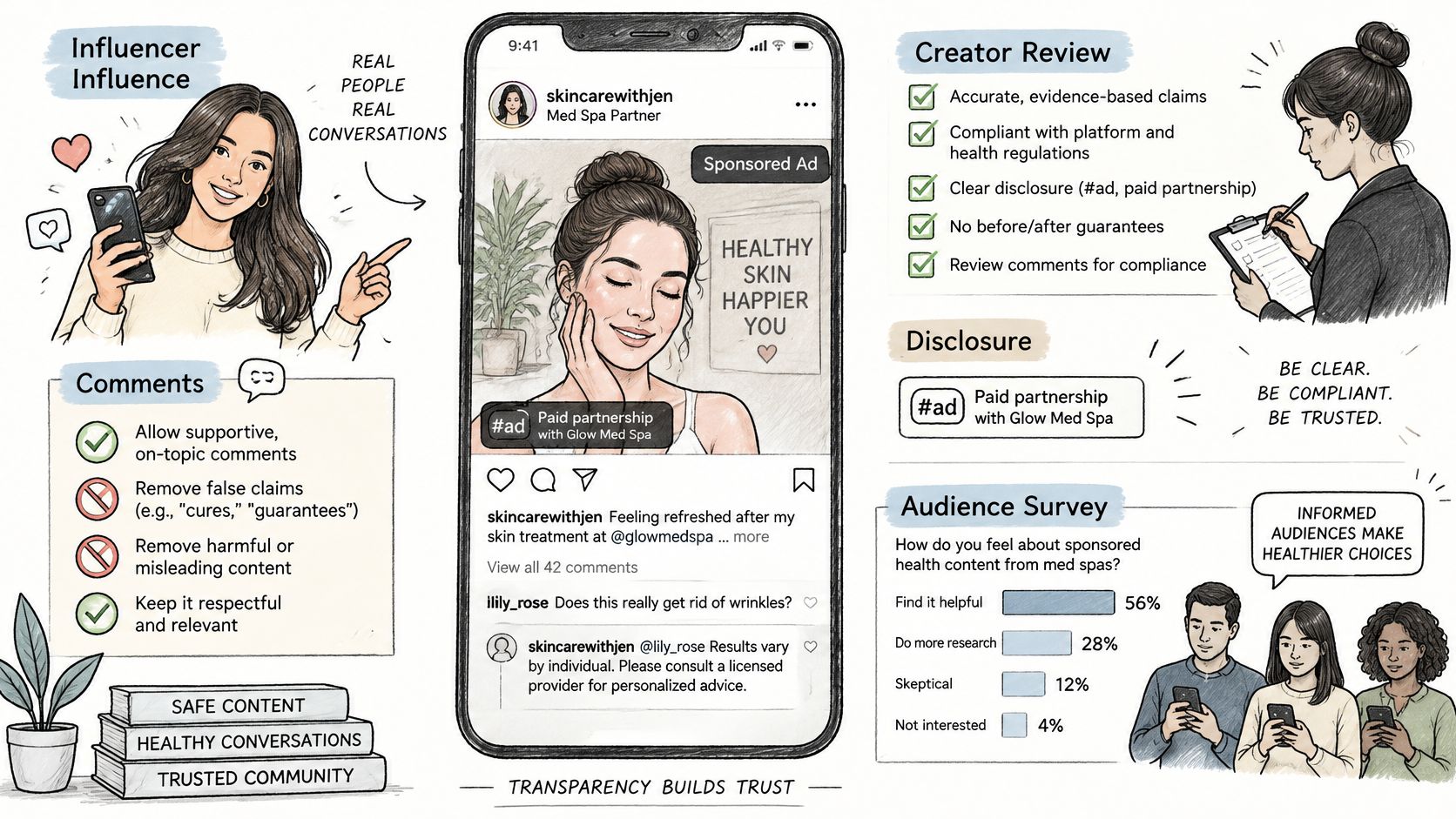
Give every participant the same publishing boundaries.
Put responsibility ahead of relatability
Use a credentialed-creator model: trained staff or carefully vetted creators explain expectations, recovery, risks, and reasons someone might not be a candidate. The responsible clinician reviews every script, and the creator stays within their actual qualifications.
Build these controls into approval:
- Hidden sponsorship risks misleading viewers. Label paid or gifted relationships clearly in the content itself, not behind a link or among unrelated hashtags.
- Patient comments can expose confidential information. Don't confirm treatment history or patient status, even when the commenter volunteers it. Acknowledge the message generally and direct care-related discussion to an approved secure channel.
- Unsupported promises can misrepresent treatment. Require the clinician to verify outcome, safety, permanence, and suitability claims before publication. A testimonial isn't enough to establish a general medical claim.
- Background details can identify patients. Check screens, paperwork, reflections, voices, and treatment-room footage as well as the main subject. Obtain appropriate written permission before publishing identifiable patient content.
For outside marketing support, use a medical advertising agency review checklist to clarify who approves scripts, permissions, and campaign changes. Don't leave clinical sign-off implicit in an agency handoff.
Use the video below alongside a staff discussion of your own approval process.
Keep a publication stop list
- Guaranteed results: Reject wording that promises an individual outcome.
- Permanent outcomes: Hold the claim unless the exact wording and treatment context are substantiated.
- Risk-free claims: Don't publish assurances that erase relevant risks.
- Incomplete comparisons: Hold before-and-after images missing treatment dates, follow-up timing, or stated limits.
Have qualified counsel review jurisdiction-specific requirements. A content checklist supports careful publishing, but it doesn't replace legal or clinical oversight.
Med Spa Scalers combines social content and DM follow-up with booking systems that connect inquiries to consultations. Visit Med Spa Scalers to request a free marketing audit of your ads, follow-up speed, booking flow, and patient list, and get specific next steps for finding where prospective appointments are being lost.
See how many patients you're leaving on the table
Get a free marketing audit of your ads, follow-up and booking flow. No pressure, just a clear picture.
Book a free marketing audit