Ad Agency Medical Guide: What It Does and How to Choose One
U.S. direct-to-consumer advertising for health services grew from $542 million in 1997 to $2.9 billion in 2016, according to the Los Angeles Times' coverage of medical-marketing spending. That expansion makes a practical point for clinic owners: advertising puts you in front of patients, but you still need a reliable way to answer, book and care for them.
If you're searching for an ad agency medical practices can trust, don't judge the agency by its ads alone. Judge how it manages the money, messages and patient information between the first click and the attended consultation.
Table of Contents
What a Medical Ad Agency Actually Does
Annual U.S. medical-marketing spending increased from $17.7 billion in 1997 to $29.9 billion in 2016, across prescription-drug promotion, disease awareness, health-service advertising and laboratory-test marketing, according to JAMA's analysis of medical marketing. This is broader healthcare spending, not a med-spa market estimate, but it explains why clinical credibility must coexist with clear consumer communication.
A medical ad agency helps a practice do three connected jobs: get found by prospective patients, turn inquiries into consultations and bring existing patients back. Think of it as the front door, phone line and recall list, not just the billboard.
The connection between those jobs matters more than any individual channel.

Core service lines of a medical ad agency
| Service | What It Covers | Output to Check |
|---|---|---|
| Paid search and social ads | Campaigns for high-value treatments on Google and Meta | Cost per booked consult |
| Landing pages and offers | Pages and forms that turn interest into inquiries | Form completion rate |
| Local SEO and Maps | Visibility for treatment searches near the clinic | Map and search calls |
| CRM and follow-up | Pipelines, reminders and reactivation sequences | Reply time and show rate |
| Social DM follow-up | Turns Instagram and Facebook messages into consults | Consults booked from messages |
Say your clinic advertises laser treatments. Google Ads might reach someone actively searching for a nearby provider, while Instagram introduces the service to someone still comparing options. Those patients need different messages, but both need accurate information and a clear next step.
The agency should connect the advertisement to a relevant landing page, route the inquiry into a CRM and make the handoff to booking visible. Our ad creative strategy guide addresses the messaging side of that connection.
Practical rule: Buy a clearly defined patient-acquisition process, not a collection of disconnected marketing tasks.
Results depend on the treatment, offer, local competition and clinic capacity. An agency can improve targeting and communication, but it can't determine clinical suitability or guarantee that every inquiry becomes a patient. Its work should be judged on what happens after the click.
How to Judge a Medical Ad Agency
| Criterion | Strong Answer | Red Flag |
|---|---|---|
| Measurement | Reports booked consults and cost per booked patient | Reports only clicks, impressions or leads |
| Account ownership | Ad accounts, CRM data and patient lists stay in your name | Agency holds the accounts or the data |
| Healthcare compliance | Explains claim substantiation, consent and data flows | Promises results without any compliance review |
| Response speed | Covers instant reply, reminders and no-show recovery | Treats follow-up as outside the scope |
| Pricing transparency | Separates setup fee, monthly retainer and ad spend | Quotes only a vague monthly figure |
| Exit terms | Clear next steps if you stop working together | Long lock-in with no handover plan |
What the answers reveal
Measurement tells you whether the agency accepts responsibility for a useful business outcome. Clicks describe activity, but they don't tell you whether the front desk booked an appropriate consultation.
Account ownership determines whether you can change providers without rebuilding your marketing operation. If the agency controls access, you may struggle to retrieve campaign history or export records when the relationship ends.
Compliance readiness shows whether the team understands that persuasive advertising and medically supportable advertising aren't always the same thing. A results promise without a review process leaves unanswered questions about what the agency will publish and send.
Response coverage exposes gaps between vendors. If one team generates inquiries while another assumes the clinic handles everything else, nobody may own the failed handoff.
Transparent pricing lets you compare the actual scope rather than the headline fee. A vague monthly total makes it difficult to distinguish media costs from management and software work.
Exit terms establish how the transition will happen. Written responsibilities are more useful than a verbal assurance that everything will be straightforward.
What our terms mean in practice
At Med Spa Scalers, ad accounts, CRM data and patient lists stay in the client's name, and everything stays with the client if they stop working with us. Our Med Spa Growth System separates the setup fee, monthly retainer and directly paid ad spend; exact pricing follows the free audit once the clinic's needs are known.
Use the same standard when comparing proposals. Request a sample report with identifying information removed, an ownership clause and a written handover process.
Which number will you report to me each month, and who owns the account that produces it?
Why Healthcare Ads Follow Stricter Rules
Faster automation isn't automatically better. A system that sends an inappropriate message immediately can repeat the mistake across your campaign before a staff member notices.
Healthcare claims require more than appealing copy: the FTC's advertising and marketing guidance explains that health-related claims need scientific substantiation and advertisements must not be deceptive or misleading. A clinic should treat that review as part of campaign production, not an optional legal cleanup.
The distinction from ordinary retail advertising is useful to keep in view.

Establish controls before launch
Start with a claim-review file. Flag terms such as permanent, painless and clinically proven. Keep the supporting evidence beside the exact wording the agency proposes, including the treatment, intended audience and qualifications needed to avoid a misleading impression.
Then review the inquiry form and messaging permissions together. Appointment communication and promotional follow-up serve different purposes, so don't assume a request for information authorizes every later campaign. Have counsel review the consent language, recordkeeping and opt-out handling for the channels you'll use.
Define a clinical escalation boundary. An AI receptionist can help someone find availability or request a callback. It shouldn't decide whether a patient is suitable for an injectable treatment, interpret symptoms or reassure someone about a possible complication.
Finally, document vendor responsibilities and supervise access. Identify who approves messages, who can change workflows and who handles an unexpected disclosure or complaint.
This video accompanies the discussion of healthcare advertising.
Keep advertising intake separate from clinical intake
A practical advertising form asks for a name, contact details and preferred contact time. Collect symptoms and medical history through an appropriate clinical intake process rather than an open marketing form.
Don't assume that every med spa has identical obligations. Have qualified counsel assess HIPAA status, applicable state privacy requirements and automated-call or text consent under the TCPA before approving the workflow.
Keep an operational review file containing:
- Claim substantiation, matched to the approved advertisement.
- Consent records, including the language presented when permission was collected.
- Opt-out monitoring, with suppression across connected campaigns.
- Escalation logs, showing which medical questions reached staff.
- Human review, especially for AI-written replies and workflow changes.
These controls belong in the marketing budget because someone must build, maintain and supervise them.
Tracking Campaigns Without Exposing Patient Data
Tracking technologies can expose protected health information, so the HHS guidance on online tracking addresses business associate agreements for vendors handling PHI; Google separately instructs HIPAA-regulated entities not to expose PHI to Google Analytics. A business associate agreement defines permitted uses, safeguards and breach-reporting responsibilities, but it isn't permission to send every available field.
Use a conservative starting point for advertising events. Even an unauthenticated healthcare-service page needs review, and authenticated pages deserve particular scrutiny.
Patient data fields and where they belong
| Data Field | Safe in Ad Platform Events | Use Instead |
|---|---|---|
| Treatment condition or symptom | No | Generic campaign and service category |
| Patient name, phone or email | No | Only through a contracted, reviewed pathway |
| Appointment date or time | No | Aggregate booking count |
| Free-text form answers | No | CRM storage under access controls |
| Source channel such as Meta or Google | Yes, subject to payload review | Source-to-lead rate |
| Revenue by treatment category | Yes, in aggregate and after review | Aggregate revenue report |
Generic doesn't automatically mean de-identified. A source label or aggregate report can still create risk when combined with identifiers, sensitive page context or a small patient group. Treat the table as a minimization standard, not blanket approval for a particular integration.
Test what actually leaves the clinic
- Inspect the complete journey in staging. Include forms, thank-you pages, call tracking, CRM webhooks and browser events. Test unsuccessful submissions as well as completed ones.
- Record each outgoing field, its destination and the vendor receiving it. Inspect payloads rather than relying only on integration settings.
- Strip sensitive fields from pixels. Remove treatment details, names, phone numbers, appointment information and free-text symptoms.
- Rename conversion events, URLs and custom audiences so they don't carry clinical terms. Review CRM-to-platform uploads separately.
- Build aggregate reporting around source-to-lead rate, booked-consultation rate, kept-appointment rate and treatment-category revenue.
- Have qualified counsel review the data map, vendor contracts and proposed measurement pathways before launch.
Our Meta ads best-practices guide can support channel planning, but platform setup doesn't replace a clinic-specific privacy assessment.
Keep detailed patient-level reconciliation inside the clinic's controlled reporting environment. You can measure whether campaigns produce attended consultations without sending patient-level clinical data to an advertising platform.
Speed to Lead and Why Minutes Matter
Healthcare inquiry analysis discussed in CRST Global's response-time article found that the odds of connecting with and qualifying a lead fell by approximately 80% after five minutes. A response within the first minute was associated with a potential 391% conversion lift. These benchmarks aren't specific to med spas, so compare them with your own inquiry and booking records before using them to set targets.
For elective treatments, a slow reply can give a prospective patient time to contact another clinic. Measure the full response path, from the first acknowledgment to meaningful contact. An automated message confirms receipt; it doesn't answer a scheduling question or establish that an appointment is booked.

Response-time bands to measure
Use these as operating categories, not guaranteed performance thresholds.
| Response Band | What to Compare | Action |
|---|---|---|
| Under 60 seconds | Contact rate and consultation-booking rate | Keep the instant acknowledgment |
| 1 to 5 minutes | Contact rate and consultation-booking rate | Add a live call attempt |
| 5 to 30 minutes | Show rate and cost per kept appointment | Add timed SMS follow-up |
| Over 30 minutes | Show rate and cost per kept appointment | Escalate to a staff call |
Build a routing workflow
- Collect inquiries centrally. Route Meta forms, website forms, missed calls and inbound texts into the same managed pipeline.
- Acknowledge receipt promptly with an approved message and a clear next step.
- Attempt a live call in line with the patient's permissions and communication preferences.
- Use timed SMS follow-up only where consent supports it, and stop when someone opts out.
- Escalate unanswered inquiries to staff once they reach the clinic's over-30-minute operating band.
Med Spa Scalers focuses on reply speed, reminders and reactivation before asking a clinic to spend more on ads. A med spa speed-to-lead study can provide additional context for evaluating a reply process.
Repair the reply path before buying more leads.
Measuring Inquiry to Kept Appointment
Online scheduling influences provider choice for 80% of healthcare consumers, while 24% may seek another option when booking is difficult, according to Press Ganey's healthcare consumer experience report. Those findings concern healthcare consumers broadly, but they identify a useful diagnostic question for aesthetic clinics: can an interested person finish booking?
A fast reply won't fix unavailable appointments, confusing deposits or a booking page that's difficult to use on a phone. Measure the complete path, including whether patients attend.
Follow the appointment funnel
| Stage | Metric | Question It Answers |
|---|---|---|
| First reply | Time to first human- or AI-assisted reply | Is anyone answering while intent is high? |
| Booking page | Share of inquiries reaching the page | Is the next step clear? |
| Booking completion | Completion time and days to appointment | Can patients finish and find suitable availability? |
| Deposit and confirmation | Deposit completion and confirmation response | Does the patient complete the commitment steps? |
| Attendance | Show, cancellation and reschedule rates | Are consultations actually kept? |
| Revenue | Revenue per attended consultation | Is the clinic using capacity productively? |
Keep definitions consistent. A booking should mean an appointment entered in the calendar, while a kept appointment should mean the patient attended, not merely confirmed.
Compare inquiries from the same acquisition period where possible. Otherwise, this month's advertising cost may be divided by appointments generated by an earlier campaign, making performance look better or worse for the wrong reason.
A documented clinic example
After Lumière Aesthetics, an injectables practice in Scottsdale, Arizona, added instant SMS follow-up, self-booking, three-step reminders and review requests, its reply time was 38 seconds, booked rate was 37%, and cost per new patient was $108.
Across our full-system results in months 4 to 6, the median cost per new patient from ads was $160. These are documented outcomes, not guarantees, and the clinic example reflects a package of changes rather than proof that one feature caused the result.
For your practice, connect campaign decisions to available clinical capacity. If the calendar is full, consider promoting another suitable service or improving rescheduling before increasing acquisition. More inquiries can create administrative work without adding completed revenue.
What an Agency Costs and What You Pay For
There isn't a single useful price for a medical ad agency without a defined scope. A proposal should distinguish building the system, managing it and buying advertising space.
Don't confuse those charges with patient-acquisition cost. The fee tells you what the agency charges; the outcome calculation tells you what the combined effort produces.
Compare the cost lines
| Cost Line | What You're Paying For | What the Proposal Should Clarify |
|---|---|---|
| One-time setup | Account configuration, tracking and CRM build | Deliverables, testing and completion criteria |
| Monthly retainer | Strategy, creative, reporting and agreed follow-up management | Included work and ongoing responsibilities |
| Ad spend | Distribution through Google and Meta | Direct payment, budget authority and pause process |
A setup quote should identify what will exist when implementation is complete. A functioning pipeline, tested booking handoff and documented measurement configuration are clearer deliverables than account optimization.
The retainer needs the same precision. Managing advertisements isn't the same scope as answering inquiries, maintaining reminders and handling no-show recovery.
Calculate a comparable outcome cost
Use this formula:
Cost per kept appointment = monthly management cost plus monthly ad spend, divided by attributable kept consultations.
For a hypothetical comparison, say two proposals generate the same number of leads. The lower-fee agency may still cost more per attended consultation if its scope excludes follow-up and fewer patients reach the clinic.
Keep setup costs visible rather than omitting them. You can show an ongoing operating view and a separate all-in view, provided the accounting method stays consistent between proposals.
Budget test: Compare the same cost categories against the same appointment definition over the same reporting period.
Before approving a quote, resolve the practical details:
- Setup coverage: Does it include tracking, CRM configuration and integration testing?
- Ongoing scope: Who handles replies, reminders and workflow maintenance?
- Pause terms: What happens to media spending and management charges if campaigns stop?
- Performance terms: Is any compensation tied to kept appointments, and how are those appointments verified?
Also consider the front-desk time your clinic must supply. A cheaper retainer with weak follow-up can cost more per patient than a higher one with clearly assigned reply handling.
Book a Free Audit Before You Sign
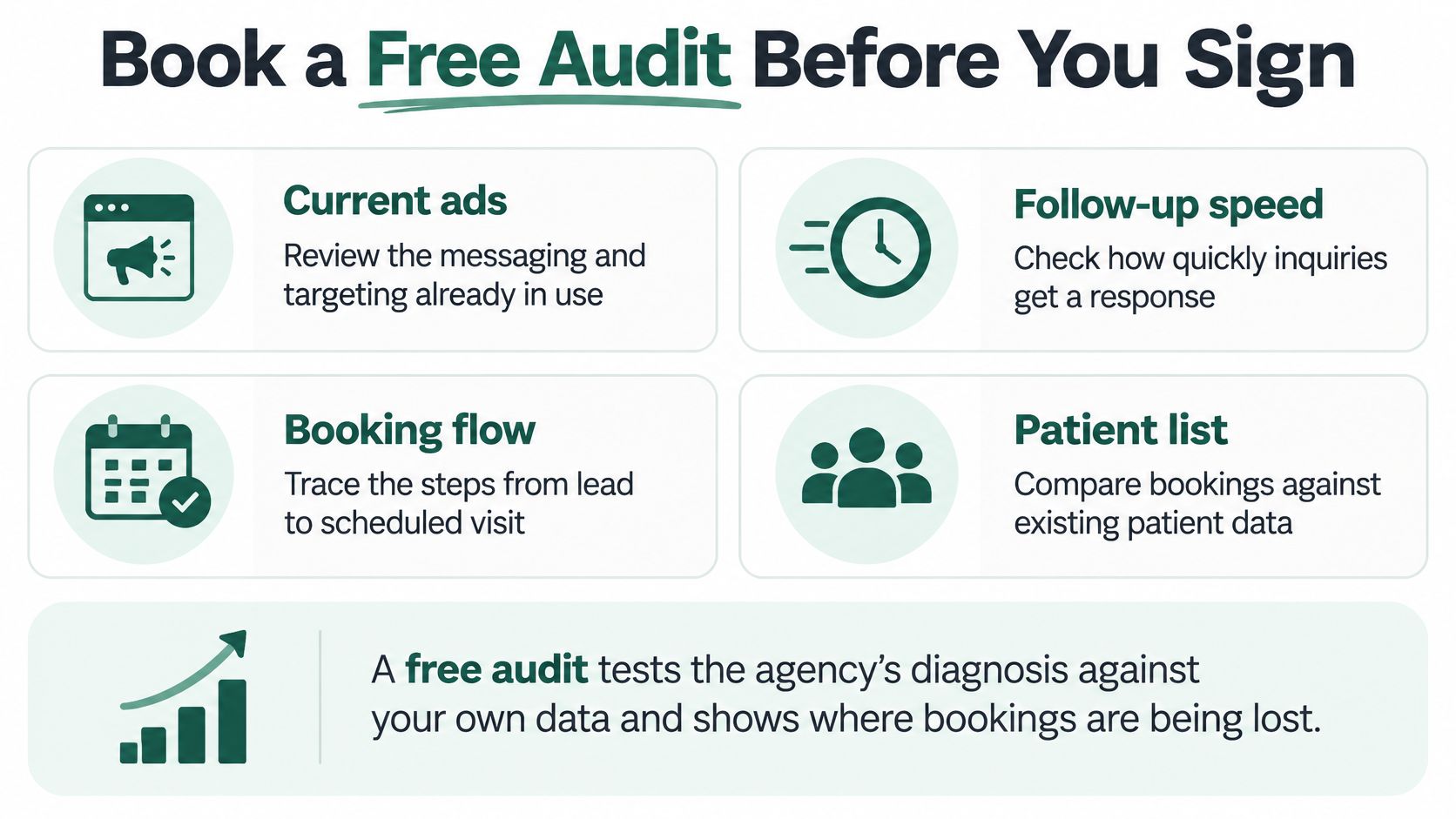
Request an audit before committing to an ongoing contract. It gives you a way to test the agency's diagnosis against your own operation rather than choosing on presentation quality.
Our free marketing audit reviews current ads, follow-up speed, booking flow and the patient list to identify where bookings are slipping through. It provides clear next steps whether or not you choose to work with us.
Use the audit to connect advertising activity with the clinic's actual booking process.
Complete the pre-signing checks
- Request the reply-time figure and its definition. Establish whether it measures an automated receipt, a call attempt or a meaningful conversation.
- Arrange the claims, consent and data-flow review before campaign approval. Name the person responsible for signing off.
- Complete a booking on your phone. Record the steps, note confusing instructions and check what happens when the preferred appointment isn't available.
- Get written answers to every agency-evaluation criterion, including reporting definitions, ownership and handover responsibilities.
Bring campaign reports, booking totals and a description of your current follow-up process. Share patient records only through an approved, access-controlled method, not an ordinary email attachment sent for convenience.
We reply to audit requests within one business day to arrange a short call or send a recorded walkthrough, whichever you prefer. Request the audit, bring your current numbers and don't sign until the checklist is answered in writing.
Med Spa Scalers combines medical-spa advertising with CRM-based follow-up, AI reception, reminders and reactivation to help turn inquiries into booked consultations. Visit Med Spa Scalers to request a free marketing audit and identify where your advertising, response process and booking flow need attention before you increase spending.
See how many patients you're leaving on the table
Get a free marketing audit of your ads, follow-up and booking flow. No pressure, just a clear picture.
Book a free marketing audit