10 Meta Ads Best Practices for Med Spas in 2026

In a 2026 benchmark covering 368 creatives, 15 direct-to-consumer brands, approximately 48.45 million impressions, and $685,791 in spend, the Meta creative fatigue benchmark found that the top 10% absorbed 68% of spend. Meta concentrates delivery in a few ads fast. If those ads produce cheap curiosity instead of booked consultations, your calendar stays empty while Ads Manager looks busy.
That's why most med spa campaigns stall after the click. Owners judge success by cost per lead, then discover the front desk can't contact those leads, they don't book, or they never show. These ten Meta ads best practices follow the patient journey from click to kept appointment, so every decision ties to cost per booked consultation, show rate, and revenue.
Check the metric named in each practice weekly. Don't increase budget until the booking event, follow-up speed, and CRM reporting agree with what Meta reports.
Table of Contents
1. Optimize Campaigns for Booked Consultations, Not Clicks
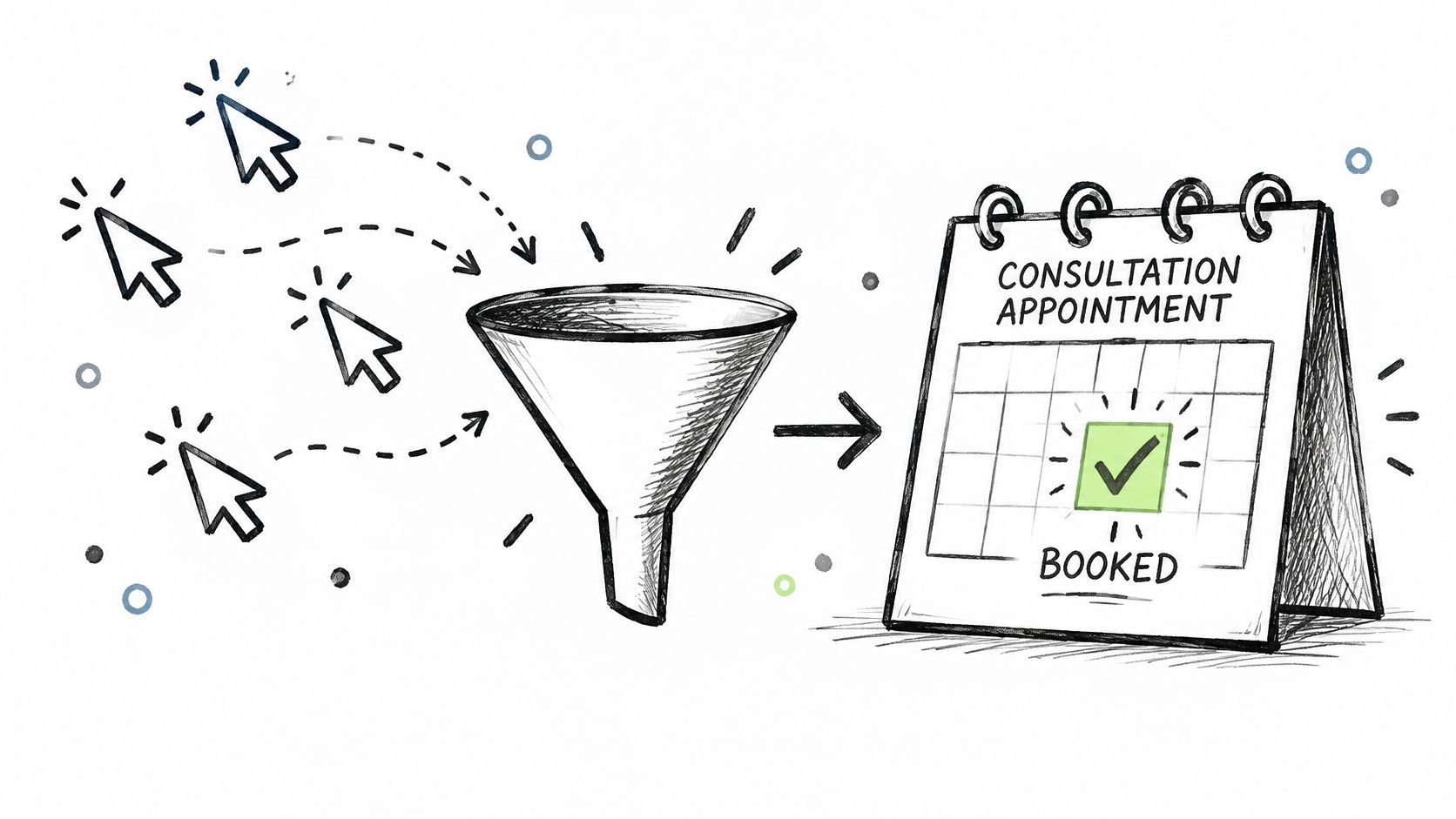
Set the optimization event to a booked consultation, not a click or raw form submit. Traffic and basic Lead objectives find people who tap and fill forms. A Schedule event fired on your confirmed booking page tells Meta to find people who reserve time.
Say a single-location injectables clinic moves from an Instant Form to a Schedule event on its booking confirmation screen. Cost per lead may rise, but cost per booked consultation becomes the decision metric, and the front desk gets fewer unreachable inquiries. That's the trade you want.
Make the Event Clean
- Fire only on confirmation: Trigger the event on the thank-you screen, never when someone merely opens the calendar.
- Keep volume usable: If bookings are too sparse to learn from, use a qualified lead event as a temporary fallback, then move up the funnel.
- Review weekly: Daily booking counts swing too much for reliable budget calls.
Our med spa Facebook ads approach runs Meta and Google ads for your highest-value treatments and tracks them to booked consults, which is the standard you should apply in-house too.
Check this week: cost per booked consultation by treatment, not cost per click.
2. Implement Conversions API with Deduplication and High Event Match Quality
Browser Pixel data alone is no longer reliable. Ad blockers, cookie limits, and phone privacy settings drop events, so Meta learns from an incomplete picture of who booked.
Pair the Pixel with Conversions API (CAPI), which sends events server to server from your website backend, booking system, or CRM. Give the browser and server versions of the same event a shared event_id so Meta deduplicates them instead of counting one booking twice.
Say a multi-location group connects its CRM to CAPI. A confirmed consultation triggers a server event with hashed contact data, the Pixel keeps capturing on-site behavior, and Events Manager totals start reconciling with CRM bookings.
Practical rule: Send only the event name and permitted hashed contact identifiers. Never send health conditions, treatment details, or other sensitive data as event parameters.
Use Meta's Partner Integration or a verified CAPI gateway if you don't have a developer. Run Test Events before launch, then watch Event Match Quality in Events Manager and add permitted customer parameters where match quality is weak. Passing hashed email and phone, plus click identifiers such as fbc and fbp where available, helps Meta match conversions to users.
Check this week: deduplication status and Event Match Quality for your booking event.
3. Structure Campaigns Around Treatment Categories and Funnel Stages
One blended campaign hides your winners. Build separate campaigns by treatment category, such as injectables, laser and skin, body contouring, and weight loss or memberships, then split by funnel stage.
Cold prospecting, retargeting, and patient reactivation behave differently. Separate structures let you set budgets by margin, write creative for each service line, and track cost per booked consultation by treatment without a low-price offer starving a high-value one.
Say a clinic runs prospecting for neurotoxin, laser hair removal, and body contouring, plus one retargeting campaign for pricing page visitors. The team sees which treatment produces booked consults that show, then shifts budget there instead of guessing from combined lead totals.
Keep the Structure Lean
- Start small: A single location usually needs only a handful of active campaigns, not a sprawling account.
- Protect learning: Avoid large, frequent budget or targeting edits that reset optimization.
- Separate reactivation: Past patients convert at a different rate and will distort cold prospecting results.
- Name clearly: Use treatment, objective, and audience in the campaign name so weekly reporting stays readable.
Check this week: cost per booked consultation and show rate for each treatment campaign.
4. Use Broad and Advantage+ Targeting with Strong Creative Signals
Hand-stacked interest lists do less work than they used to. With Advantage+ audience and broad targeting, Meta uses your conversion history, creative, and offer to find likely bookers. For a med spa, your strongest inputs are geography, the treatment message, and clean booking data.
Keep narrow controls where they protect economics. Hold a tight service-area radius, exclude existing patients and recent bookers, and respect age and policy limits for the treatment. Beyond that, let delivery explore.
Say a new laser clinic launches one broad campaign inside its service area with several distinct videos explaining candidacy, downtime, and pricing. As booking events accumulate, delivery finds the neighborhoods and age groups that book, without the team rebuilding interest stacks every week.
Feed that system 5 to 10 distinct creatives per ad set so it can learn which messages attract bookings. If cost per booked consultation rises, check creative fatigue, frequency, and the landing page before you narrow targeting. Tightening the audience often treats a creative problem as a targeting problem.
Check this week: cost per booked consultation by geography inside your radius, plus frequency on your top ad set.
5. Build Custom, Lookalike, and Value-Based Audiences from Your CRM
Your CRM holds better targeting data than any interest list. Patients who booked, showed, paid, and returned tell Meta what a valuable prospect looks like. All leads don't.
Upload hashed customer lists to build Custom Audiences for exclusions and retargeting, then create lookalikes from showed or paying patients. Value-based lookalikes help when you sell both entry-level injectables and high-ticket packages, because Meta can weight the seed by patient value.
Say a clinic builds a lookalike from membership patients from the past year instead of from every form submit. The new campaign starts from proven buyers, which usually produces cleaner bookings than a seed polluted by price shoppers who never showed.
A managed med spa CRM makes this refresh routine instead of a quarterly spreadsheet project.
Build the Lists That Matter
- Paying and showed patients: Your primary lookalike seed.
- Booked but not showed: A separate audience for reminder and recovery creative.
- Recent bookers and patients: Exclude them from cold prospecting.
Refresh lists monthly. Confirm consent and privacy compliance, and don't upload data that reveals a person's health condition.
Check this week: booking rate from lookalike versus broad, using the same offer.
6. Design Lead Forms and Landing Pages That Pre-Qualify and Book
A form shouldn't just collect contact details. It should route the right person to a calendar while interest is highest, and give your team enough context to personalize the first reply.
Keep most prospecting forms to 3 to 5 fields. Ask one qualifying question about treatment interest and, where it fits, one about timeline. Add more friction only for high-ticket services where an unqualified consult wastes provider time. That's the trade-off. Shorter forms produce more leads, longer forms produce cleaner ones.
For context, the WordStream and LocaliQ lead benchmark summarized by The Ad Spend covering 726 lead-objective campaigns from April 2024 through June 2025 reported a median conversion rate of 7.72%. A form can convert at that level and still lose money if leads don't answer, book, or attend.
Say a body contouring clinic uses a five-field Instant Form with treatment and timeline questions. Qualified leads route straight to the CRM, and the confirmation screen offers a calendar link for same-day booking.
Test your page on iPhone and Android. If it loads slowly or the booking button sits below the fold, fix that before buying more traffic.
Check this week: form completion rate, booking rate, and cost per booked consultation by form version.
7. Develop a Creative Testing System with Diverse Formats and Hooks
Creative does most of the targeting now, so one hero ad isn't a system. Start each test with one treatment, one offer, and one changing variable.

The Hunch guide to creative testing on Meta recommends waiting for at least 50 conversion events per variation before declaring a winner, with a test period of roughly five to seven days or longer when volume is limited. Early winners are often random variation on small samples.
Say you test three hooks for one neurotoxin offer: a provider introduction, a what-it-feels-like video, and a common-myths carousel. Hold audience, budget, destination, and conversion event constant, then judge by cost per booked consultation and show rate, not clicks alone.
Watch this walkthrough before you set up your next controlled test:
Produce 3 to 5 new concepts per treatment each month, with at least two videos. State the benefit or question in the first three seconds, add captions, and refresh when frequency climbs and response falls. Get written consent before using any patient or provider likeness.
Check this week: cost per booked consultation by hook, after a full evaluation window.
8. Follow Meta Advertising Policies for Cosmetic, Health, and Weight-Loss Ads
Compliance is a performance issue. A rejected ad stops delivery, a restricted account stops lead flow, and restricted lower-funnel signals can change how you optimize.
Meta's Health and Wellness policy confirms that ads for health and weight-loss services must target people aged 18 or older. Treat that as a floor, not the whole review. Check current Advertising Standards before launching a new treatment category, especially weight loss, compounded medications, or any offer with prescription implications.
Avoid language that calls out personal attributes, implies negative self-perception, or promises guaranteed outcomes. Don't build paid ads around before-and-after imagery without confirming current policy. Provider education, treatment process explainers, FAQs, and consultation-focused offers usually give you a safer and clearer message.
A clinic whose body contouring ad is rejected hasn't lost a creative contest. It has lost selling days while the account sits in review.
Say that clinic replaces the rejected creative with a provider explaining candidacy, downtime, and what happens at the consult. The ad matches the landing page, avoids a guaranteed result, and returns to delivery without rewriting the whole campaign.
Have a named compliance reviewer approve copy, pages, and forms. Check Account Quality weekly so a small rejection doesn't become an account problem.
Check this week: rejected ads, Account Quality warnings, and any claim on your landing page that your ad doesn't support.
9. Automate Fast Lead Response, Follow-Up, and No-Show Recovery
Meta can generate the inquiry. Your response system decides whether it becomes a kept appointment. Prospects often contact several clinics in one sitting, so a lead that waits until morning is usually someone else's booking.
Push Instant Form leads straight into your CRM and trigger an automated text within 60 seconds. Include one clear next step, such as a calendar link, and ask about treatment interest. A human or AI receptionist should qualify and book from there, with a personal follow-up during business hours for anyone who doesn't self-book.
Our med spa speed to lead study looks at how response time affects bookings across 186,400 leads, which is why we focus on reply speed, reminders, and reactivation before asking a clinic to spend more on ads.
After the First Minute
- Keep following up: Use a timed SMS, email, and call sequence for leads who don't book, respecting consent, opt-outs, and reasonable hours.
- Remind twice: Send consultation reminders 24 hours and 2 hours before the appointment.
- Recover no-shows politely: Send an easy reschedule link, not blame or pressure.
Check this week: median response time, contact rate, booking rate, and show rate by treatment.
10. Measure Cost per Booked Patient with Call, Form, and Source Tracking
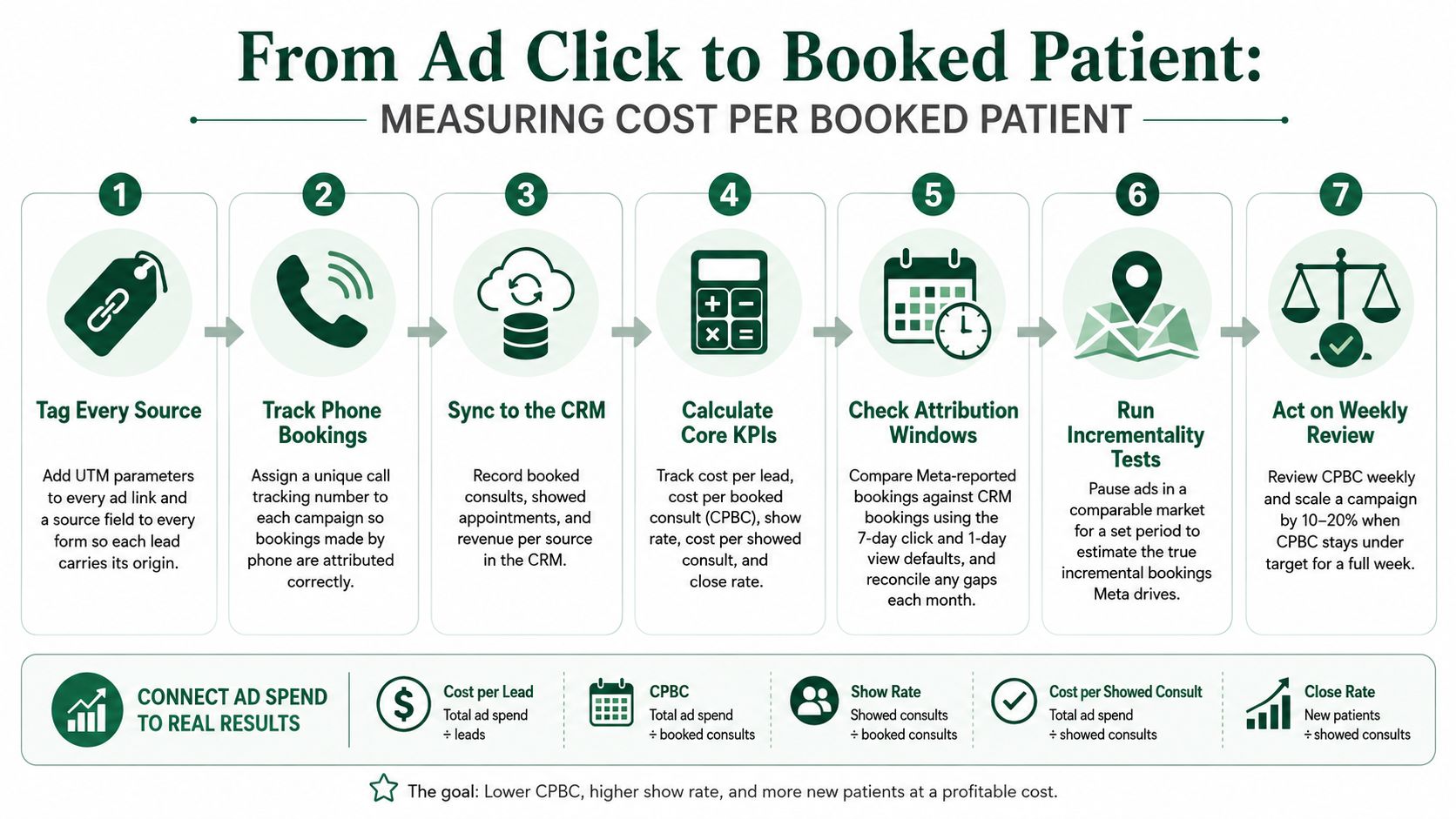
Clicks don't pay rent. Reporting should connect spend to leads, bookings, kept appointments, closed treatments, and revenue, broken out by campaign and by treatment.
Build that chain before you judge performance. Put UTMs on every ad URL, call tracking numbers where calls matter, a source field on every form, and CRM stages for qualified lead, booked consultation, attended appointment, and completed treatment. Every call and form should trace back to the ad, page, or channel that produced it. When a body contouring prospect phones instead of submitting a form, the tracking number is what keeps that booking attributed to the right campaign instead of vanishing into "direct." Keep patient identifiers out of URL parameters and any field Meta can read; attribution only needs the source.
Ads Manager shows Quality, Engagement, and Conversion rate rankings for each ad, comparing it with other ads competing in the same auction. Use those rankings to diagnose creative, not to declare business success.
Budget decisions run on three numbers: cost per booked consultation, cost per showed consult, and revenue per kept patient. A three-location group might find body contouring costs more per booked consult than injectables yet produces far more revenue per showed consult. Fund it to its value; cutting it on a worse front-end number starves a strong service line.
Reconcile Meta-reported bookings against CRM bookings monthly, since platform counts and front-desk records rarely match exactly. Scale spend gradually, and only after cost per booked consultation and cost per showed consult hold for a full week. For a cleaner read on incremental bookings, run a periodic geo holdout by pausing a comparable market.
Check this week: cost per showed consult and revenue per channel, not platform cost per lead alone.
How the 10 Meta ads best practices compare by metric, funnel stage, and main constraint
| Item | Primary Metric | Funnel Stage | Main Constraint |
|---|---|---|---|
| Optimize Campaigns for Booked Consultations, Not Clicks | Cost per booked consultation | Bottom-funnel conversion | Booking events are low-volume and may slow learning |
| Implement Conversions API with Deduplication and High Event Match Quality | Event Match Quality | Tracking and attribution | Technical setup, deduplication, and sensitive-data safeguards |
| Structure Campaigns Around Treatment Categories and Funnel Stages | Cost per booked consultation by treatment | Prospecting, retargeting, and reactivation | Too many campaigns can fragment conversion data |
| Use Broad and Advantage+ Targeting with Strong Creative Signals | Cost per booked consultation | Prospecting | Needs conversion data and tight geographic controls |
| Build Custom, Lookalike, and Value-Based Audiences from Your CRM | Audience match and booked-consultation performance | Retargeting and prospecting | Requires clean CRM data, sufficient seed size, and compliant data use |
| Design Lead Forms and Landing Pages That Pre-Qualify and Book | Lead-to-booking rate | Lead capture and booking | Balancing form simplicity with lead quality |
| Develop a Creative Testing System with Diverse Formats and Hooks | Cost per booked consultation by creative | Awareness and consideration | Production effort and policy-compliant creative |
| Follow Meta Advertising Policies for Cosmetic, Health, and Weight-Loss Ads | Ad approval and account health | All stages | Changing policies and category-specific restrictions |
| Automate Fast Lead Response, Follow-Up, and No-Show Recovery | Response time and show rate | Lead follow-up through appointment attendance | Consent requirements and avoiding impersonal or excessive messaging |
| Measure Cost per Booked Patient with Call, Form, and Source Tracking | Cost per booked and showed consultation | Full funnel through revenue | Attribution gaps across ads, CRM, and phone bookings |
Where to Start: Fixing Your Meta Ads Stack This Month
Start with measurement and follow-up, not a bigger budget. Confirm your booking event fires only on a confirmed consultation, test your Pixel and CAPI events for deduplication, and compare Meta-reported bookings with CRM bookings for the past month. If those numbers don't reconcile, every later decision is built on noise.
Next, submit a test lead from your own phone. Time the first text, follow the booking link, and see how long a real person takes to reply if you don't book. Check whether the lead lands in the right pipeline with the right source, treatment, and owner. Fix slow routing, missing consent handling, and dead-end thank-you screens before you touch targeting.
Once the plumbing holds, rebuild the account around treatment categories and funnel stages. Keep the structure lean enough for each campaign to collect meaningful booking volume. Give broad and Advantage+ campaigns several distinct creatives, exclude current patients, and build lookalikes from showed and paying patients instead of from every inquiry you've ever received. Ads typically need 60 to 90 days to optimize fully, so judge structural changes over full weekly cycles instead of reacting to one slow Tuesday.
Then put creative on a production calendar. Test one variable at a time, hold audience and budget steady, and promote a winner only after it produces enough booked consultations to trust. Turn the winning hook into the control for the next test. Refresh concepts monthly before frequency pushes your acquisition cost up, and run every new weight-loss, injectable, laser, or body contouring claim through a compliance review before launch.
Review one simple scorecard every week: spend, leads, median response time, contact rate, booking rate, cost per booked consultation, show rate, cost per showed consult, and revenue. Share it in plain English with the owner and front desk. When the front desk can see which campaigns produce patients who arrive, they prioritize follow-up differently, and your media decisions get better feedback.
If you want an outside read before rebuilding, Med Spa Scalers offers a free marketing audit that reviews your ads, follow-up speed, booking flow, and patient list, and shows where bookings are slipping through. Every engagement begins with that audit, after which the system is built, run monthly, and reported on what it produces. Your ad accounts, CRM data, and patient list stay in your name, and monthly reporting includes what didn't work and what is changing.
Fix the booking event this week. Fix response time next. Then earn the right to scale.
Med Spa Scalers builds Meta and Google ad campaigns tracked to booked consultations, with CRM automation, AI reception, reminders, and no-show recovery on GoHighLevel, so inquiries get a fast reply and a clear path to the calendar. Visit Med Spa Scalers to request a free audit of your ads, follow-up speed, and booking flow before you spend more on Meta.
See how many patients you're leaving on the table
Get a free marketing audit of your ads, follow-up and booking flow. No pressure, just a clear picture.
Book a free marketing audit