Cosmetics Marketing Agency: What It Does and How to Choose

Online beauty sales grew 9 times faster than in-store sales in 2025, and North America recorded 21% online growth, according to NielsenIQ's State of Beauty 2025 report. That gap is the whole agency decision. Reach that never becomes an order, a booked consult, or a kept visit is a cost, not a result.
A cosmetics marketing agency should be hired to move money through a funnel you can audit, not to collect impressions. For a med spa or aesthetics clinic, the only score that matters is booked and kept revenue by channel. Clicks, followers, and engagement are inputs. If an agency can't show where those inputs die between the ad and the chair, you're buying activity.
Table of Contents
- What a Cosmetics Marketing Agency Does Across Channels
- Why Trackable Channels Now Take the Budget
- How to Read Performance Through the Funnel
- Why Reply Speed Decides Who Books
- Where Influencers and AI Fit Without Hurting Trust
- How to Judge an Agency Before You Sign
- Brief Your First Agency With Three Questions
What a Cosmetics Marketing Agency Does Across Channels
A cosmetics marketing agency plans and runs the paid media, search, social, and follow-up that help skincare, makeup, and aesthetic treatment businesses get found, chosen, and rebooked. The job has three parts. Get in front of the right person. Turn that interest into a purchase or a booked consultation. Bring them back for the next product or the next treatment in a series.
Brand-side work and clinic-side work share labels but have different outcomes. A product brand is judged on orders. A med spa is judged on consultations that are kept and, often, on a treatment series. Ask which business the agency runs before you compare proposals.
| Service | What it covers | Judge it by |
|---|---|---|
| Paid search and paid social | Meta and Google campaigns for high-value treatments or products | Cost per booked consultation or order |
| Local SEO and Google Maps | Treatment pages, reviews, and map listings | Calls, direction requests, and booked consults from local search |
| Landing pages and offers | Forms, offers, and pages built around one treatment | Inquiry conversion rate by page |
| Lead response and CRM | Instant SMS, AI call handling, and pipelines | First response time and contact rate |
| Social media and DM follow-up | Content plus DM conversations that lead to appointments | DMs converted to consultations |
| Influencer partnerships | Creator content and paid partnerships | Assisted bookings, not reach alone |
| Reactivation and retention | Campaigns to dormant patient or customer lists | Rebooked patients and revenue from the list |
Three jobs, one scoreboard
Getting found covers Meta and Google for injectables, lasers, body contouring, or a hero SKU, plus local SEO and Google Maps for clinics. Getting chosen is the landing page, the offer, the form, and the DM or phone conversation that books the consult. Getting them back is reactivation of a dormant list and reminders that protect show rate.
We run those pieces as one system on GoHighLevel: ads tracked to booked consults, an AI receptionist, speed-to-lead, reminders, no-show recovery, and social content with DM follow-up. Creative that looks busy and never books is a failed service, whatever the deck says.
Before the first sales call, write the services you need and the single metric beside each one. If a proposal can't name that metric, it isn't a plan.
Why Trackable Channels Now Take the Budget
U.S. cosmetics and personal-care advertising expenditures exceeded $4 billion in 2021, across television, radio, print, out-of-home, cinema, and digital, and U.S. beauty advertisers spent about $373 million in January 2023 alone, per Statista's overview of U.S. beauty and cosmetics advertising. Agencies aren't competing in a quiet niche. They're competing for a slice of a crowded, high-budget market. Proof beats a prettier mood board.
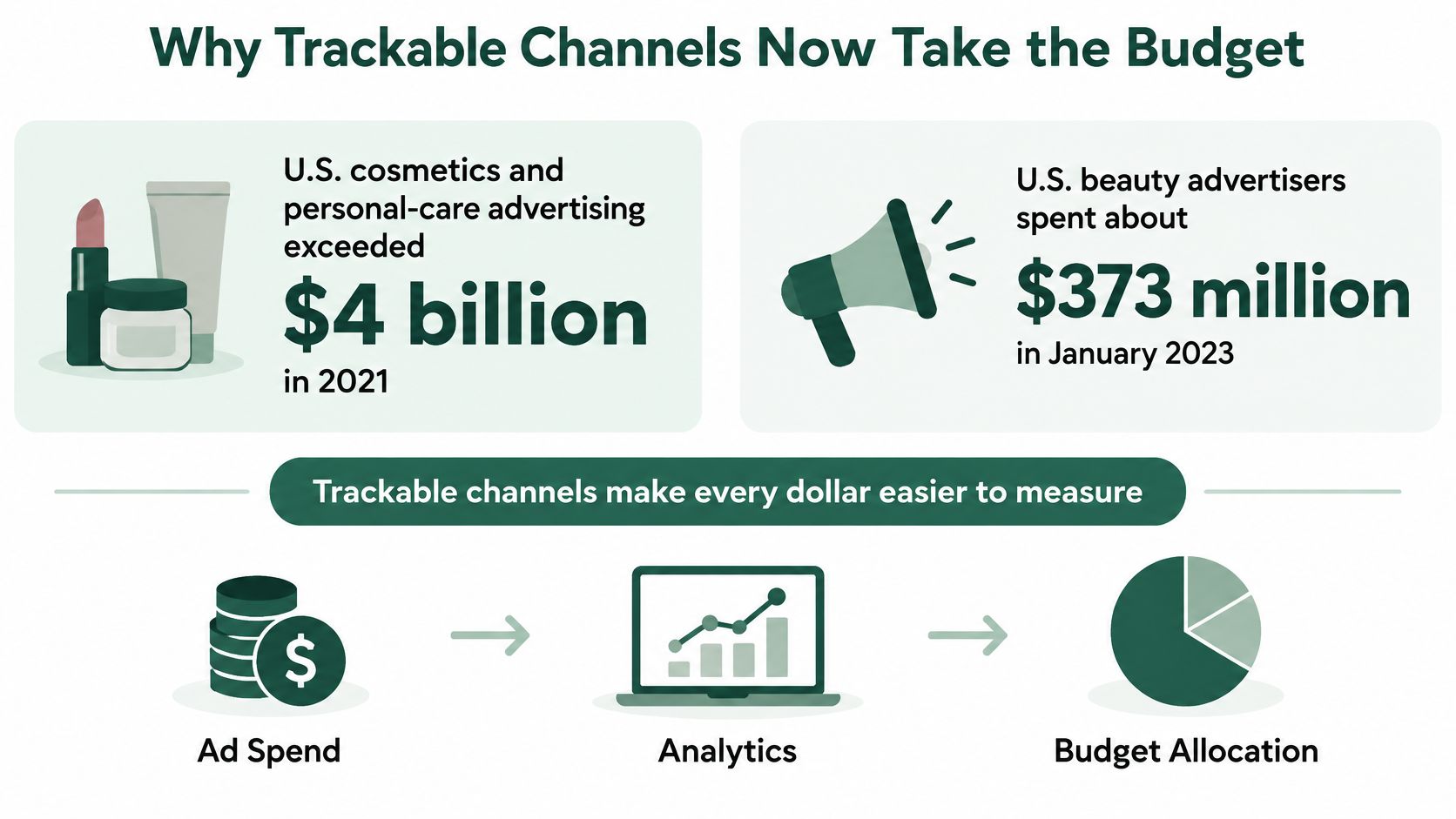
A television spot can report impressions and almost never show what it sold. Paid search, paid social, a treatment landing page, CRM follow-up, and attribution can show cost per lead and cost per kept appointment. Picture two campaigns that each reach the same number of people. The TV buy ends at "we were seen." The Meta lead campaign can show who asked for a consult and who sat in the chair.
What the biggest advertisers already did
L'Oréal reported that 79.2% of its media investment was digital in 2025, up from 78.6% in 2024, with advertising and promotion at about €14.178 billion, equal to 32.2% of sales. Unilever reported that digital was more than 70% of brand and marketing investment in 2025, up from 40% in 2021. That's an operating model, not a platform fad. Spending near a third of sales only works if someone can say which touch produced the sale.
For a med spa buyer, the same rule is local. The agency should name the outcome it owns, booked consults or kept appointments, and show the report. A useful primer on splitting credit across those touches is SourceLoop on budget and ROI gains. If you're comparing paid search setups, start with how med spa PPC ties spend to consults rather than to traffic. Every test that follows depends on that shift from reach to a number you can defend.
How to Read Performance Through the Funnel
A 2026 benchmark for Beauty & Personal Care paid search lists a 6.75% click-through rate, a $4.62 average cost per click, a 10.35% conversion rate, and a $39.25 cost per lead, as published in Cassandra's 2026 Google Ads benchmarks. Treat all four as directional. The "conversion" in that study is a form fill, and a form fill is not a qualified consult, a kept visit, or a purchased treatment. Your actual numbers will move with your city, your offer, ad-policy limits on medical claims, local competition, and the value of the procedure behind the click.
| Funnel stage | Metric | Reference value |
|---|---|---|
| Impressions to clicks | Click-through rate | 6.75% (Beauty & Personal Care paid search, 2026) |
| Cost per click | Average CPC | $4.62 |
| Clicks to leads | Conversion rate (form submission) | 10.35% |
| Lead acquisition | Cost per lead | $39.25 |
| Leads to booked consultations | Booked-consultation rate | Bookings divided by leads, split by treatment |
| Booked to kept appointments | Show rate | Kept appointments divided by bookings |
| Kept appointments to revenue | Revenue per kept treatment | Collected revenue after discounts, per kept visit |
The math that actually decides the channel
Cost per booked consultation is ad spend divided by bookings. Cost per kept appointment is ad spend divided by kept appointments. Contribution margin is revenue minus no-shows, discounts, provider time, and fulfillment. Run the arithmetic on your own leads: a $39.25 lead that books one time in twenty produces a consult that costs roughly $785, while a $90 lead that books one time in four costs $360. Cheap leads are not cheap consults.
Read the table top to bottom and fix the first stage that leaks. A strong click-through rate with a weak conversion rate points at the landing page. Plenty of leads with few bookings points at follow-up. Healthy bookings with a poor show rate points at reminders and deposits. Only then does ad spend deserve scrutiny.
Each channel needs its own landing page, call-tracking number, CRM source field, and treatment report for injectables, laser, body contouring, and weight-loss programs. Without that split, a cheap source looks efficient while its contact rate, booking rate, or show rate fails. Teams producing treatment-level creative variations through tools like Codex for content creators still have to trace each variant back to bookings, not to views.
Reactivation belongs on a separate line, because it needs no new ad spend. For Serenity Face & Body in Columbus, Ohio, a campaign to 3,860 dormant patients rebooked 313 of them and brought in $108,400 in 45 days. Judge your patient list the same way you judge a channel: revenue produced against effort spent.
Practical rule: Review one treatment every week on spend, leads, contacted leads, bookings, show rate, kept appointments, revenue, and contribution margin. Kill or fix the stage that leaks, not the whole account.
Why Reply Speed Decides Who Books
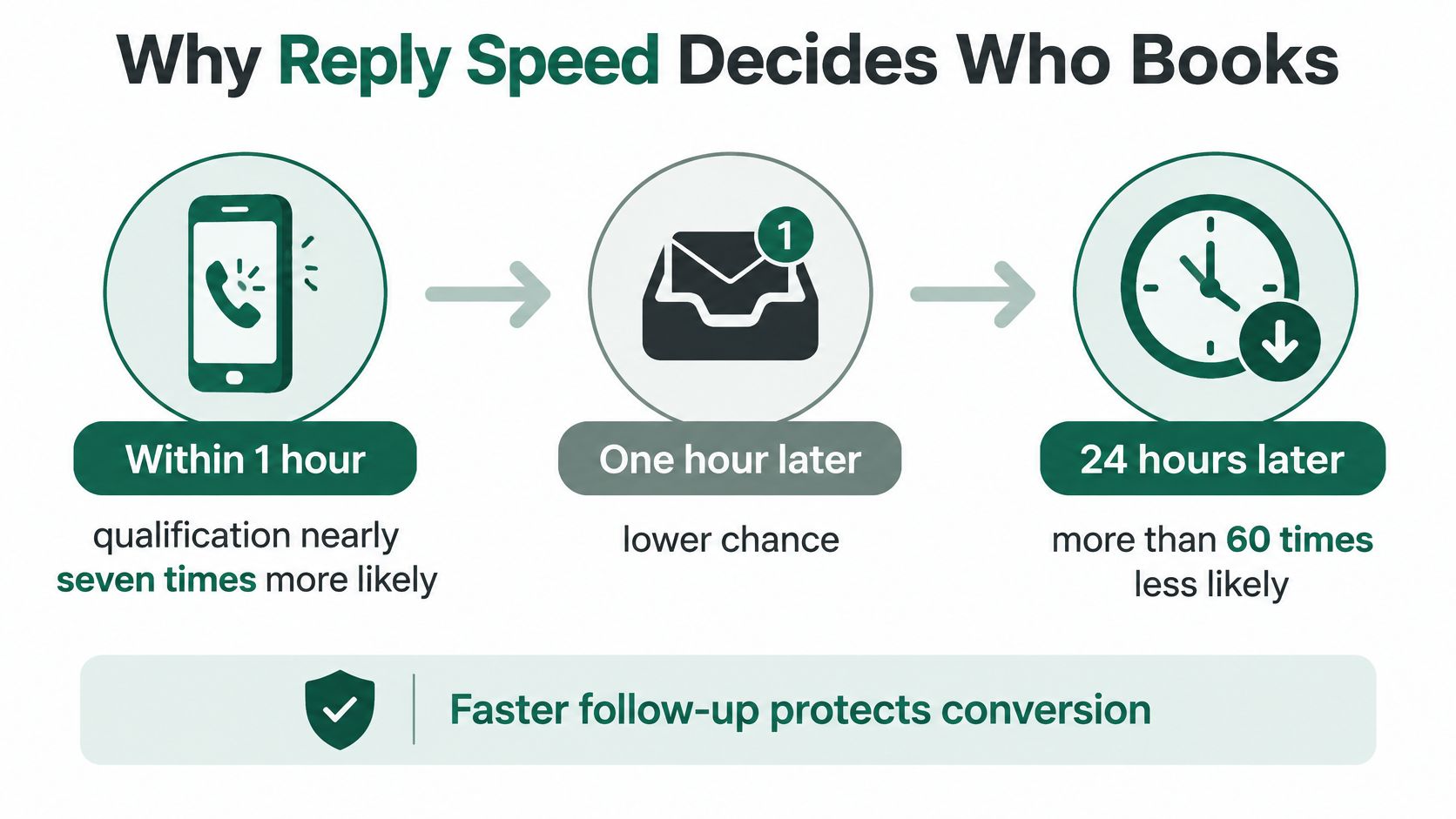
In a study of 1.25 million leads across 29 business-to-consumer and 13 business-to-business companies, contacting a new lead within one hour made qualification nearly seven times more likely than waiting another hour, and more than 60 times more likely than waiting at least 24 hours, according to Digital Applied's speed-to-lead benchmarks. The same playbook cites an audit of 2,241 U.S. companies in which only 37% responded within one hour, 23% never responded, and the average reply among companies that did answer was 42 hours.
Neither study measured med spas, so treat the figures as directional benchmarks. They show the size of the speed penalty, and your own numbers will differ by market and offer.
The lead is already talking to the next practice.
The workflow every inquiry should hit
Route every Meta, Google, website, and phone inquiry through one path. Med Spa Scalers' CRM and automation service, built on GoHighLevel, runs this path with an AI receptionist, speed-to-lead follow-up, reminders, and no-show recovery.
- Capture the lead with source and treatment. Later metrics only split by channel if those fields exist on day one.
- Send an immediate SMS confirmation. The person knows a human, or a clearly disclosed assistant, has the request.
- Route calls and missed calls to AI-assisted handling or a staff alert. Escalate clinical questions about medications or candidacy to a licensed person.
- Run a timed follow-up over several days. One text is not a system. A lead follow-up system is a sequence with an owner.
- Offer self-booking and reminders. The calendar link removes the phone tag that creates no-shows.
- Track median first-response time, contact rate, qualified-consultation rate, and booked-consultation rate by treatment and channel. "Lead generated" is not a KPI.
After Lumière Aesthetics in Scottsdale added instant SMS follow-up, self-booking, three-step reminders, and review requests, reply time was 38 seconds, booked rate was 37%, and cost per new patient was $108. At Glow Theory Laser & Skin in Vancouver, an AI receptionist, qualifying instant forms, and deposits at booking cut missed calls to 3% and cost per new patient to $88.
Neither gain came from buying more traffic. Both came from closing the gap between inquiry and booking, the stage an agency report skips when it stops counting at leads.
Run the workflow on one channel for 30 days. Compare reply time, contact rate, and booked rate with the two weeks before it started.
Set a sub-60-second reply target as a service objective, then validate it against booked and kept appointments. Results still depend on your market, your offers, and your team.
Where Influencers and AI Fit Without Hurting Trust
Influencer reach is the default pitch, and the trust numbers don't support making it the engine. McKinsey's 2025 global beauty research found that only 18% of consumers consider influencers their most trusted source of beauty information, while 83% believe AI can provide better beauty recommendations than people. The same industry evidence, from AlixPartners, ranked influencer relationships last among purchase motivators, with 57% of consumers considering them important, and noted limited ROI as paid-partnership spending rose.

Use creator content for awareness and social proof. Then connect it to search, reviews, CRM follow-up, and retargeting so a booking can be attributed across social, search, phone, and the follow-up sequence. If the creator post can't be tied to an assisted consult, it's a branding expense. Judge it that way. Creative tests belong in an ad creative strategy that reports assisted bookings, not follower growth.
Personalization with a boundary
A 2025 Fashion Institute of Technology beauty survey found that 86% of respondents were open to fully personalized, AI-generated beauty products, about 70% were willing to exchange some privacy for greater relevance, and 45% were comfortable with AI automatically repurchasing products, as detailed in the FIT beauty and AI white paper. Willingness is not permission to store skin photos, medications, or body-image notes.
For a med spa, collect only what you need to qualify and book. Disclose when AI is in the conversation. Get consent. Restrict staff access. Keep a human professional on clinical questions.
Does the automation raise booked and attended consultations without raising complaints or opt-outs? If it doesn't, turn that step off.
How to Judge an Agency Before You Sign
The strongest signal is how the agency defines success. Impressions and clicks mean they're managing activity. Booked consultations, cost per booking, show rate, and cost per kept appointment mean they're managing outcomes.
| Criterion | Good sign | Red flag |
|---|---|---|
| Measurement | Reports booked consultations and cost per booking | Reports impressions and clicks only |
| Data ownership | Ad accounts, CRM data, and patient lists stay in your name | Agency holds the ad accounts or the list |
| Pricing | Setup fee, retainer, and ad spend listed separately | Vague fees, or ad spend hidden inside the retainer |
| Speed to lead | Target reply time stated and monitored | No described process for new inquiries |
| Treatment experience | Playbooks for injectables, lasers, body contouring | One generic playbook for every service |
| Promises | Commits to process and reporting, not patient counts | Guarantees a fixed number of patients |
| Reporting | Monthly, plain-language, tied to bookings and show rates | Dashboard only, with no booking data |
Why each line protects you
Measurement stops a busy month from looking like a profitable one. Data ownership is essential. Ad accounts, CRM data, and the patient list stay in your name, and they stay with you if you stop working with us. If the contract ends and the list walks out the door, you paid to build someone else's asset.
Pricing should show a one-time setup fee, a monthly retainer, and ad spend you pay directly, which is how our Growth System is structured. Published "typical" agency fees aren't a reliable comparison, so ask for an itemized written quote. Exact pricing comes after a free audit, once the clinic's needs are known.
Speed to lead should name a reply-time target and the report that shows whether it was met. Treatment experience matters because a lip-filler consult, a laser package, and a weight-loss membership don't share one offer or one show rate. Promises are the tell. We don't guarantee a patient count, because results depend on the market, the offer, and your team. We do commit to fast follow-up on every lead, clear reporting on booked consults, and month-to-month improvement. A fixed patient guarantee is a red flag.
Reporting should arrive monthly in plain language, tied to bookings and show rates. A traffic dashboard with no booking data is a stall.
Brief Your First Agency With Three Questions
Walk in with three questions and don't leave without answers in writing.
Which measurable outcome will you move? Cost per booked consultation, show rate, or rebooked patients. Pick one primary number for the first month.
What happens to our ad accounts, CRM data, and patient lists if we stop? The acceptable answer is that they stay in your name.
How fast will every new inquiry get a first response, and how is that measured? Ask for the target and the report, not a vibe.

Two checks on the first call
Ask which treatment playbooks they've run, injectables, lasers, body contouring, or weight loss, and which reply-time target they'll put in the agreement. A generic "full-service beauty" answer is a mismatch for a clinic.
Then take a low-risk first step. Our free marketing audit reviews ads, follow-up speed, booking flow, and the patient list, and it shows where bookings are slipping. Every engagement starts there. After that we build the system, run it monthly, and report what it produces. We reply to audit requests within one business day, either to schedule a short call or to send a recorded walkthrough.
Use the first month as a test, before you add ad budget:
- Week 1. Audit and baseline spend, leads, contact rate, bookings, show rate, and revenue by treatment.
- Week 2. Fix response time and the follow-up sequence.
- Week 3. Reactivate the existing patient list.
- Week 4. Review cost per booked consultation by treatment. Only then decide whether more media spend is earned.
Med Spa Scalers can be judged with those same questions and that same 30-day test. Nothing is promised in advance. Choose the agency that writes down the funnel numbers it will move before you sign a budget.
Med Spa Scalers builds the path from Meta and Google ads to a kept appointment, with CRM follow-up, an AI receptionist, and reactivation for U.S. med spas and aesthetic clinics. If you want an agency judged on booked and kept revenue rather than reach, start with a free look at where your consults are leaking. Visit Med Spa Scalers and request the audit.
See how many patients you're leaving on the table
Get a free marketing audit of your ads, follow-up and booking flow. No pressure, just a clear picture.
Book a free marketing audit