Meta Ads Agency: What It Does and How to Choose One
Your report shows impressions and clicks climbing. Your front desk shows something else, a quiet phone, a thin calendar, and no clear answer for what the spend produced. That gap is where most Meta campaigns fail. A good agency closes it by connecting the ad to a booked and kept appointment, not by reporting a cheaper click. This guide explains what a Meta Ads agency should do, how it charges, and what to verify before you sign.
Table of Contents
- Pixel, Conversions API, and the CRM Working Together
- Why Attribution Windows Keep Moving
- The Privacy Rule Clinics Cannot Skip
- The Metric Ladder From Lead to Revenue
- One Example That Makes the Gap Obvious
- Why Real Time CRM Feedback Changes the Numbers
What a Meta Ads Agency Actually Does
Say you're a med spa owner watching Ads Manager on a Monday morning. Reach is up, link clicks look healthy, and the agency calls it a strong week. Yet nobody can tell you how many of those clicks became consultations, how many people showed up, or what a new patient cost you.
That's the difference between buying media and running a system. A Meta Ads agency plans, builds, runs, and reports paid campaigns on Facebook and Instagram. The stronger ones own the whole path, from the first ad view through the form, the follow up, and the appointment itself.
Seven Jobs, One Continuous Path
When an agency stops inside Ads Manager, the valuable handoffs go unmeasured. A lead can sit untouched for hours, a booking can never reach the CRM, and a no show can look identical to a patient who started treatment. Each service below should leave you with a document or report you can inspect.
Core services a Meta Ads agency should cover
| Service | What it covers | What you should receive |
|---|---|---|
| Strategy and goal setting | Choosing campaign objectives and the offers to promote | A written plan tied to a business goal such as booked consultations |
| Creative production | Images, video and ad copy tested against each other | A creative testing log and a refresh schedule |
| Audience building | Prospecting, lookalike and retargeting audiences | Audience definitions and exclusion lists |
| Tracking and events | Pixel, Conversions API and CRM event connections | An event map and a match quality check |
| Landing pages and forms | Pages and lead forms that capture inquiries | Conversion rate by page and form |
| Lead handling | Follow up speed and the booking flow after the click | Response time and booking reports |
| Reporting | Weekly delivery checks and monthly results | A report linking spend to booked and kept appointments |
What Full Scope Looks Like in Practice
Consider one treatment, such as a laser package, sold as a stand alone offer. The agency writes the ads, builds a page that repeats the same promise, connects the form to your CRM, and triggers an immediate text when someone submits it. You then see one chain of numbers instead of five disconnected screenshots.
That's how we work. We run Meta and Google ads for a med spa's highest value treatments and track them to booked consults, so budget decisions rest on appointments rather than traffic. Judge every row in the table by the same test. Ask what proof you'll receive, who owns it, and how it connects to the next step.
How a Meta Campaign Runs From Setup to Results
A campaign is a chain of decisions. A weak link at any step raises your cost per booking, even when the ads themselves are fine. The sequence below shows what should happen, why it matters, and where owners usually lose money.
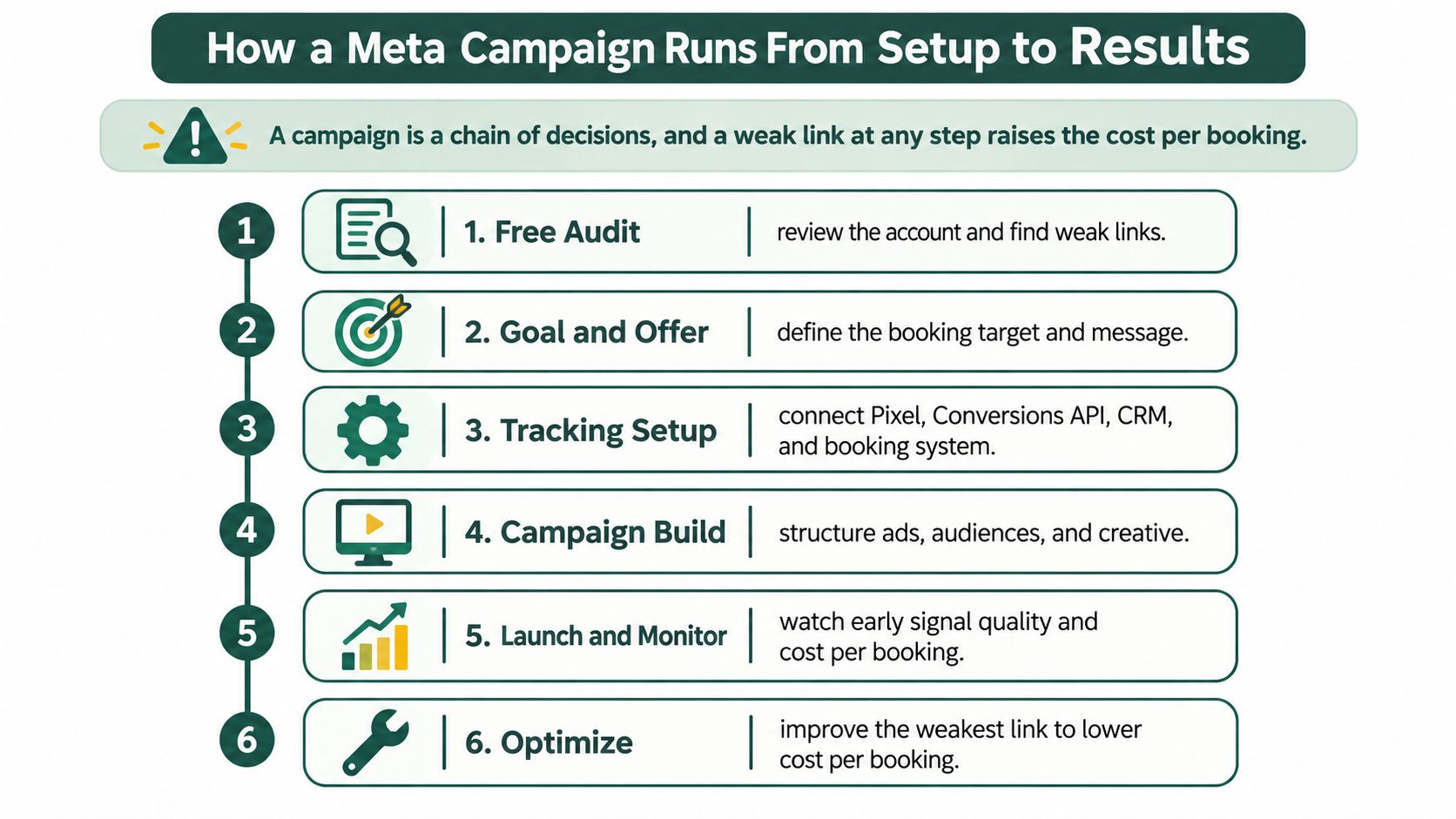
The Six Steps in Order
Run a free audit first. Review current ads, landing pages, lead follow up, and the booking flow to find where inquiries leak out. The common mistake is skipping this and rebuilding ads on top of a broken follow up process.
Set the goal to a business event. Your target should be a booked consultation, not a generic lead or a page view. Meta optimizes toward whatever you ask for, so asking for cheap form fills produces cheap form fills.
Map the funnel before you launch. Define each stage as Lead, Contacted, Qualified, Consultation Booked, Consultation Attended, and Treatment Started, then send the later stages back to Meta. Launching before tracking works means your first weeks of spend teach the system nothing useful.
Build creative for one treatment at a time. Produce three to five ad variations per audience, each with a distinct angle, and match the landing page headline to the ad promise. A sound ad creative strategy tests significantly different hooks rather than the same image with a new headline.
Launch with a test budget and a realistic clock. Expect 60 to 90 days before the account is fully optimized, because the system needs conversion volume to learn. Judging a campaign after three days usually kills ads that haven't had a fair test.
Check weekly, decide monthly. Review delivery every week, then pause weak ads and move budget toward the offers producing kept appointments. Every engagement with us begins with a free audit, after which we build the system, run it monthly, and report on what it produces.
Practical rule. Never increase budget to fix a problem you haven't located. Find the leaking stage first, then decide whether it needs money or a process change.
What to Have in Writing Before Launch
Ads, follow up, and reactivation should run every month, with a report on leads and booked appointments. Before the first ad goes live, get these items confirmed in writing.
- Goal event. The exact event name and definition you'll optimize toward.
- Tracking map. Which events fire from the browser, the server, and the CRM.
- Response owner. Who contacts a new lead, through which channel, and how fast.
- Review cadence. When you'll see delivery checks and when you'll see booking results.
- Stop point. The result that triggers a pause, a rebuild, or a budget change.
How Meta Ads Agencies Charge and What You Pay For
Your agency fee is only part of the cost. Ad spend is usually paid separately to Meta, and creative production may be a third line. Owners get surprised when they compare one agency's all in quote against another agency's management fee alone, so separate the three numbers before you compare anything.
Five Fee Models Side by Side
Meta ads agency fee models compared
| Fee model | How it is billed | Best fit | Watch for |
|---|---|---|---|
| Flat monthly retainer | A fixed fee every month for management and reporting | Steady budgets and ongoing optimization | The fee continues even when results slip |
| Setup fee plus retainer | A one time build of tracking, creative and funnel, then a monthly fee | Businesses starting from scratch | Confirm who owns the accounts and setup assets |
| Percentage of ad spend | A fee calculated as a share of the media budget | Large, steady budgets | Rewards higher spend, not better bookings |
| Performance bonus | A base fee plus a payment tied to agreed results | Clear, measurable goals | The result must be defined as booked or kept appointments |
| Project based | A fixed price for a defined deliverable such as a launch or audit | One time needs | Little optimization after the project ends |
The Incentive Hidden in Percentage Fees
Percentage of spend looks simple, and that's its appeal. It also pays the agency more when your budget rises, whether or not bookings rise with it. A flat retainer avoids that conflict but keeps billing when performance stalls, so pair either model with a written review point tied to kept appointments.
Med Spa Scalers uses a one time setup fee plus a monthly retainer, and the client pays ad spend directly. That keeps the media budget visible on your own card and in your own account. We share exact pricing after the free marketing audit, once your clinic's needs are known, because a clinic with working tracking needs a different build than one starting from zero.
Ask every provider three questions. What's included in the fee, and what's billed separately? Who pays Meta, and from whose account? What happens to the creative, audiences, and tracking setup if the contract ends?
Tracking Setup Behind Reliable Meta Reporting
A browser Pixel alone is not enough, and treating it as enough is the most common technical mistake in med spa accounts. Browsers block scripts, people switch devices, and the events that matter most, a kept consultation or a started treatment, happen offline days later. Your reporting is only as good as the signals feeding it.
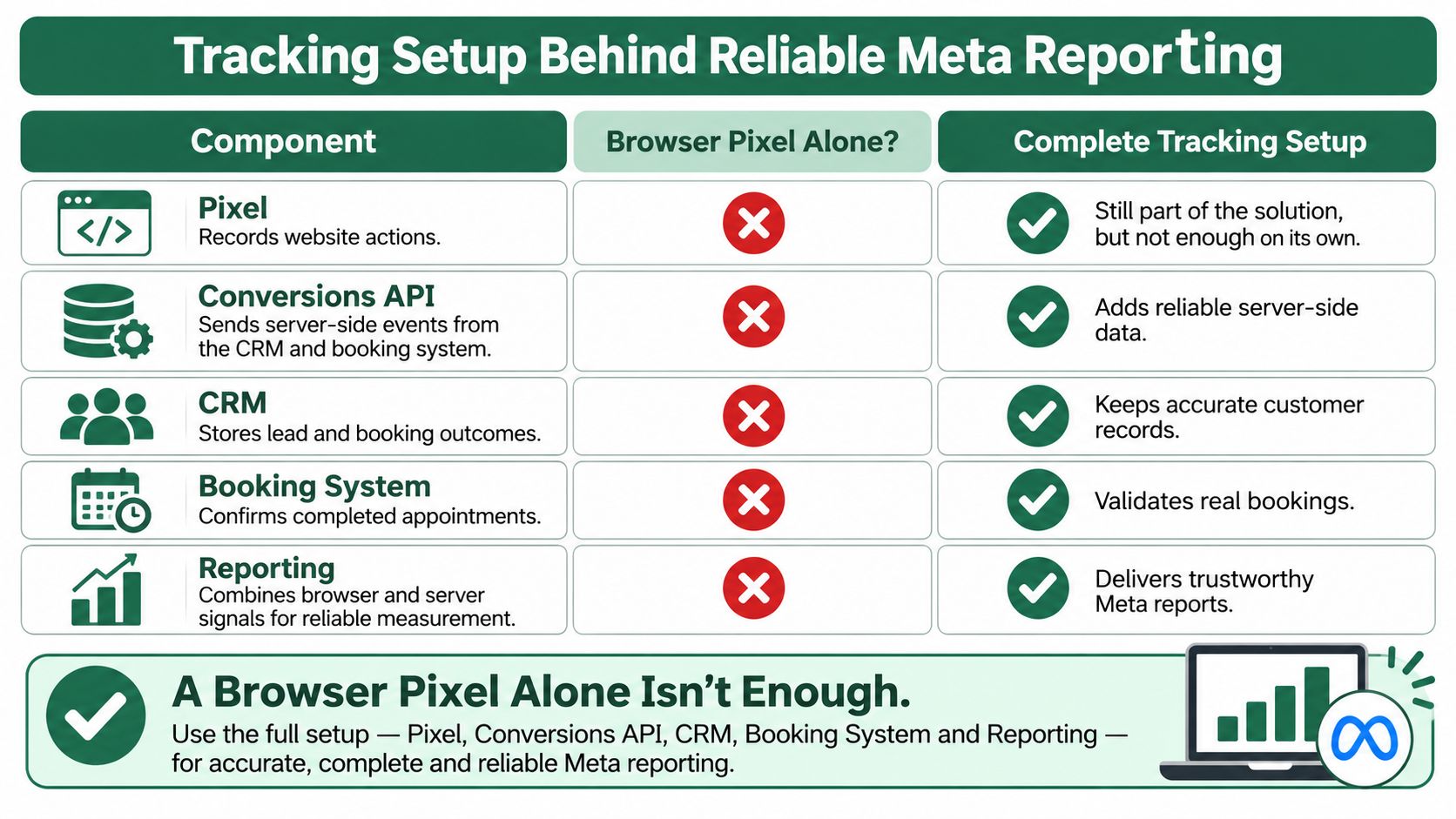
Pixel, Conversions API, and the CRM Working Together
The Pixel records website actions in the browser. The Conversions API sends server side events from your CRM and booking system, ideally in real time. Because both can report the same booking, they must share an event ID so Meta can deduplicate them and count one appointment once.
Give every lead a unique ID plus source and campaign metadata, then carry that ID through Lead, Contacted, Qualified, Consultation Booked, Consultation Attended, and Treatment Started. Sending those later stages back lets Meta learn which people become patients. Match quality decides how much that helps, since matched events support attribution and optimization while unmatched events stay limited to basic measurement.
Calls and forms should be tracked back to the ad, page or channel that produced them. That is the difference between a dashboard that looks busy and a system that shows which spend produced a kept appointment. Ask who owns the plumbing too: ad accounts, CRM data and the patient list should stay in the clinic's name, and they should stay with the clinic if the engagement ends.
Why Attribution Windows Keep Moving
Meta has changed which attribution windows its reporting offers, so comparisons across periods can mislead. A report that looks worse this quarter may be counting differently, and a report that looks better may be taking credit for bookings that would have happened anyway.
Publish two numbers and label both. Use platform reported results to manage delivery, and use CRM tracked cost per booked and kept consultation to allocate budget. Document the attribution window on every report so period comparisons stay honest.
The Privacy Rule Clinics Cannot Skip
Keep health information out of event names, page URLs, parameters and custom audiences, and remove the Pixel from patient portals. Treatment specific URLs can reveal what someone was considering even when a form says nothing medical. Fewer, safer events, such as a qualified consultation request or a booked consultation, beat a detailed feed of treatment level data.
Put this checklist to any agency before launch.
- Event map. Every event, its source system and its exact definition.
- Deduplication test. Proof that browser and server events share an ID.
- CRM timestamps. Consistent times for inquiry, booking and attendance.
- Latency audit. How long events take to reach Meta, plus duplicate rates.
- Weekly reconciliation. CRM bookings compared against Meta reported conversions.
- Window note. The attribution window used, written on the report itself.
Metrics That Show Whether Ads Are Working
Start with the cheapest number and climb toward the most valuable one. Each step down this ladder is harder to fake and closer to revenue. The funnel below shows how those stages connect, from first inquiry to treatment started.

The Metric Ladder From Lead to Revenue
Meta campaign metrics from lead to revenue
| Metric | How it is calculated | What it tells you |
|---|---|---|
| Cost per lead | Ad spend divided by form or call leads | Useful for delivery checks, weak on its own |
| Cost per booked consultation | Ad spend divided by consultations booked | The main number for budget decisions |
| Cost per attended consultation | Ad spend divided by consultations kept | Shows lead quality after no shows |
| Show rate | Booked consultations that attend, as a percentage | A low rate points to follow up or qualification gaps |
| Treatment start rate | Attended consultations that start treatment, as a percentage | Connects ad spend to revenue |
| Platform return on ad spend | Revenue reported by Meta divided by spend | Check against CRM revenue before trusting it |
Cost per lead is easy to inflate. Lower the friction on a form, remove qualifying questions, or broaden the audience, and lead costs fall while patient quality falls faster. That's why a campaign can look efficient in Ads Manager and still lose money at the front desk.
One Example That Makes the Gap Obvious
Say one campaign produces leads at $50 and another at $90. The $50 leads rarely answer the phone and almost never book, while the $90 leads book, attend, and start treatment. The cheaper lead costs you more, because you're paying staff time to chase people who were never going to come in.
Response speed drives much of that difference. Our med spa speed to lead study examines how response time affects bookings, and the operational point is simple. A new inquiry should enter the CRM at once, receive a rapid text or call, and then generate status events as it moves.
A low show rate is rarely an advertising problem. It usually points to slow follow up, weak qualification, or missing reminders.
The video below walks through how these stages connect in a live funnel.
Why Real Time CRM Feedback Changes the Numbers
Meta's Conversions API business tools page describes the API as a direct connection between marketing data and its optimization systems and recommends sending events in real time or as close to real time as possible. Server events can be used for measurement, reporting, and optimization similarly to browser events, so a kept appointment recorded today can shape delivery tomorrow.
Front desk response speed, contactability, and attendance create large gaps between nominal lead volume and realized patient value. Before reallocating budget, audit event latency, duplicate rates, match quality, and the reconciliation between CRM bookings and Meta attributed conversions.
Hold every report to one rule. Each number states its source and its definition, and platform figures sit beside CRM figures rather than replacing them. Verify Meta's reported return against revenue your own system recorded before you act on it.
Questions and Red Flags When Choosing an Agency
Judge an agency by what it can show you, not by how confidently it describes the platform. Two things reveal the most, how it measures results and who controls each asset. The conversation below is where those answers should come out in plain language.
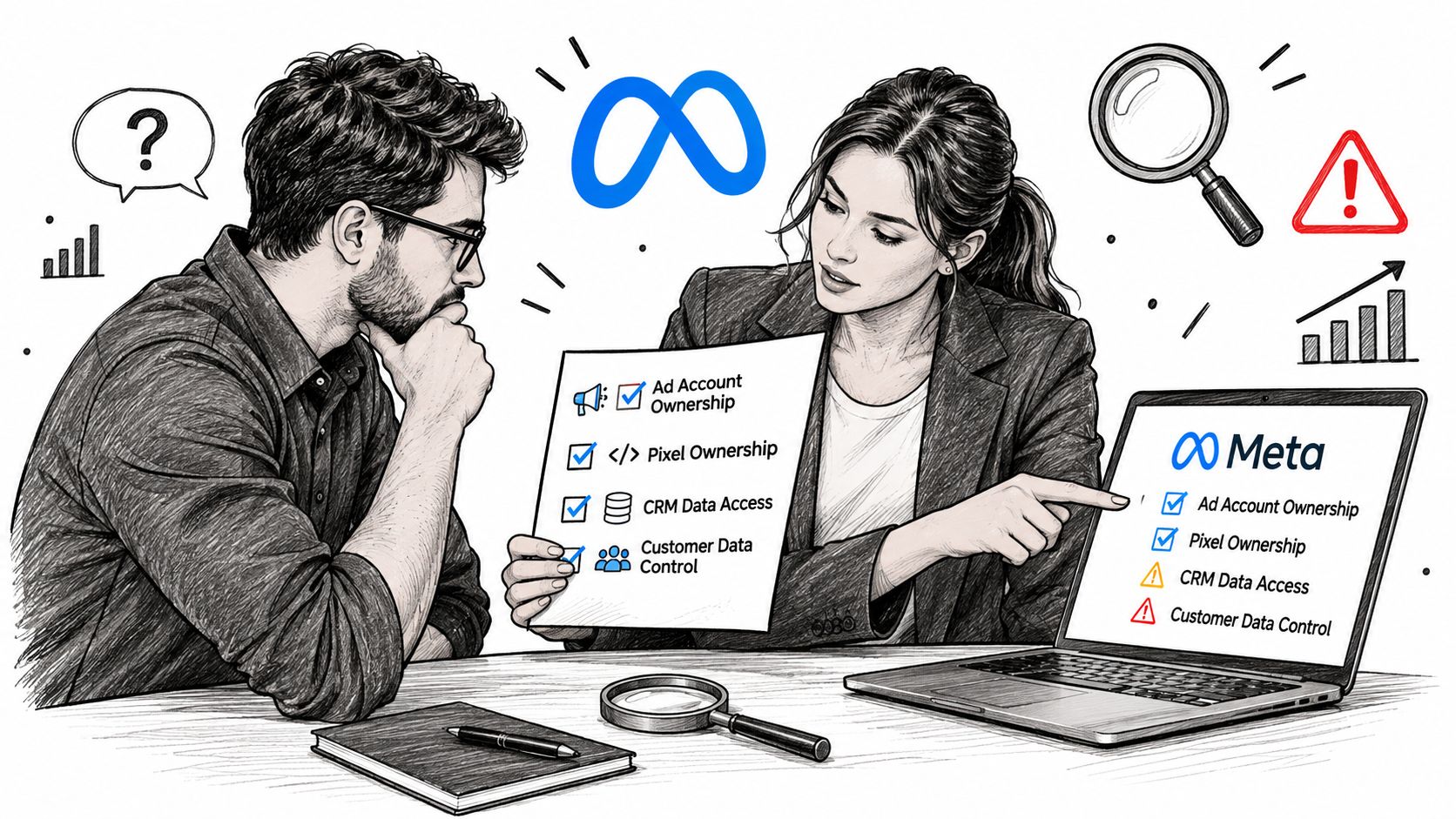
Questions That Produce Verifiable Answers
- Who owns the assets? Ask who owns the ad account, the Pixel, the CRM data, and the patient list, and get it in the agreement.
- What does the monthly report show? It should show booked and attended appointments, not only clicks, impressions, and leads.
- Who follows up, and how fast? Name the person or system responsible for the first contact and the target response time.
- How is creative tested? Ask how many new ads ship each month, who makes them, and when they get replaced.
- What happens if we leave? Confirm which accounts, audiences, creative files, and data exports stay with you.
Red Flags Worth Walking Away From
- Guaranteed results. Nobody controls Meta's auction, your market, or your show rate.
- Reports built on soft metrics. Clicks and impressions without bookings hide the outcome you're buying.
- Reluctance to share access. If you can't see your own account, you can't verify a single claim.
- Long lock in before any audit. A provider asking for commitment before inspecting your funnel is selling before diagnosing.
- No written goal event. Without a defined event, every result can be reframed as a win.
Use one benchmark to test the answers you hear. Med Spa Scalers states that ad accounts, CRM data, and the patient list stay in the client's name, and everything stays with the client if they stop working with us. Our team has also managed $24.6 million in Meta ad spend for the spas it has worked with.
Verification test. A claim only counts when you can check it inside the actual account during the audit.
Ask the same questions of at least three providers. Put the written answers side by side and compare ownership, definitions, and reporting before you compare price.
Confirm Your Agency Plan Before You Sign
You've narrowed the field. Now slow down for four checks, because each one is cheap today and expensive after you've signed.
First, review the audit against the proposal. Our free marketing audit reviews your ads, follow up speed, booking flow, and patient list, and shows where bookings are slipping through. It should tell you whether your problem is ad delivery or the follow up system, since adding budget to a leaking funnel rarely fixes either one.
Second, get the definitions in writing. Record the goal event, the metric definitions, the attribution window, and the reporting schedule. A marketing plan checklist helps you confirm nothing important was left as a verbal promise.
Third, compare total cost, not just fees. Take at least three proposals, add the ad spend to each one, and check whether creative and tracking setup are included. Exact pricing from Med Spa Scalers follows the audit, once we know what your clinic needs built.
Fourth, agree on a 90 day review. Set the point where you'll stop, rebuild, or scale based on booked and kept appointments. Pick the agency that proves it can turn spend into booked and kept appointments and leaves the accounts and data in your name.
If your ads are generating clicks your calendar can't confirm, start with our free marketing audit of your ads, follow up speed, booking flow, and patient list, and we'll show you exactly where bookings are slipping through. Visit Med Spa Scalers to request the audit and see what your Meta spend should be producing.
See how many patients you're leaving on the table
Get a free marketing audit of your ads, follow-up and booking flow. No pressure, just a clear picture.
Book a free marketing audit