Med Spa Consultants: What They Do and How to Choose One

Your Saturday campaign did its job. Then the inquiries landed at 9:40 on Saturday night and 6:15 on Sunday morning, the voicemail was left while your front desk was checking in a laser appointment, and none of the three got an answer before Monday. By Monday afternoon, two of them had booked somewhere else.
That gap between interest and a kept appointment is where most med spa revenue leaks. It's also the gap a good med spa consultant is paid to close, and the point where a careless one adds volume to a front desk that was already underwater. Knowing which one you're hiring comes down to the measures in the contract, not the pitch.
Table of Contents
- What Med Spa Consultants Do Day to Day
- Why Med Spa Growth Demands Outside Help
- Retention Metrics Owners Should Track
- Where Automation Must Stop for Compliance
- Reminder Sequences That Protect Kept Appointments
- Matching a Consultant to Your Growth Goals
- How Med Spa Consultant Fees Are Structured
- Shortlist Consultants and Request an Audit
What Med Spa Consultants Do Day to Day
A med spa consultant is an outside operator who builds and runs the business systems a clinic needs to get found, turn inquiries into booked consultations, and keep patients returning, while keeping the clinical work inside its legal limits. The closest comparison is a general contractor on a renovation. The GC doesn't hang drywall or pull wire, but they sequence the trades, hold each one to a standard, and make sure the finished building passes inspection.
The comparison sets a hard boundary. A consultant who writes treatment protocols, clears a patient for a laser, or promises a particular clinical outcome has stepped outside the role. One who sequences advertising, follow-up, booking, reminders, and consent documentation is squarely inside it.
Seven service areas and the measure attached to each
| Service area | What the consultant does | How results are judged |
|---|---|---|
| Advertising | Runs Meta and Google campaigns for high-value treatments | Cost per booked consult |
| Lead capture | Builds offers, landing pages and forms | Inquiry rate by offer |
| Speed to lead | Sets up instant call and text replies, including AI reception | Reply time in seconds or minutes |
| Booking and CRM | Maps the pipeline from inquiry to booking | Inquiry-to-booking rate |
| Retention | Designs reminders, no-show recovery and reactivation | Show rate and rebooking rate |
| Local search | Ranks treatment pages in local search and Google Maps | Calls and bookings from search |
| Governance | Defines staff roles, consent flow and escalation rules | Share of charted consults with complete consent |
Read the third column as the contract. If a consultant can't say which number they'll move and how often they'll report it, the scope is a mood rather than a service.
Advertising and lead capture get the attention because they're visible on an invoice. Speed to lead is usually where the cheapest wins sit, since a clinic that answers in minutes converts inquiries it already paid for. Booking and CRM work is unglamorous plumbing, and it's the difference between an inquiry living in a shared inbox and one that appears in a pipeline with an owner and a timestamp. Retention and local search compound over months. Governance looks like overhead until a complaint or a board inquiry arrives, at which point it's the only thing that matters.
Scope follows the size of the operation. A single-site owner-operator with a busy injector schedule usually needs two things first: replies inside a few minutes and a reminder sequence that protects the appointments already booked. A multi-location group has a different problem, which is comparing four sites on the same measures so the weakest one can't hide behind the strongest one's average.
Where to start: rank the seven areas by appointments lost, not by spend. The area losing the most bookings is the first contract, even when the ad account is the thing everyone wants to discuss.
A clinic losing consults at the booking step doesn't need a bigger budget. It needs that step fixed, and the table tells you whether the fix is speed, pipeline, or reminders.
Why Med Spa Growth Demands Outside Help
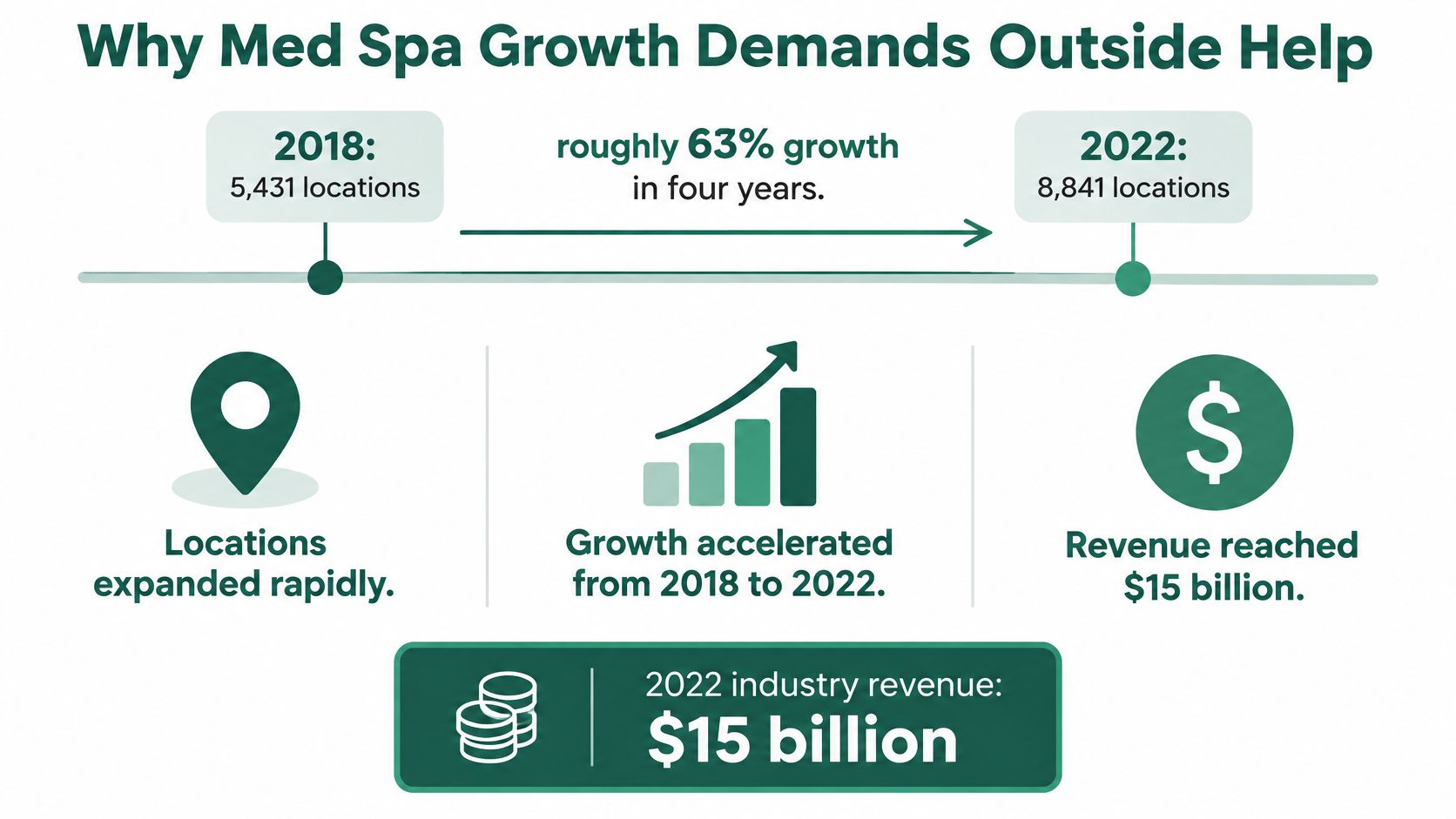
Medical spa growth outran the supply of people who know how to run one. AmSpa's med spa statistics put the number of U.S. medical-spa locations at 5,431 in 2018 and 8,841 in 2022, an increase of approximately 63% in four years. The same 2022 report estimated industry revenue at $15 billion and employment at about 70,000 people.
The shape of that market explains why owners bring in help:
- Revenue per site: average annual revenue per medical spa reached $1,982,896 in 2022, against $1,722,551 in 2021 and $1,526,382 in 2018.
- Structure: about 81% of practices were single-location businesses averaging eight employees, while the remaining 19% were multi-location organizations averaging six locations and 16 employees at the primary facility.
- Why it matters: the same report links growth to demand for help with expansion, staffing, compliance, financial controls, retention and standardizing operations.
Those two audiences want different work. An owner-operator with one location and eight employees is often the injector, the marketer and the person answering the phone at 8pm. What they need is hands-on: a booking flow that runs without them, a reminder sequence, a price list that holds margin, and someone to tell them which hire comes next. A group running six sites needs the opposite kind of help. Their value is consistency, which means shared scheduling logic, one reporting standard across locations, and retention programs that don't depend on which manager happens to be working that day.
The practical conclusion is that a clinic's stage decides which services matter first, not the size of its ad budget. A single site with a full calendar and a 40% show rate doesn't need more traffic. A six-site group with strong local demand but four different intake forms needs standardization before it needs another campaign.
Retention Metrics Owners Should Track
Retention is the cheapest growth a med spa has, and the numbers are now large enough that nobody has to guess. AmSpa's 2024 industry reporting found repeat patients made up 73% of medical-spa patients, up from 65% in its 2022 report. Its 2023 market count put the U.S. at about 10,488 medical spas averaging 245 patient visits a month, which works out to more than 30 million treatment visits a year.
Five numbers are worth reporting every month:
| Metric | What it measures | Benchmark |
|---|---|---|
| Repeat patient share | Share of patients who return for more treatment | 73% in AmSpa 2024 reporting, up from 65% in 2022 |
| Average monthly visits per site | Patient visits per med spa each month | 245 in 2023 AmSpa data |
| Inquiry-to-booking rate | Share of inquiries that become a booked consult | No external benchmark, so set it from your own trailing 90 days |
| Booked-to-kept rate | Share of booked consults that actually attend | No external benchmark, so report it by treatment and lead source |
| Rebooking within treatment window | Share of patients who book their next visit on time | No external benchmark, so set the window per treatment and compare month to month |
The mechanics behind a returning patient
Repeat visits don't happen because the treatment was good. They happen because someone built a reason and a moment to come back. Four levers do most of the work: treatment-plan continuity, where the next visit is discussed and booked before the patient leaves; membership design, which converts a one-off purchase into a monthly habit; recall campaigns aimed at patients who haven't been in for six or twelve months; and no-show recovery, which treats a missed appointment as an open conversation instead of a closed file. Each one is a system, not a personality trait.
The trap with retention reporting: a rising booking count can hide falling kept appointments. Track show rate by treatment and by lead source, or a strong month of ad performance will look like growth while the calendar quietly empties.
Run a monthly review with the same five rows. Compare each figure to last month, name the one that moved most, and fix that one before touching anything else. Owners who skip the review tend to buy more ads, which is the only lever that makes a retention problem more expensive.
Where Automation Must Stop for Compliance
An AI receptionist answers a text at 11:40 on a Tuesday night. It replies in four seconds, quotes a price for lip filler, tells the sender a full syringe would suit her face, and books her for Thursday. The response time is excellent. The booking is a liability.
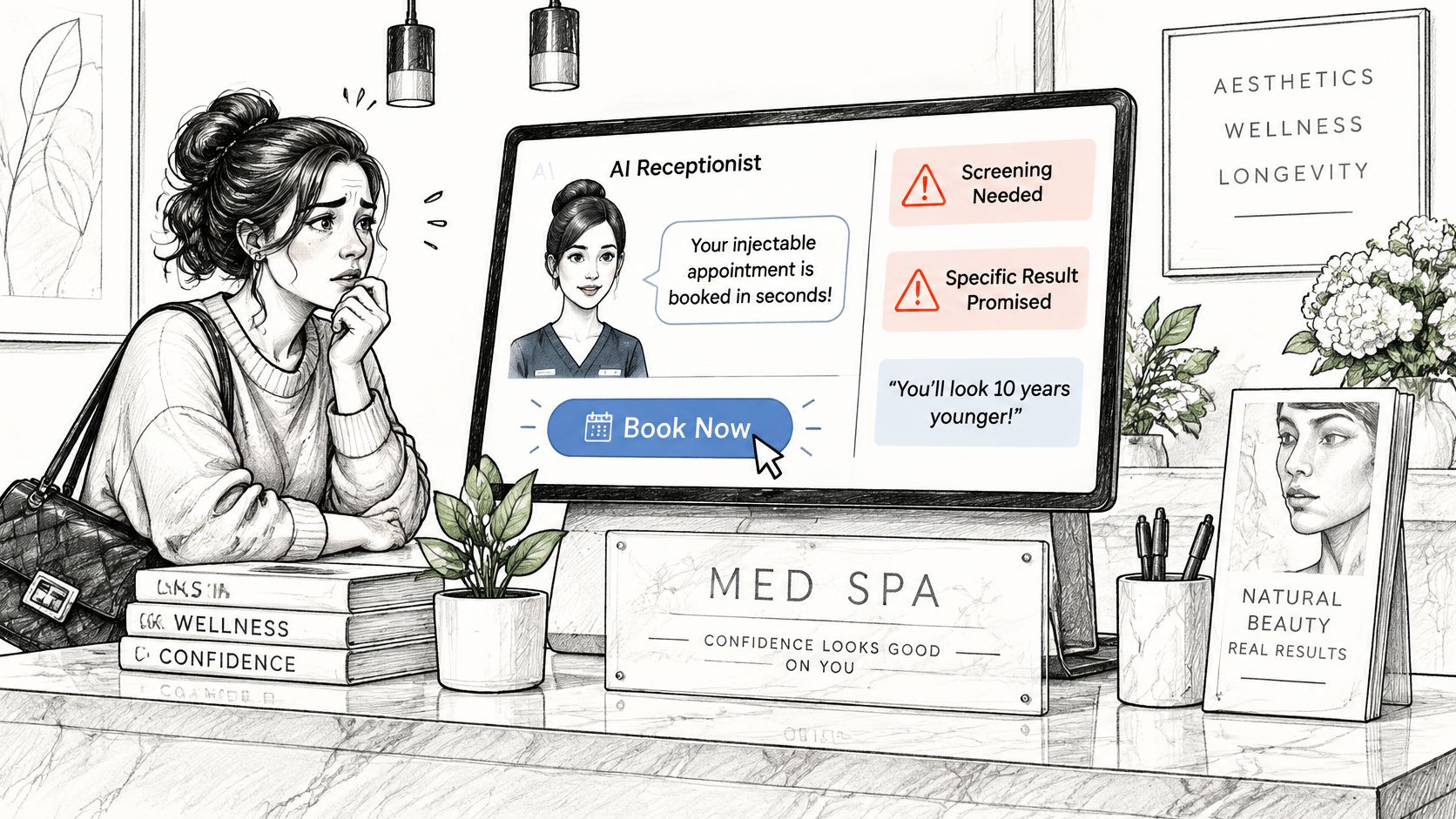
Consent is where this gets concrete. Washington State's aesthetics informed-consent guidance requires providers to disclose enough information for a decision-maker to make an informed choice, and it emphasizes that consent forms should be signed and dated, including at follow-up visits and whether care happens virtually or face to face. An automated reply that nudges a patient toward a specific treatment is doing the opposite of informed choice.
The useful split is between enablement and clinical judgment. A consultant can improve intake forms, scheduling, reminders and the routing of documentation. Automated messages and an AI receptionist must not diagnose, recommend an individual treatment, promise outcomes, or stand in for a clinician's evaluation.
What automation may handle and what stays with a clinician
- May handle: appointment logistics, price ranges already published, directions and parking, rescheduling links, deposit collection, language preference, and a warm handoff to a named staff member.
- May not handle: candidacy questions, product or dosage recommendations, expected results, aftercare for a complication, or anything that reads as a clinical promise.
- Always routes to a human: adverse events, pregnancy and medication questions, complaints, and any message containing the words pain, swelling, burn, or infection.
Build the workflow so only administrative information is collected before the visit, clinical questions and adverse-event concerns go to qualified staff, and every consent keeps an auditable record of version and timestamp. When treatment plans or follow-up circumstances change, documentation gets renewed rather than reused. The pipeline itself is a plumbing job, and how you configure a med spa CRM determines whether a burning question reaches a nurse or sits in a shared inbox until Thursday.
If your follow-up includes outbound calls or texts, review the consent rules for automated calls before switching anything on, because marketing consent and treatment consent are separate questions with separate answers.
Four state-specific checks before you deploy
- Delegation: who may perform each procedure, and what supervision the state requires for your staffing model.
- Telehealth: whether a virtual consult can legally precede an in-person treatment for the services you sell.
- Privacy: how patient information moves between your forms, CRM, and ad platforms.
- Record retention: how long consent and treatment records must be kept, and in what form.
Then measure the right thing. The benchmark isn't booked consults alone, it's the share of appointments with complete, correctly timed, clinician-owned documentation.
Reminder Sequences That Protect Kept Appointments
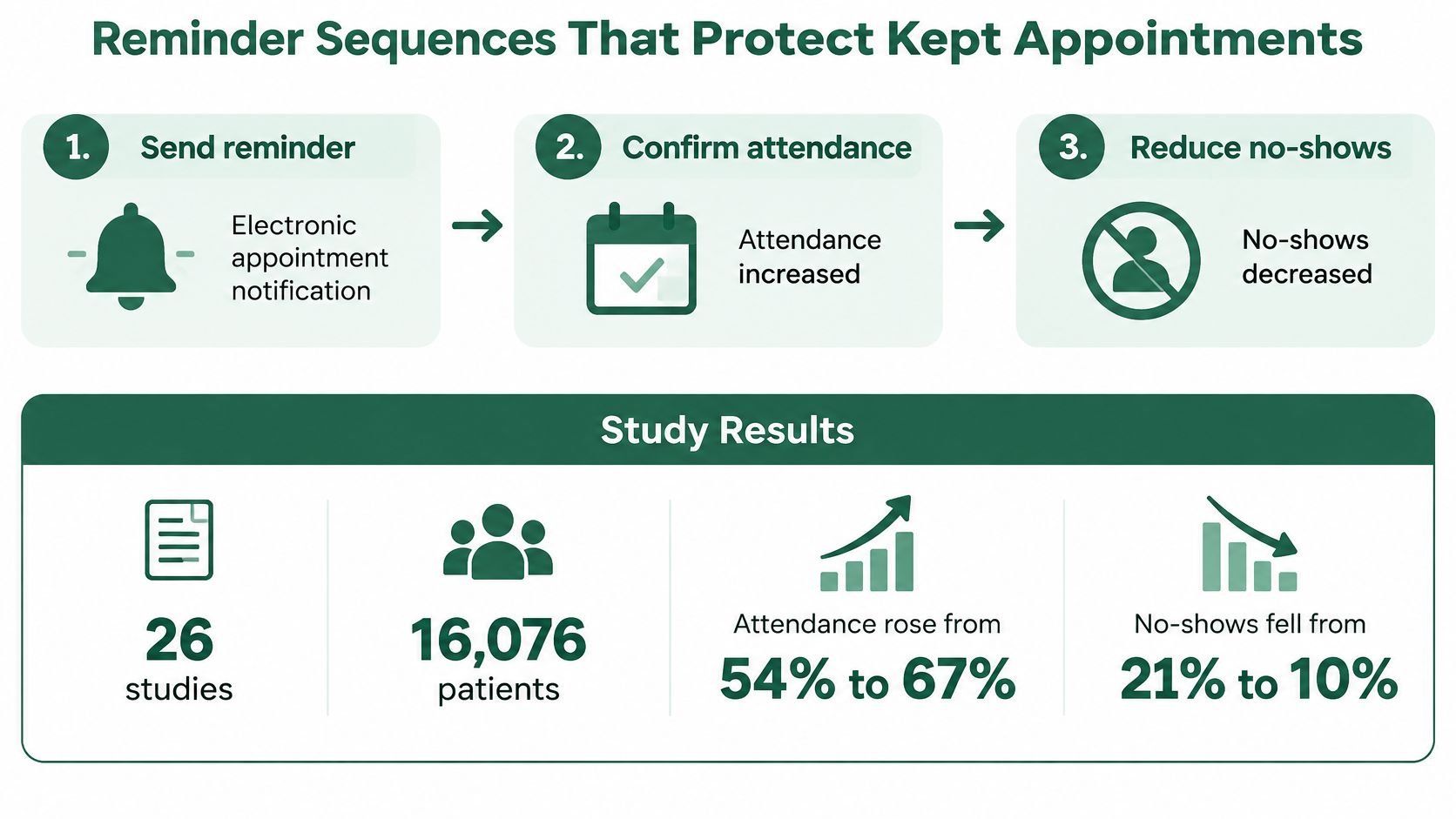
Attendance is a conversion metric, not a front-desk habit. A systematic review and meta-analysis of 26 studies covering 16,076 patients found electronic appointment notifications raised attendance from 54% to 67% and cut no-shows from 21% to 15%. Multiple notifications beat a single message, and voice notifications appeared more effective than text alone.
- Booking confirmation, sent immediately. Treatment, provider, address, deposit status, and what to expect. It kills the doubt that sets in five minutes after someone books.
- An early reminder, far enough ahead to reschedule. A day or two out, depending on the treatment. The goal is to catch the conflict while a new slot can still be resold.
- A short final notice close to the visit. Arrival details, parking, and one tap to cancel or move. Keep it to two lines.
- A cancel-or-reschedule path on high-ticket consults. For injectables, laser, body contouring, and weight-management programs, the easy exit recovers demand instead of just suppressing the no-show.
Measure attendance and no-show rates by treatment, lead source, reminder channel, and time interval. Review the best practices for confirming appointments by SMS before you rewrite your templates, and build the recovery step into a no-show recovery workflow so a cancellation triggers an offer to the waitlist.
Lumière Aesthetics, an injectables practice in Scottsdale, Arizona, added instant SMS follow-up, self-booking, three-step reminders and review requests. Reply time came to 38 seconds, the booked rate reached 37%, and cost per new patient landed at $108.
One caveat: the evidence supports digital reminders as a reliable process step, but it doesn't prove any particular script or timing pattern is best. Change one variable at a time and compare it with a baseline.
Matching a Consultant to Your Growth Goals
Most owners shop by asking who's good. The better first question is what's broken. Until you can name the bottleneck, every proposal looks reasonable and the cheapest one wins by default.
The quality of the booking experience decides much of this. Zenoti's med spa booking survey data reports that 79% of respondents have skipped booking because reaching someone or booking online was too difficult, 82% would be more likely to rebook when 24/7 booking options exist, and 44% prefer texting. Those numbers describe demand you already paid for and then lost at the last step.
That's why I'd judge a consultant on friction-adjusted measures rather than lead volume: cost per qualified booked consult, cost per kept appointment, after-hours conversion, no-show recovery, and reactivation revenue. A cheap lead that never books is the most expensive line in the budget. It also helps to write down what each quarter's growth goal requires before taking calls, using a marketing plan checklist so the proposal you're comparing has something concrete to be measured against.
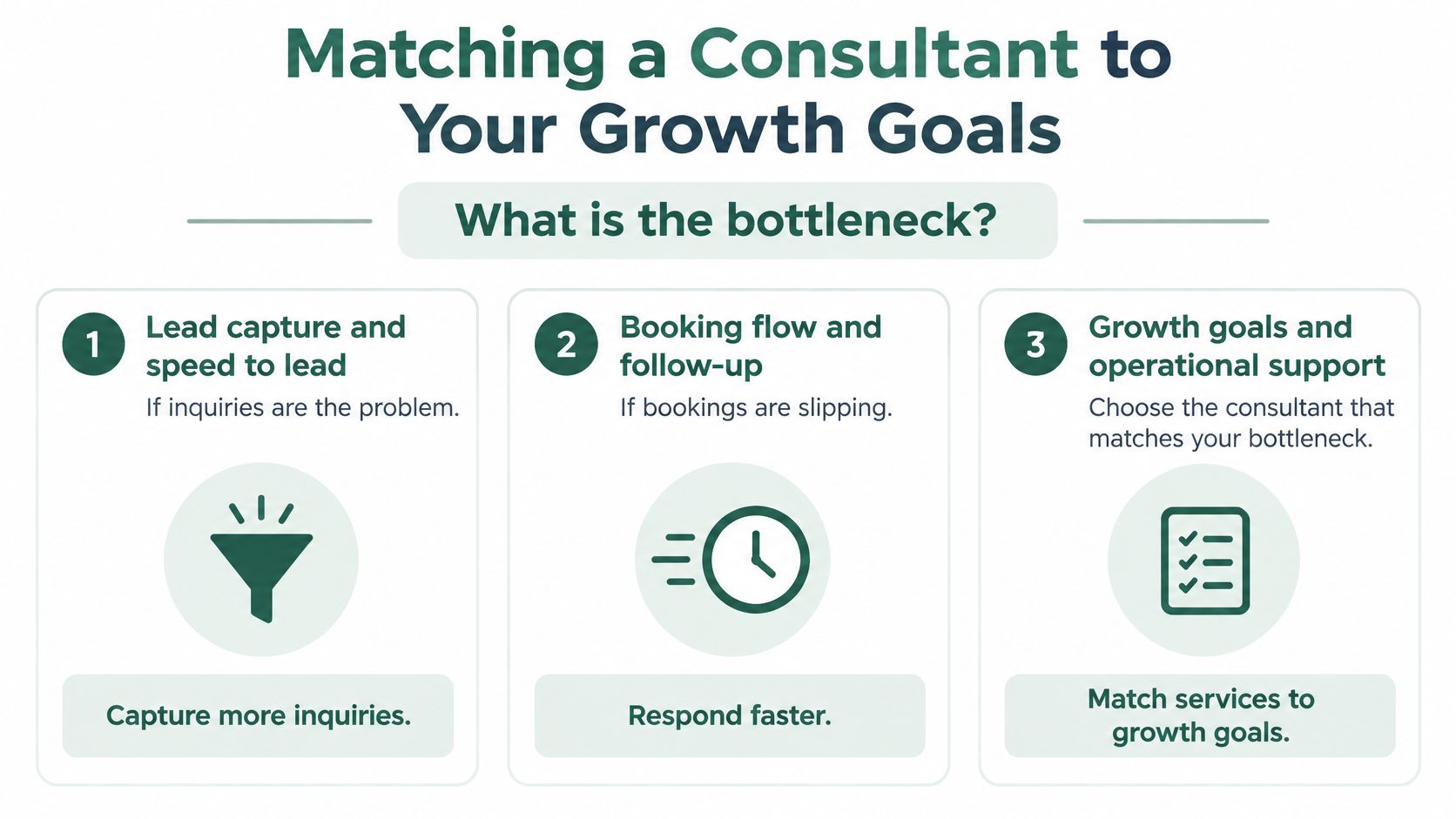
| Growth goal | Capability to require | Proof to request |
|---|---|---|
| More booked consults | Reporting on cost per booked consult by source | Sample weekly report with bookings by channel |
| Better show rates | Reminder design by treatment and channel | Show rate broken down by treatment and reminder type |
| Compliant scale | Written consent and escalation rules for AI and staff | Workflow document showing where humans review |
| Multi-location growth | Consistent metrics and reporting across sites | One dashboard covering every location on the same measures |
Compliant scale is the row owners underestimate. An analysis of medical spa regulatory risk published by Legal 500 points out that state medical boards decide who may perform procedures and what supervision is required, while federal rules can reach devices, health information, workplace safety, and product claims. Accreditation guidance leans on emergency protocols, hazardous-agent handling, medical-director requirements, staff training, and personnel files. A consultant who can't produce a workflow document showing where a human reviews an AI conversation hasn't done that work.
Three red flags in a proposal
- A guaranteed patient count. Nobody controls your market, your offers, or your team's follow-through. Any number presented as a promise is a sales tactic.
- Reporting on clicks, impressions, or leads alone. Those are inputs. Booked consults and kept appointments are the outputs.
- No written escalation rules. If the document doesn't say which messages stop and go to a clinician, the automation is running without a brake.
Our own reporting follows the same logic. Med Spa Scalers measures its work by booked consults and cost per booking, doesn't guarantee a specific number of patients because results depend on the market, offers and team, and commits instead to fast follow-up on every lead, clear reporting on booked consults and month-to-month improvement. Ad accounts, CRM data and the patient list stay in your name, and they stay with you if you stop working with us.
How Med Spa Consultant Fees Are Structured
The fee model tells you who carries the risk when results are weak. Three structures cover most engagements: a monthly retainer for ongoing management, a setup fee for building the booking flow, CRM pipelines and reminder sequences, and a one-time audit that gives you findings before you commit to anything ongoing. Some firms add a performance component, which only works when it's tied to something you both can measure, like cost per kept appointment or reactivation revenue.
Rank the work by evidence and by the bottleneck the audit found, not by how impressive the deck was. Speed to lead and reminder setup usually come first because they lift numbers you already have. Multi-location reporting matters when you have several sites to compare. Local search is worth funding once bookings are being kept.
Sign nothing until the quote answers these five questions in writing. Everything else is a conversation.
- Scope: the services included and, just as important, the ones excluded.
- Ownership: who holds the ad accounts, CRM data and patient lists, and the exit terms for moving them.
- Reporting: how often reports arrive and exactly which metrics appear in them.
- Governance: who owns consent and escalation rules, and who signs off before an automated message goes live.
- Exit: the notice period and any fees for ending the engagement.
Compare quotes only when they cover the same scope. A cheaper package that omits governance isn't better value, it's a bill you'll pay later with interest.
Shortlist Consultants and Request an Audit
Build a shortlist of three to five consultants using the criteria above, then ask each one for a free audit before you talk about a retainer. The free marketing audit at Med Spa Scalers reviews your ads, follow-up speed, booking flow and patient list, and shows where bookings are slipping through. It gives clear next steps whether or not you choose to work with us, and audit requests get a reply within one business day, either a short call or a recorded walkthrough, whichever you prefer.
Walk in with data rather than opinions:
- Export the last 90 days of inquiries, with source and the time each one arrived.
- Note your average time to first reply. Measure it by hand on a sample if your tools don't report it.
- Pull booked-to-kept numbers by treatment, not one blended rate.
- List the patient records that haven't booked in the past year.
Then line the findings up against the goal-to-capability table. If the biggest gap is speed, hire the person who can prove reply times. If it's retention, hire the one who reports show rates by treatment. If it's governance, hire the one with a written escalation workflow. Pick the consultant whose proof matches the first gap you intend to fix, and start there.
Med Spa Scalers builds the follow-up, booking, reminder and reactivation systems that sit between an ad click and a kept appointment, and reports on booked consults and cost per booking instead of impressions. If your inquiries are arriving faster than your front desk can answer them, the free audit will show you exactly where the bookings are dropping and what to fix first. Request it at Med Spa Scalers.
See how many patients you're leaving on the table
Get a free marketing audit of your ads, follow-up and booking flow. No pressure, just a clear picture.
Book a free marketing audit