Local SEO Optimization: A Step-by-Step Guide for 2026
In 2024, 80% of U.S. consumers surveyed for SOCi's Consumer Behavior Index said they searched for local businesses online at least weekly, according to coverage of that index. For a med spa, that weekly habit is the appointment funnel. Someone types a treatment and a neighborhood, Google weighs a short list, and the clinic that matches the query gets the call.
Local SEO optimization is not a keyword job you finish once. The Google Business Profile, treatment and location pages, citations, reviews, and AI-written summaries are one system. I would judge the work by calls and booked patients, not by a rank on a screenshot.
Table of Contents
Local Ranking Signals and What to Fix First
Google's local ranking guidance states that local results are primarily determined by three factors: relevance, distance, and prominence. Relevance is how closely the Business Profile matches what the searcher typed. Distance is how far the business sits from that person, or from the place named in the query. Prominence is how well known the business is. Google names web links, articles, directories, review quantity, and review scores as signals that can contribute to prominence.
A filled-in profile can still lose. Services that don't match the query, an address that disagrees with the website, or a thin reputation will do it. A clinic farther away can outrank a nearer one when Google judges it a better match.
| Signal | What Google Looks At | Quick Check | First Fix |
|---|---|---|---|
| Relevance | How closely the profile matches what the searcher wants | Compare your primary category with the top local competitors | Choose the most specific primary category and list each service |
| Distance | How far the business is from the searcher or the place named in the query | Search from several neighborhoods and note where you appear | Add service areas and location pages only for places you truly serve |
| Prominence | Reputation and recognition from reviews, links, articles and directories | Count recent reviews and look for local press or directory mentions | Set up a steady review routine and earn local links and citations |
| Consistency | Matching name, address, phone and hours across the web | Search your phone number and address and compare each listing | Correct the mismatched listings before anything else |
Distance is the factor you can't move for a searcher across town. Most of the gain sits in relevance, prominence, and consistency.
A complete profile that still loses
Say a dental office has every field filled, yet the primary category reads “Dentist” while patients type “emergency dentist.” The nearer office loses to a competitor whose category and services match the urgent query. The same pattern hits a med spa whose profile says “Spa” while patients search “Botox” or “laser hair removal” in their neighborhood.
Practical rule: More reviews and positive ratings can improve local ranking, but only when the category and services already match the query.
Run the four checks in one afternoon. Write down the signals where you score weakest, and work the rest of this guide in that order.
How to Set Up and Complete Your Google Business Profile
BrightLocal's 2025 Consumer Search Behavior research surveyed a representative panel of 1,000 U.S. adults and found that 45% defaulted to Google for local searches, while 15% selected Google Maps as their first port of call. In that same research, 85% considered contact information and opening hours important when researching a local business, and 67% said they often or always look at reviews after a local search. The listing is a conversion surface, not a directory line.
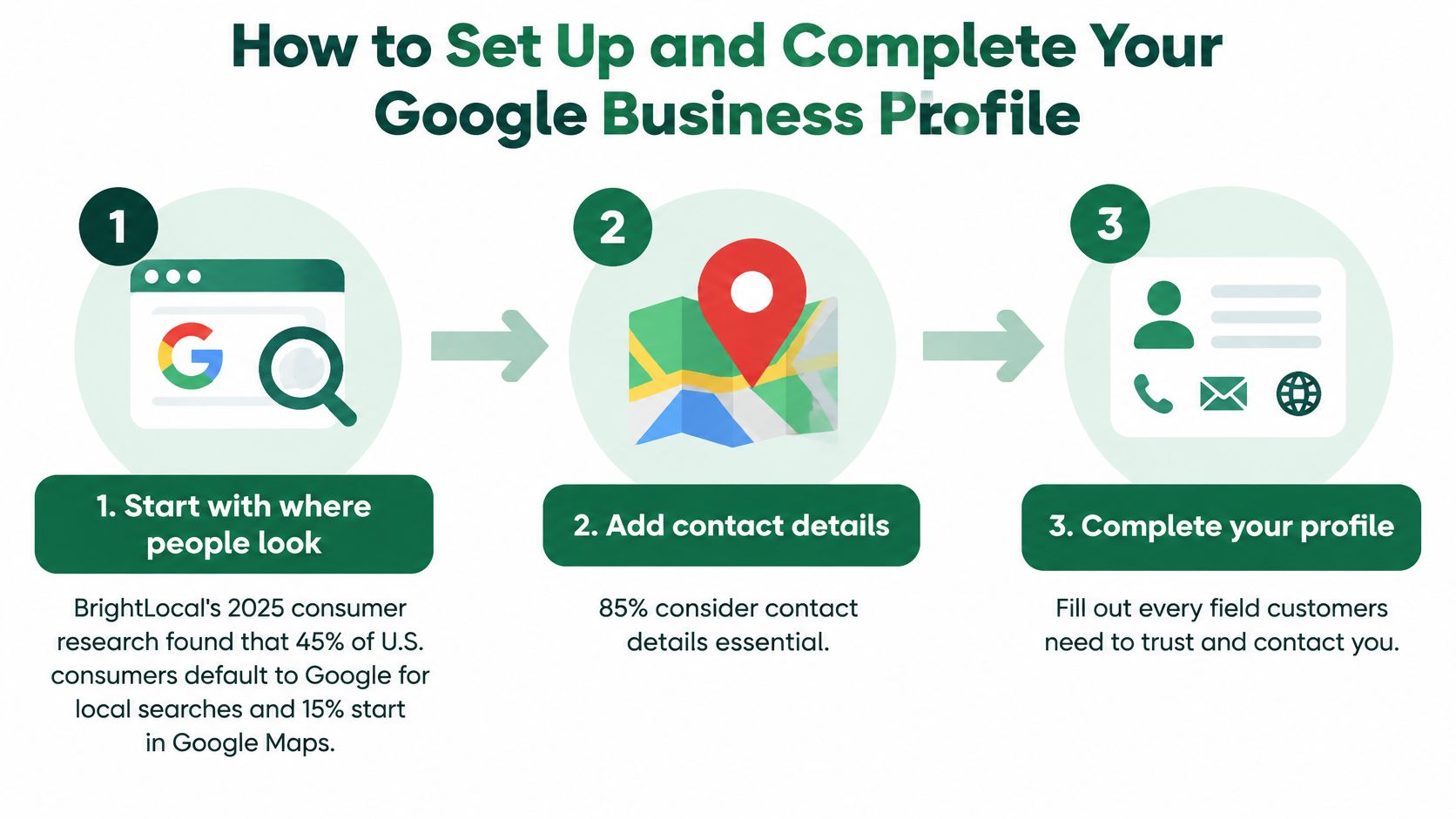
Work the profile in this order. Each step has one slip that costs more than the rest.
- Claim or verify the profile. The business name must match the sign on the door, not a keyword string such as “Best Botox Miami.” A second owner account often creates a duplicate that splits reviews.
- Pick one primary category that matches the service you want most, then add secondary categories for the rest. “Medical spa” plus a generic “Spa” category sends mixed signals if injectables are the booking engine.
- Enter the storefront address, or the cities and radius if you hide the address as a service-area business. Don't list towns you don't staff.
- Enter regular hours, holiday hours, and one phone number. A tracked line is worth it if you want call data. The costly slip is last year's holiday hours left in place, so Google shows you closed on a normal Tuesday.
- Add each service with a short description in plain language patients use, not only the clinical name.
- Upload photos of the storefront, team, and treatment rooms, and refresh them monthly. Stock images of other cities get ignored.
- Add a booking or contact link and post a short update each week so the profile doesn't look abandoned.
- Reply to every review within a few days. Silence reads as a closed front desk.
The mistake that costs the most is a name stuffed with keywords, or a duplicate profile. Both confuse Google about which listing is real, and both take longer to undo than a missing photo.
Watch the short walkthrough, then compare it with your own fields.
Self-test from your own neighborhood. Search your main category and confirm that hours, phone, and services on the public listing match what you typed. If they don't, stop and fix the profile before you touch the website.
Location and Service Pages That Earn Local Visibility
A useful location page covers a place the clinic serves. It names the injectors and nurses who work there, shows before-and-after photos taken at that clinic with documented consent, mentions a real neighborhood landmark, and lists the treatments delivered in that room. A doorway page swaps the town name into one repeated paragraph and hopes Google treats forty copies as forty clinics.
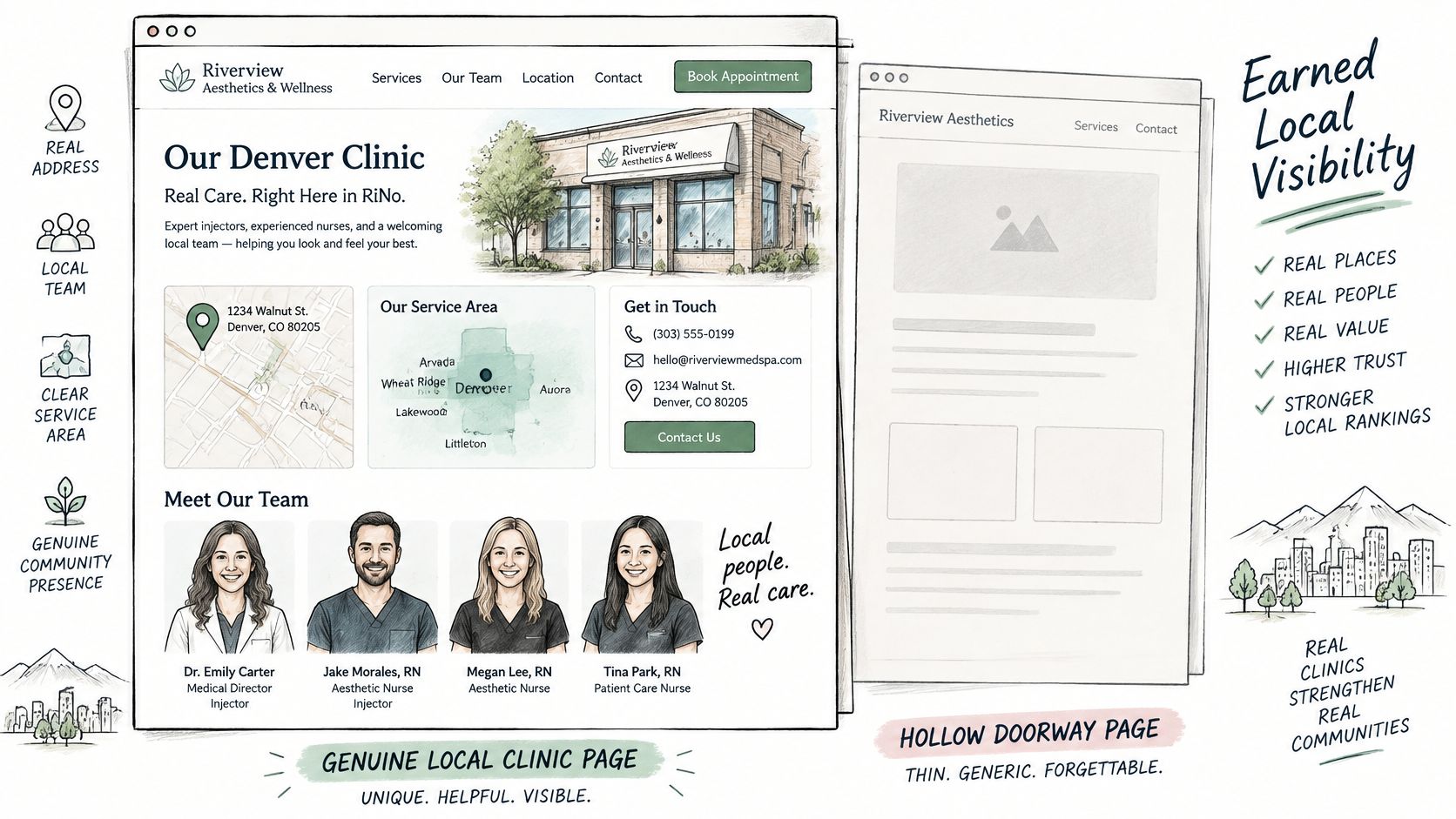
Those thin city pages dilute relevance. They also train patients to distrust the site, because the Aurora page and the Lakewood page say the same thing.
The structure that holds up
A med spa in Denver with separate pages for Aurora and Lakewood, each listing treatments performed there, the staff who perform them, and local booking hours, will outperform forty near-identical city pages. Build it like this.
- One page per commercially important treatment. Laser hair removal and neurotoxin injections each get their own URL, with eligibility notes and a short FAQ written for that service.
- Links from the homepage and from the matching location pages. The treatment page should not be an orphan.
- The same name, address, and phone in the footer and on the contact page as on the Google Business Profile.
- An embedded map on each location page, not a screenshot of a map.
- MedicalBusiness or LocalBusiness structured data that matches the profile exactly, including hours.
Don't publish a city page for a town where you have no staff, no hours, and no patients.
In Google Search Console, filter for treatment-plus-city queries and see which URLs earn impressions. Rewrite the pages that earn none before you create another one. New pages on a thin pattern just multiply the problem.
Citations and Local Links That Build Prominence
A citation repeats your name, address, and phone. A link sends a visitor or tells Google another site stands behind you. Both support prominence, and they are not the same job.
Start with the broad data aggregators that feed many directories, so one correction can flow outward. Next, list the industry and category directories where aesthetic patients already look. Then go local: the chamber of commerce, a neighborhood association, a trade group, a sponsored community event, a supplier or partner site, and local news about a real project.
One accurate listing on a respected local source is worth more than twenty copied listings with last year's hours. Old hours on a popular directory will outvote your website until you fix them.
A one-afternoon audit
Build a spreadsheet with columns for source, live URL, name, address, and phone as shown, status, and action. Mark each row correct, outdated, or duplicate. Fix duplicates first. They split reviews and leave search engines guessing which phone number is current. A fuller walkthrough of that cleanup sits in our guide to local SEO citations.
Skip paid link packages and pay-to-list farms. They add no real audience, and the junk listings become cleanup work later.
This quarter, pursue three sources and stop there.
- One local association you can join and show up for.
- One local news or community contact tied to a real event or patient-education talk, not a press release about rankings.
- One industry directory your patients already use when they compare clinics.
Reviews That Lift Visibility Without Breaking Rules
Reviews can strengthen patient confidence and support local visibility, but a review count alone does not explain why a clinic ranks or gets booked. Treat review requests as a routine part of the patient journey, alongside accurate treatment pages and business information. For practical guidance, follow these med spa Google review practices.
- After each eligible visit, send a neutral text or email with a direct link to the review form. Leave treatment details out of the message.
- Ask every eligible patient, not only those who seem happiest. Selective requests skew the feedback and can violate platform rules.
- Do not offer an incentive in exchange for a review or a positive rating. A gift card for five stars puts the profile at risk.
- Vary the timing and wording naturally. Keep requests tied to real visits rather than sending one generic blast.
- Reply publicly within a few days. Thank the reviewer and take the conversation offline. Do not confirm that someone was a patient or name a treatment, which could disclose private health information.
- Move complaints offline promptly and record how the practice resolved them.
For example, if a patient mentions a long wait after a laser session, the practice manager can call that afternoon rather than argue in public. Never publish identifiable before-and-after images without documented consent.
What to count each month
Track new reviews, median rating, response time, and the share of reviews that mention a treatment in the patient's own words. Segment the figures by location and treatment line so a strong overall rating does not hide a problem at one clinic or for one service. Recent, specific feedback helps prospective patients understand what a visit involves; a sudden burst of generic praise does not provide the same detail.
Local Metrics to Track Each Month
A page can rank well for a query nobody books. Rankings alone will flatter you. The monthly view has to connect discovery to a kept appointment. If you want a structured pass over the same numbers, start from a local SEO audit and then keep this sheet.
| Metric | Where to Find It | Healthy Trend | Action When It Drops |
|---|---|---|---|
| Non-branded search impressions | Search Console performance report, filtered by query | Rising for service-plus-city queries | Check whether the matching service page covers that query |
| Profile calls | Google Business Profile insights or a tracked phone number | Steady or rising month over month | Check hours, the call number and whether calls go unanswered |
| Direction requests | Google Business Profile insights | Rises with local promotions and seasonal demand | Confirm the address, pin placement and service-area settings |
| New reviews and average rating | Reviews tab on the profile | Steady flow of new reviews each month | Restart the review request step and check response times |
| Booked leads by source | CRM or booking system, grouped by source | Growing share from local search | Compare cost and show rate by source before adding budget |
How the numbers talk to each other
Non-branded impressions tell you people found you without already knowing the clinic name. Calls and direction requests show they intended to act. Reviews show whether recent patients are willing to say so in public. Booked leads by source tell you whether that visibility is worth the front-desk time.
Once a month, search your main service and city in a private window. Write down whether any AI-written summary gets your services, hours, and providers right. A wrong summary can cost calls even when the blue links still look fine.
A rising call count with flat bookings points at the phone process, not the listing. Unanswered calls, a booking link that dead-ends, or a follow-up that waits until the next morning will waste a profile that is otherwise doing its job. Keep the five metrics on one sheet so you don't “fix SEO” when the leak is the front desk.
How AI Summaries Describe Your Med Spa
Local visibility is turning into an entity-and-evidence problem. In a 2025 analysis cited by PushLeads, AI Overviews appeared for 6.49% of tracked queries in January and 13.14% by March. Another local-search analysis in that same write-up reported AI Overviews on 40.2% of local-business queries by May 2025. The first thing a searcher sees may be a generated paragraph, not your listing.
Pew's analysis of nearly 69,000 Google searches, also summarized there, found that when an AI summary appeared, users clicked a traditional result only 8% of the time, compared with 15% without a summary. About 26% ended the browsing session after the summary, versus 16% without one. If the paragraph is wrong, many people never reach your site to correct it.
One mismatch, one wrong answer
A clinic lists “Botox” on the profile, “neurotoxin” on the treatment page, and never names the supervising provider. The summary can attach the wrong treatment name and the wrong hours, because each surface told a slightly different story.
Align the treatment name across the profile service list, the treatment page, and provider bios that state credentials in plain text. Put the consultation policy and basic eligibility on the page in sentences, not only inside an image. Keep hours identical in the profile, the site footer, and the booking system.
Each month, search the main treatment plus the city in a private window and log whether services, hours, and provider facts are right. Don't put outcome promises or unsupported medical claims in any text an AI system might repeat. Vague superiority language undermines trust on injectables, laser resurfacing, body contouring, and medical weight loss even when the map pin looks strong.
Four-Week Order to Act on This Guide
Fix the record before you ask for more attention. Review collection will not rescue a profile that shows the wrong hours.
Week 1. Run the four signal checks. Correct every inconsistent listing and merge or remove duplicate profiles.
Week 2. Finish the Google Business Profile fields, add the service list with short descriptions, and upload current photos of the clinic, team, and treatment rooms.
Week 3. Rebuild or consolidate treatment and location pages, add MedicalBusiness or LocalBusiness markup that matches the profile, and start the neutral review request after eligible visits.
Week 4. Open a monthly metrics sheet. Record a baseline for non-branded impressions, profile calls, direction requests, reviews, and booked leads by source. Run the first AI summary check and note what it got wrong.
I would not reorder this. Profile and citation errors poison every later page and every review you earn. Our free marketing audit reviews a med spa's ads, follow-up speed, booking flow, and patient list, and shows where bookings are slipping through. It gives clear next steps whether or not you choose to work with us.
Today, open the Google Business Profile, compare the hours and phone number with the website, and fix any difference before you do anything else. That ten-minute check is the one that makes the next four weeks count.
Med Spa Scalers helps U.S. med spas connect local search, reviews, and treatment pages to calls that become booked consults, with follow-up and reporting tied to appointments rather than rankings alone. If you want a clear look at where inquiries stall between the map listing and the chair, visit Med Spa Scalers and request the free marketing audit. You'll get next steps you can use either way.
See how many patients you're leaving on the table
Get a free marketing audit of your ads, follow-up and booking flow. No pressure, just a clear picture.
Book a free marketing audit