Local SEO Citations: What They Are and Why They Matter

You have a med spa, your Google profile looks complete, and you're still losing map visibility to a clinic down the street. That gap often comes down to something quieter than ads or website design. It's whether directories, maps, and review sites all describe your clinic the same way. When those copies disagree, a patient who's ready to call gets a reason to pause, and a search system gets a reason to hesitate too.
Table of Contents
What Local SEO Citations Are and Where They Appear
A customer searches for a clinic near her, taps a map result, and sees one phone number. She opens a directory result to compare hours and finds a different number. She doesn't know which one reaches the front desk, so she calls the next clinic instead.
That small moment explains local SEO citations better than any definition. A local citation is any online mention of a business name, address, and phone number, usually called NAP. Most listings add your website, hours, and business category too.
Think of your NAP as a name tag that gets copied onto dozens of badges. Search engines compare the copies. If every badge says the same thing, they can confirm your clinic is real and located where you say it is. If the badges disagree, nobody's sure which copy to trust.
A citation is a repeated business fact, and the real question is whether every copy agrees.
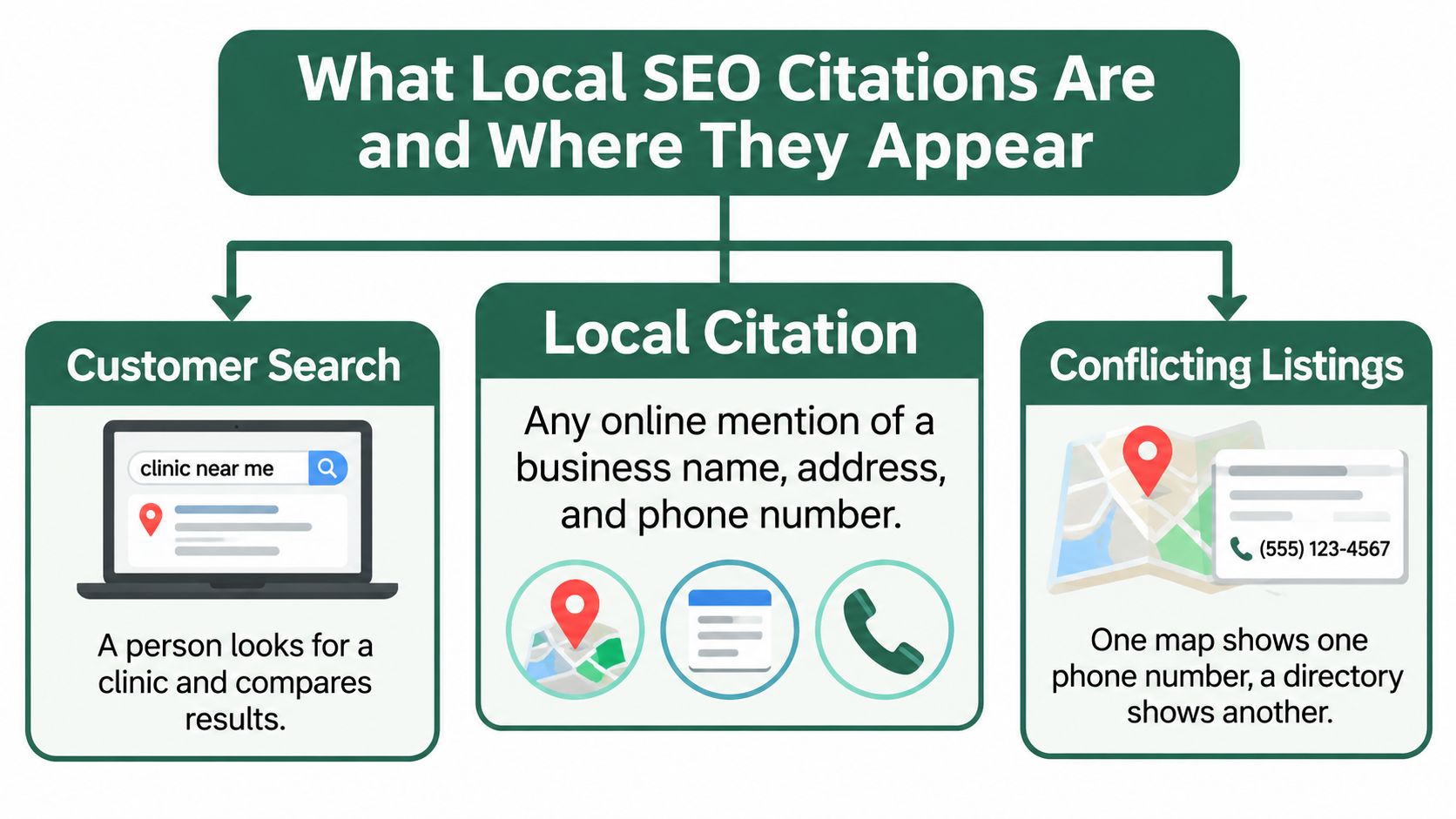
The two kinds you'll meet
Structured citations sit in neat listing fields. You'll find them on map services, review platforms, business data aggregators, and general or industry directories. Each one has labeled boxes for name, address, phone, website, and category, so they're easy to create and easy for software to read.
Unstructured citations live inside ordinary content. A local news story mentions your clinic by name. A chamber of commerce member page lists your address, an association roundup names you among area providers, or an event page credits you as a sponsor. There's no form, but the business facts are there for readers and machines to pick up.
These pages aren't side noise in search results. Business directories accounted for 31% of the first 8,000 organic search results analyzed for local-intent queries in 2024, according to BrightLocal's Business Listings Visibility Study. A patient comparing clinics will meet directory pages whether you manage them or not.
Run a quick self-check before you change anything. Search your business name together with your city and your phone number, then note every page that shows up. That list is your starting inventory, and it usually contains a few surprises.
Core Fields That Must Match Exactly
Search systems don't read your listings the way a person does. They compare a short set of fields to decide whether two listings describe the same business, and some fields carry far more risk than others when they don't match.
The highest-risk fields are your phone number, city, ZIP code, and website URL. A person shrugs at a small mismatch. Software reconciling thousands of records treats a mismatch as evidence that it's looking at a different business, an old location, or a record it can't trust. Google explains that local prominence also reflects signals such as websites linking to the business and customer reviews in its guide to improving local ranking, so citations support your visibility rather than replacing those other signals.
Your NAP-plus-URL standard
| Field | Standard format | Risk if mismatched |
|---|---|---|
| Business name | One legal or customer-facing name, same spelling everywhere | Name variants split one clinic into two entities |
| Street address | One street format, same suite number | A suite mismatch can read as a second location |
| City | Spelled exactly as on the website | High risk, weakens local relevance |
| ZIP code | Matches the address exactly | High risk, expected to match exactly |
| Phone number | One local number in one format, identical everywhere | High risk, expected to match exactly |
| Website URL | One canonical homepage or booking URL using https | High risk, sends users to different pages |
| Business hours | Current hours, including holiday changes | Missed calls and visits during closed hours |
| Categories | One primary category plus services that match the website | Confuses relevance for treatment searches |
Work through the table one field at a time, and write down the single approved version of each. Decide how you'll write your street address, down to whether the suite goes on the same line. Pick one local phone number, not a tracking number on one site and the front desk line on another.
Use the same language in your treatment descriptions. If your website says injectables, laser treatments, and body contouring, your listings should use matching category and service terms. A directory that describes you only as a day spa sends a weaker, fuzzier signal about what you sell.
The rule for the whole table: match exactly, not approximately, and treat your own website as the master copy.
That last part matters when you're tempted to tidy up a listing on the fly. You don't edit a directory to whatever looks right in the moment. You copy from the master version, every time, so the fifteenth listing matches the first.
Why Accuracy Matters More Than Listing Volume
A patient finds your clinic on a directory, calls the number shown, and reaches a dead line from before you moved. She doesn't search for the right number. She books a consultation with the competitor whose number worked.
That behavior is common enough to measure. BrightLocal's citation research reported that 68% of consumers would stop using a local business if they found incorrect information on online directories, while 90% of surveyed local-search professionals said accurate citations are important to local search rankings, according to BrightLocal's expert local citation survey. The exposure is wide, too, because BrightLocal's local-search statistics report that 80% of U.S. consumers search online for local businesses weekly, and 32% do so daily.
Wrong phone numbers, outdated hours, duplicate profiles, and old addresses all create friction at the exact moment someone decides whether to call or book. For a med spa, that moment is fragile. Patients compare several clinics, search treatment-specific terms, and check maps and reviews before they ever request a consultation. One avoidable error can end the comparison early, which is why citation cleanup belongs inside a broader med spa SEO plan rather than on a someday list.
| Statistic | What it measures | Source |
|---|---|---|
| 68% | Consumers who would stop using a local business after finding incorrect directory information | BrightLocal citation research |
| 90% | Local-search professionals who say accurate citations matter for rankings | BrightLocal citation research |
| 80% | U.S. consumers who search online for local businesses weekly | BrightLocal local-search statistics |
| 32% | U.S. consumers who search online for local businesses daily | BrightLocal local-search statistics |
| 86 vs 75 | Average citations for first-place vs tenth-place local businesses | BrightLocal 2018 study of 122,125 businesses |
Now for the honest part, because the volume argument sounds persuasive. A 2018 BrightLocal study of 122,125 businesses found businesses ranking first averaged 86 citations against 75 for tenth place, as summarized in this analysis of citations as a ranking factor. That's a real gap, but it's correlational, not causal. Established businesses collect more citations, more reviews, and more links at the same time, so the study doesn't prove that adding listings pushes you up.
Submitting to hundreds of weak directories mostly adds maintenance work and fresh places for your details to drift out of date. Correct what's wrong before you add anything new.
Ten accurate listings beat fifty that disagree.
Which Citation Sources to Build First
Not every directory deserves your afternoon. A source is worth maintaining only when it passes five tests. It's indexable, so search engines can read it. It's editorially legitimate, not a copy of a copy. It's relevant to your location or specialty, its details are stable, and it can plausibly send you referral visits.
That filter produces a clear working order. Google's own guidance names relevance, distance, and prominence as core local ranking considerations, as restated in Google's support response on profile ranking. Your citation tiers should feed relevance and prominence, starting where patients and search systems look first.
| Priority | Source type | Examples | Action |
|---|---|---|---|
| 1 | Google Business Profile and major data sources | Google Business Profile, core data aggregators | Claim, verify and match exactly |
| 2 | Authoritative national directories | Major general business directories | Claim, match details and merge duplicates |
| 3 | Relevant local and industry listings | Local business guides, professional or industry directories | Add only where the audience matches the business |
| 4 | Unstructured mentions | Local news, chamber of commerce pages, association roundups, event sponsor lists | Earn through real participation, do not submit |
Tier one gets claimed and verified first, because major data sources feed details to many smaller sites. Fix an error here and you often fix it downstream. Leave an error here and it keeps reproducing.
Tier two needs claiming and duplicate cleanup rather than fresh profiles. Tier three is selective by design. A healthcare or aesthetics directory your patients browse earns its upkeep, while a generic directory nobody in your city opens doesn't. Citations and links also work as partners here, so it's worth understanding how local SEO backlinks reinforce the authority your listings establish.
What to skip entirely
Avoid automated citation networks that promise hundreds of listings fast. Skip spun descriptions pasted across dozens of sites, and never stuff keywords into your business name to chase a treatment term. Each shortcut creates new places where your details diverge, and you'll inherit the cleanup later.
Tier four works differently. You can't submit your way into a news story, so you earn those mentions through real participation, such as sponsoring a community event or offering expert commentary a local publication can use.
Spend your first hour on tier one, and move down a tier only once the tier above is clean.
How AI Search and Maps Read Your Citations
Maps and AI assistants don't read one listing at a time. They compare your website, your Google Business Profile, review platforms, directory entries, and any news or association mentions, then decide whether all of it describes the same business.
The diagram below shows how those separate mentions get pulled together into one working picture of your clinic.
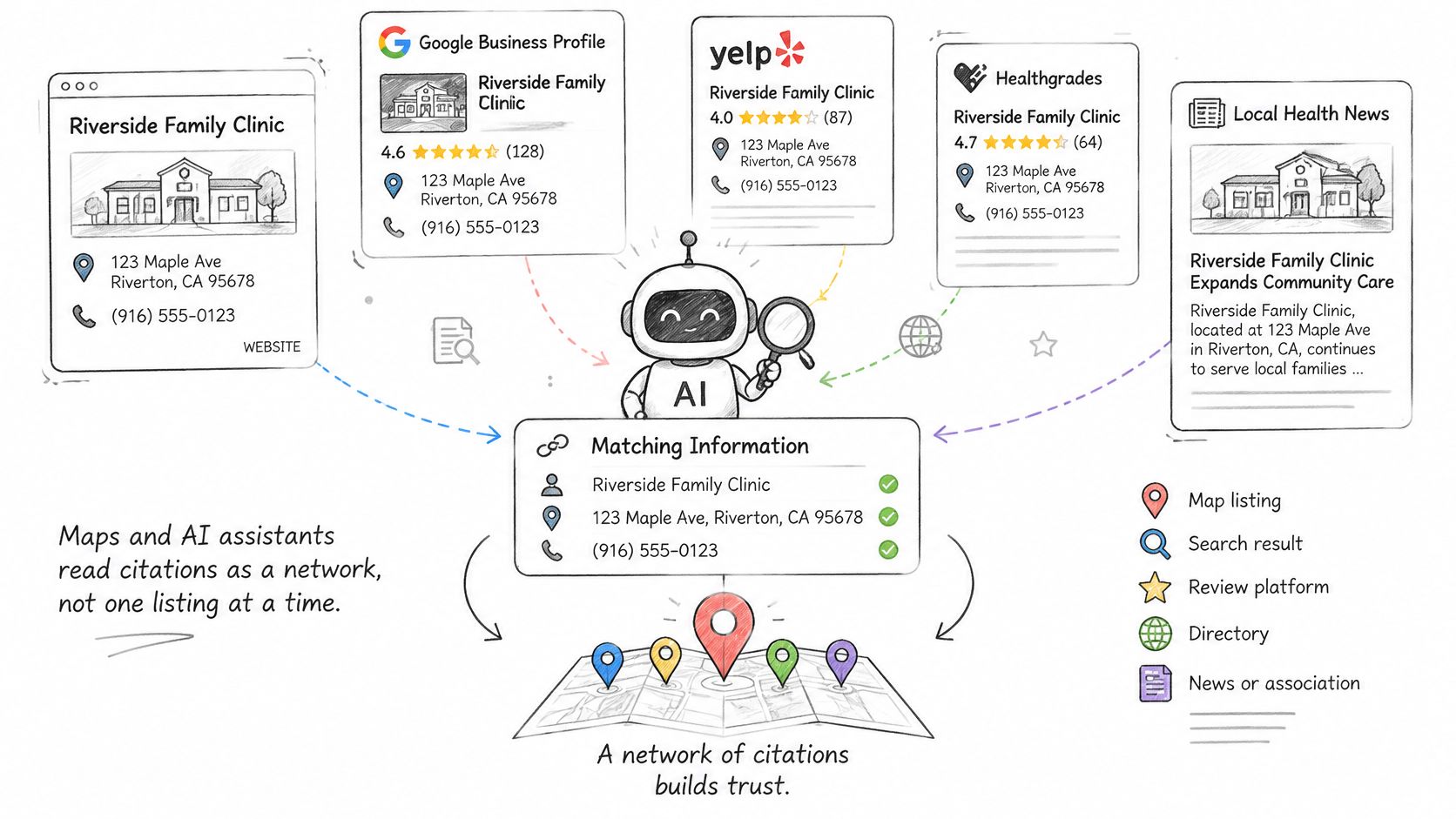
When the sources agree, the system can answer confidently. When they conflict, it may hedge, skip your clinic, or attach the wrong details to your name. Industry research summarized by Rio SEO's local search trends report notes that one analysis of 6.8 million citations found first-party websites supplied 44% of local AI citations, listings 42%, and reviews and social sources 8%. Your own website is part of the evidence, not a separate channel.
What entity confusion looks like
- Two versions of your clinic name make one business look like two, splitting reviews and history between them.
- A duplicate listing with an old address tells the system you might operate from a location you left years ago.
- A stale treatment menu on a directory leads an assistant to recommend a service you no longer offer.
- Reviews naming a departed practitioner can pull that person's reputation into answers about your current team.
Preventing this is mostly housekeeping. Keep one master set of business facts, build clear pages for each location and each treatment, and use consistent names for your clinicians and services everywhere they appear.
The short video below walks through how assistants assemble business answers from scattered sources, which makes the reconciliation process easier to picture.
Then run a check yourself. Ask AI assistants and map results about your business by name and location, and note any wrong hours, addresses, services, or booking options. AI systems vary and change often, so treat this as ongoing monitoring. Nobody can guarantee how any assistant will describe you.
How to Audit and Fix Your Citations
An audit sounds larger than it is. You're comparing copies against one master version, fixing what differs, and writing down what you did. The steps below work in order, and each one exists because skipping it causes a specific problem later.
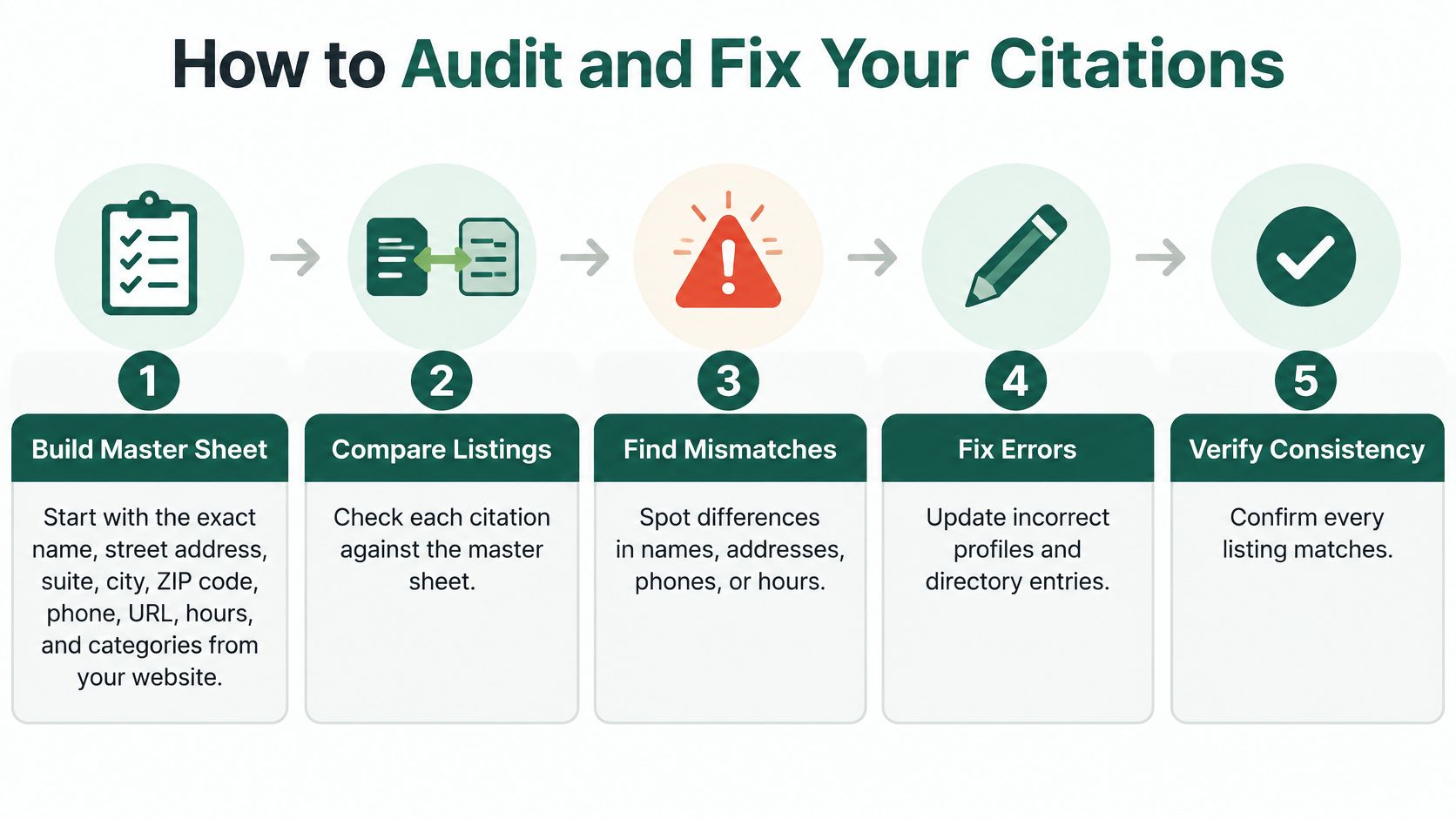
The seven audit steps
- Build your master sheet from your website. Write down the exact business name, street address, suite number, city, ZIP code, phone, URL, hours, and categories. Every later check compares against this sheet, so if it's sloppy, you'll copy errors faithfully across the web.
- Search for every listing you already have. Search your business name with your city and phone number, and record everything that appears, including unclaimed profiles you never created. The common slip is checking only the big platforms while smaller directories display your old address.
- Log each listing in a tracker. Use a spreadsheet with the source, listing URL, fields that differ from the master sheet, login owner, verification status, and last audit date. Without the login owner column, you'll waste an hour someday discovering that a former employee claimed your most important profile.
- Fix tier one first. Claim your Google Business Profile and correct every field, then move to major directories in the priority order from your tier list. Resist fixing whichever listing you stumble on next, because random order leaves the most influential errors in place longest. A full local SEO audit framework helps you slot this work alongside reviews and service pages.
- Merge or delete duplicates and obsolete addresses. Where a platform won't let you edit, request removal and note the request date in your tracker. The slip to avoid is leaving a closed location live because deleting it feels risky. A live closed location is the risky option, since patients and search systems both treat it as real.
- Verify each fix on the public page. Reload the listing a few days after editing, because some changes take time to appear and some revert to older data. Mark a listing fixed in your tracker only after you've seen the corrected version yourself.
- Repeat quarterly, and measure outcomes. Track the share of priority listings that are accurate, your duplicate count, missing listings, referral visits, calls, and booked consultations. That's the standard that matters. A longer directory list means nothing if calls don't move.
What a finished audit looks like
You're done for the quarter when every priority listing matches the master sheet and no duplicates remain. Your tracker shows who owns each login and when each listing was last verified. New listings get added to the tracker the day they're created, not reconstructed from memory months later.
One practical habit keeps the system alive. Whenever your hours, phone number, or treatment menu changes, update the master sheet first and work down the tracker the same week. Citations drift because businesses change and listings don't, so tie every business change to a listing update and the drift mostly stops.
Multi-Location and Edge Cases to Handle
Two clinics, one brand. Each location needs its own landing page and its own set of citations, with its own address and phone number. Never merge locations into a single listing to keep things simple. One merged record can't tell patients in two cities which door to walk through.
A virtual office or home address. A virtual office or a practitioner-only address shouldn't be listed as a clinic, because patients can't receive treatment there. List the staffed clinic address where care happens, and keep administrative addresses out of patient-facing directories.
A relocated office. Update your existing listings to the new address instead of creating fresh ones, then close or correct every record still showing the old site. Keeping the old address off new citations matters just as much. Search systems that see both addresses active may split your history and reviews between two places, weakening both.
A service-area setup. If you travel to clients rather than treating them at a fixed site, list your service areas where the profile allows it and hide the street address if the platform supports that option. Don't publish a residential address just to fill a required field.
Practitioner names. Keep the clinic name consistent everywhere, and list a practitioner separately only when that person has a distinct, verifiable practice address. A personal listing pointing at your clinic's address under a different name creates exactly the entity confusion you're trying to remove.
A franchise or multi-site group. Use one consistent brand name with a unique location identifier on each listing, so patients and software can tell your sites apart without inventing new business names.
Drop one misconception before you start. Copying a stylised brand name everywhere isn't the same as consistency. The rule is simpler and stricter. Match the legal or customer-facing name exactly, in every field, on every listing.
Start Your Citation Audit This Week
Three actions will put your citations in order, and none of them requires new software.
- Write the master sheet. Take the name, address, phone, URL, hours, and categories directly from your website.
- Run the search and log everything. Search your name with your city and phone number, then record every listing in your tracker.
- Fix the five highest-risk listings. Start with your Google Business Profile, correct each field, and reload the public pages a few days later to confirm the changes stuck.
Put the quarterly review in your calendar now, while you're looking at the tracker. A review that lives only as an intention doesn't survive a busy month.
If you'd rather have help, you can request a free marketing audit from us. The audit reviews your ads, follow-up speed, booking flow, and patient list, and shows where bookings are slipping through. It returns clear next steps whether or not you choose to work with our team, and your ad accounts, CRM data, and patient list stay in your name either way.
Start with the master sheet today, because that customer comparing two phone numbers still just needs one that works.
If your listings are pulling in different directions, we can help you straighten the record and connect the cleanup to the booking flow that turns searches into consultations. Visit Med Spa Scalers to request your free audit, and we'll show you exactly where patients are slipping away and what to fix first.
See how many patients you're leaving on the table
Get a free marketing audit of your ads, follow-up and booking flow. No pressure, just a clear picture.
Book a free marketing audit