Medical Spa Social Media Strategy That Books Consults

Likes and reach are easy to report. They're also a poor definition of success for a medical spa. A post can attract attention without giving prospective patients a reason to trust the clinic, understand a treatment, or book a consultation.
Treat medical spa social media as part of the patient journey, not a popularity contest. The job is to attract appropriate prospects, help them evaluate the provider and treatment, and make the next step clear. A quiet post that leads to a well-informed inquiry can be more valuable than a viral one that brings in people who aren't a fit.
That shift changes what the practice publishes, how staff handle messages, and which numbers belong on the monthly report. The useful question isn't “How many people saw this?” It's “Did this help the right person move toward a consultation, and did that person show up?”
Table of Contents
- Why Followers Are the Wrong Goal for Medical Spa Social Media
- Where U.S. Aesthetic Patients Spend Their Time
- The Three Jobs Every Med Spa Post Must Do
- Tailoring Content by Treatment Line and Audience
- Trust Formats That Pre-Qualify Patients for the Consult
- Turning DMs and Comments Into Booked Appointments
- Measuring What Actually Predicts a Kept Consultation
- Your 30-Day Med Spa Social Media Reset
Why Followers Are the Wrong Goal for Medical Spa Social Media
A growing audience can look like progress while the booking calendar stays unchanged. Followers who never consider your services don't make a post successful, and a viral transformation video can create the wrong expectations or attract inquiries your team can't serve. Reach measures exposure, not patient fit.
Social media does influence how some people assess aesthetic providers. In a 2023 peer-reviewed U.S. survey, 41% of respondents who had undergone aesthetic procedures said a provider's social-media presence positively affected their desire to see that provider, while only 9% preferred a provider with no social-media presence (Aesthetic Surgery Journal survey). That makes a clinic's profile more than a gallery. It can be part of the credibility check a potential patient performs before reaching out.
Measure movement, not applause
A post earns its place when it helps someone take a relevant next step: viewing treatment information, asking a specific question, requesting an assessment, or booking. Likes and views can help you understand whether content is attracting attention, but they don't tell you whether the person behind that attention is an appropriate patient.
This distinction matters most when a post draws a lot of comments or messages. A high volume of “How much?” inquiries may still be unproductive if the clinic doesn't explain what the treatment involves, who performs it, or why an individual consultation is needed. Content that sets expectations can reduce casual engagement while improving the quality of conversations.
Practical rule: Judge a post by the next useful action it supports, not by the number of people who tapped the heart.
Build your strategy around the clinic's actual path from discovery to appointment. Make the provider and treatment clear, give people a reason to trust what they see, and ensure the profile makes contacting the practice straightforward. Then connect social inquiries to the booking process so the team can distinguish attention from demand.
Where U.S. Aesthetic Patients Spend Their Time
The right platform follows the patients and treatments you want more of; trend chatter in marketing groups is a weak proxy. In the 2023 Aesthetic Surgery Journal survey cited earlier, Facebook had the widest reported use among U.S. aesthetic-procedure respondents, with Instagram and YouTube close behind and TikTok, Twitter, and Snapchat still relevant for narrower audiences.
| Platform | Share of U.S. aesthetic patients | Best use for a med spa |
|---|---|---|
| 70% | Local community visibility, patient education, and paid campaigns | |
| 65% | Treatment education, provider introductions, and visual proof | |
| YouTube | 63% | Longer explanations, procedure overviews, and clinician Q&As |
| TikTok | 45% | Short educational videos and treatment discovery |
| 40% | Timely commentary and professional updates | |
| Snapchat | 29% | Short-lived, informal content where the audience fits |
Treat those shares as a demand map, then check your own inquiry quality. A clinic selling injectables to established local patients may get cleaner consult requests from Facebook and Instagram, while a practice known for device-based treatments can use YouTube to explain candidacy before the front desk ever replies. TikTok can create discovery fast, but the comments often skew price-first unless the video states who performs treatment, what the consult covers, and why suitability varies. If Facebook belongs in the acquisition mix, compare organic conversations with paid reach through med spa Facebook ads before increasing spend.
Make the profile credible before adding volume
Platform choice only helps when a stranger can quickly see who provides care, which services are offered, and how to request an assessment. Use a clear clinic description, accurate service information, visible contact options, and provider introductions that name qualifications without overstating them. In the same survey, 55% of aesthetic-procedure respondents preferred seeing a provider with a platform verification badge.
Visual proof needs tighter handling than reach metrics suggest. In that survey, 70% of respondents considered before-and-after photographs important, including people who rated them important or very important. Post transformations only with documented permission, consistent presentation, and context that reminds viewers individual outcomes vary; a dramatic image that attracts the wrong expectations can fill the inbox while lowering kept-consult rate.
The Three Jobs Every Med Spa Post Must Do
A useful post should do at least one of three jobs: get discovered, build trust, or drive a qualified next step. If a clinic's feed only shows polished results, it may look active while leaving prospective patients' practical questions unanswered.

Get discovered by people with relevant intent
Short videos, local service explainers, and treatment-specific posts help a practice appear in the conversations people are already having about aesthetic care. A reel that explains what a consultation covers can introduce the clinic; a caption that names the service and service area can help people recognize whether the post applies to them. Discovery content should give enough context to prompt a useful next step, not merely chase views.
Build trust before asking for a booking
Provider bios, clinician-led FAQs, facility walkthroughs, and careful patient stories help a stranger assess the practice. A transformation image can show a visual outcome, but a provider explaining how they evaluate suitability answers a different question: “Can I trust this clinic to discuss what's right for me?” Educational content and visual proof complement each other; neither replaces the other.
Drive action by setting expectations
A consultation invitation works better when the post makes the next step specific. Explain what the clinic can discuss, how a prospect can contact the team, and what information they may want to bring up. Offers can support action, but a discount without treatment context may attract price-first inquiries that aren't prepared for a clinical conversation.
Review your recent posts and ask which job each one serves. If nearly everything is designed for discovery, add credibility and decision-support content. If the feed is informative but lacks a clear contact route, make booking easier to find. That balance keeps the page useful beyond its most attractive images.
Tailoring Content by Treatment Line and Audience
A single feed has to answer very different questions at once. The person weighing injectables wants to know how the provider assesses and plans. The person comparing laser or skin treatments is usually working through candidacy and recovery. Someone asking about body contouring needs an honest account of what the service can and cannot address. If every post reads the same, at least two of those people scroll past without ever reaching a consult.

Give each service line its own editorial angle
For injectables, a clinician can explain what happens during an assessment, how the practice discusses goals, and why treatment plans differ between people. For laser and skin services, focus on how a consultation evaluates a concern, what preparation or recovery questions patients should raise, and how the team explains suitability. For body contouring, describe the service plainly and explain the role of an individualized evaluation rather than implying a guaranteed transformation.
Weight-loss programs and memberships call for another approach. Prospective patients need to understand the structure of the program, what support the clinic provides, and how the team decides whether the service is appropriate. A promotional graphic that skips those details attracts inquiries the front desk cannot convert.
Audience differences matter, but don't assume every person in an age group behaves the same way. A 2025 practitioner survey reported social media as a cited promotional source for 60.0% of Centennials compared with 27.5% of Millennials (2025 practitioner survey). The same paper found that 66.43% of people attending an aesthetic-ultrasonography center reported minimal or no social-media influence on their decision to undergo a procedure. Social content may introduce a treatment to one person and reinforce a decision another patient already made offline.
Treat platform and format choices as hypotheses to test, never as fixed rules about generations. Short-form video may earn discovery, while a practitioner FAQ, a thoughtful review response, or a direct consultation invitation may better serve someone already comparing providers. Ask new patients how they found the clinic at intake, then compare their answers with the inquiries and booked consults the team recorded.
A few treatment-specific formats make the differences visible:
Injectables: provider-led explanations of the assessment and planning process.
Laser and skin: educational posts addressing preparation, recovery questions, and suitability.
Body contouring: service explainers that clarify the consultation and realistic expectations.
Weight loss and memberships: plain-language descriptions of program structure and clinical support.
The walkthrough below shows how a clinic can present a treatment explanation on video without promising an outcome.
Trust Formats That Pre-Qualify Patients for the Consult
Before-and-after images can help patients understand a service, but they can't carry the entire burden of trust. A 2025 survey of the general population found that 60.2% said they always ask practitioners which products are being used, while 36.3% believed before-and-after photographs can create irrational expectations (2025 product and photo survey). A gallery with no context may invite assumptions instead of helping a patient make an informed decision.
Show how the clinic thinks
A strong trust post gives prospective patients useful information without promising an outcome. Explain who may not be a suitable candidate, what questions the clinician considers, what downtime to discuss, and how the clinic describes variability in results. Keep the content grounded in the provider's clinical process and encourage individual assessment when a general post can't answer someone's personal question.
Credential content should be specific and easy to verify. Introduce the practitioner, describe their role, and make relevant qualifications clear. For products and devices, explain what the clinic uses and how staff discuss that choice with patients, without implying that a product is right for everyone.

A useful trust library includes:
Suitability explainers: describe why a consultation may determine that a treatment isn't appropriate.
Recovery guidance: answer common questions about expected downtime and follow-up.
Provider introductions: show who delivers care and where to verify their qualifications.
Patient journeys: share consented experiences with context, not a promise that others will have the same result.
Consultation prep: suggest questions a prospective patient can raise with the clinician.
Trust matters because people don't automatically accept health information they encounter in social feeds. A 2025 KFF survey of U.S. adults found that fewer than one in ten social-media users trusted most of the health information they encountered, and fewer than half considered most or some content trustworthy on any major platform (KFF health-information survey). For a clinic, that's a reason to be transparent about limits, not to make louder claims.
The trade-off is straightforward: a dramatic image may prompt quick attention, while a careful explanation can help someone decide whether a conversation with the clinic makes sense. Protect patient privacy, use documented consent for patient content, and avoid editing or framing images in ways that misrepresent results. Better-qualified inquiries are worth more than an inflated comment count.
Turning DMs and Comments Into Booked Appointments
A social inquiry isn't a booking. The clinic still needs a clear handoff from the person managing the page to the team that answers questions and schedules consultations. If someone asks about a treatment and receives no response, the post has generated interest without completing the operational work.
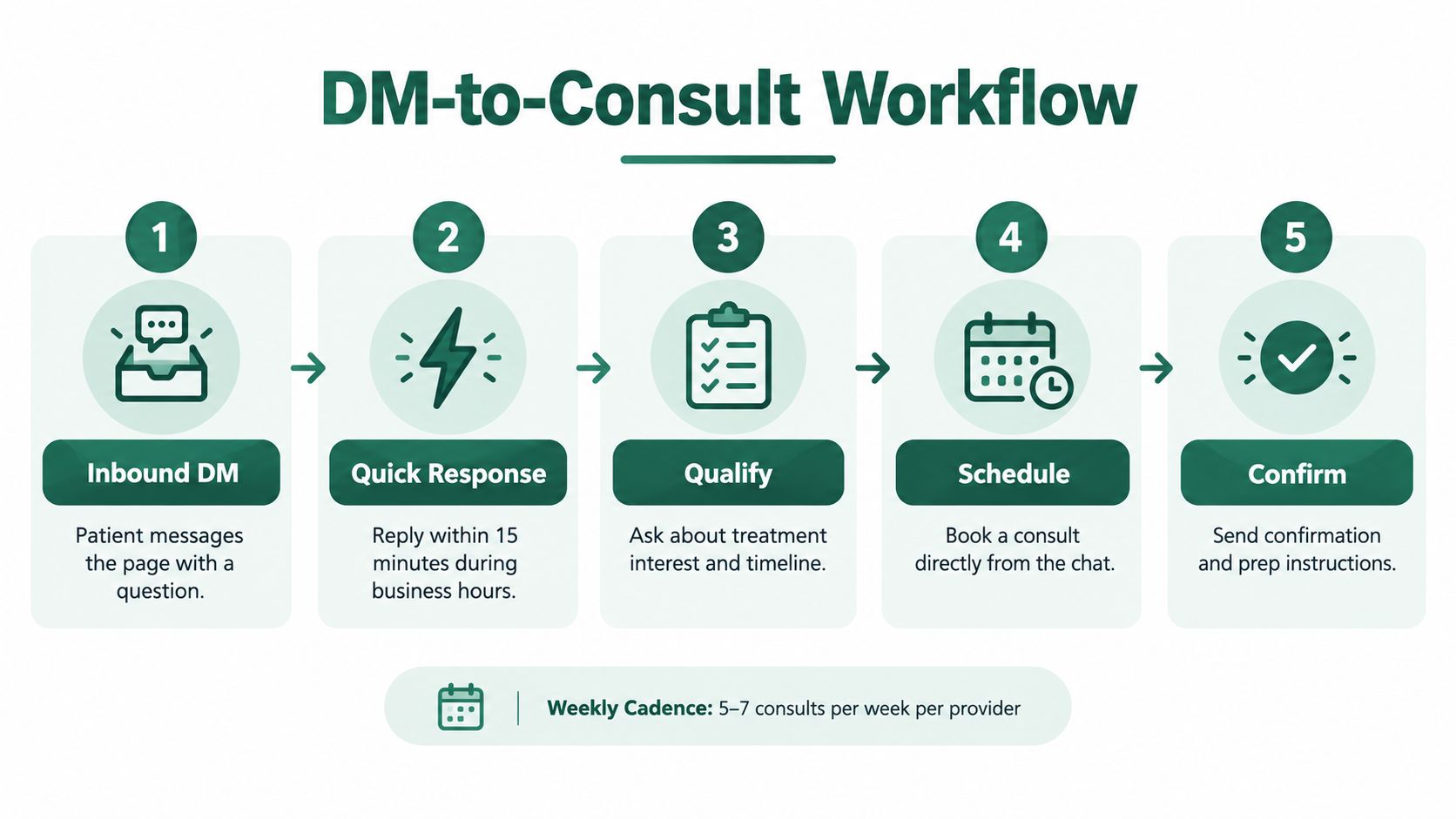
Make the response route consistent
Set a clear process for comments, DMs, and profile-link inquiries. A social-media manager can acknowledge a question and direct a person toward the right channel, but clinical questions about candidacy, risk, or individual treatment decisions should go to qualified clinical staff. The front desk should know who owns each type of inquiry and what information needs to reach the booking team.
Use this workflow:
Respond: acknowledge the message with a helpful, human reply.
Clarify: ask what service the person is interested in and whether they're looking for a consultation.
Route: pass clinical questions to the appropriate clinician and scheduling requests to the booking team.
Record: enter the inquiry, source, and requested service in the clinic's CRM.
Follow up: send a confirmation and any clinic-approved preparation information after booking.
Organic messages and paid campaigns need different handling. A person who comments on an educational post may need a simple answer and an invitation to learn more. Someone who responds to a paid consultation offer should be routed promptly into the same lead process used for other campaign inquiries. In either case, staff should avoid collecting unnecessary sensitive health details in public comments.
A practical weekly routine is to plan content in advance, check the inbox during business hours, review unanswered inquiries with the front desk, and confirm that bookings are being recorded against their source. The exact cadence should fit staffing and audience behavior; a posting schedule can't compensate for messages sitting unanswered.
Use a CRM process that connects social inquiries to appointment outcomes. Med spa lead generation should include the handoff after someone expresses interest, not stop when a form or DM arrives. Define who replies, who schedules, and who checks that the prospect received confirmation.
Measuring What Actually Predicts a Kept Consultation
Put social metrics in order of how close they are to an appointment. Reach, saves, and shares show discovery or interest. DMs, link clicks, and form completions show intent. Booked consultations show conversion. Kept appointments and treatment starts tell you whether that conversion brought in suitable patients.
A 2025 cross-sectional study found that people spending more than five hours per day on social media were significantly more likely to consider cosmetic procedures (2025 social-media use study). That finding describes consideration, not completed treatment or a guaranteed booking. High platform use can create more opportunities to reach a prospective patient, but the clinic still needs to assess fit and track what happens after the first interaction.
Keep one report tied to the patient path
Track a small set of measures that connects content to appointment quality:
| Stage | What to record | What it helps answer |
|---|---|---|
| Discovery | Reach, saves, and shares | Which content gets relevant attention? |
| Intent | DMs, link clicks, and form completions | Which posts prompt a person to inquire? |
| Conversion | Booked consultations by source | Which channels move inquiries into the calendar? |
| Quality | Attended consultations and treatment starts | Which sources bring prospects who continue? |
Don't treat a high number of messages as proof of a successful campaign. If inquiries don't turn into bookings, inspect the offer, response process, and clarity of the treatment information. If appointments are booked but people don't attend, review the confirmation and reminder workflow instead of publishing more content.
Use source tracking consistently across social links and forms, then make sure staff record where an inquiry began. A med spa CRM can keep inquiries, appointments, and follow-up in one place, making it easier to compare channels without relying on remembered conversations.
For each reporting period, identify which content prompted inquiries, which sources produced booked consultations, and which booked patients attended. Cost per booked consultation is more useful than cost per click when you're deciding whether to continue paid promotion, but it still needs the kept-appointment context. Keep vanity metrics as diagnostic clues, not as the final verdict.
Your 30-Day Med Spa Social Media Reset
Start with the profile: identify the provider, list the services accurately, and make contacting the clinic easy. Choose two anchor platforms that fit your treatment lines and audience, then publish a balanced mix of discovery, trust, and decision-support content instead of filling the feed with transformations alone.
Build a small library of clinician-led explainers, provider introductions, patient stories with documented consent, and consultation-preparation posts. Assign inbox ownership, route clinical questions appropriately, and record every social inquiry in the CRM through booking and follow-up.
Review the results against a simple dashboard: qualified inquiries, booked consultations, kept consultations, and treatment starts. Use reach and engagement to understand what draws attention, then prioritize the sources and content that produce suitable appointments.
The growth loop is practical: content introduces the clinic, trust formats help prospects assess fit, the inbox moves them toward booking, and follow-up supports attendance. Start the reset by auditing the profile and assigning one person to own the inquiry handoff.
Med Spa Scalers helps medical spas connect social content and paid campaigns with CRM-based follow-up, AI reception, and reporting tied to bookings and kept appointments. If your clinic wants to improve the path from social inquiry to consultation, visit Med Spa Scalers to explore its services.
See how many patients you're leaving on the table
Get a free marketing audit of your ads, follow-up and booking flow. No pressure, just a clear picture.
Book a free marketing audit